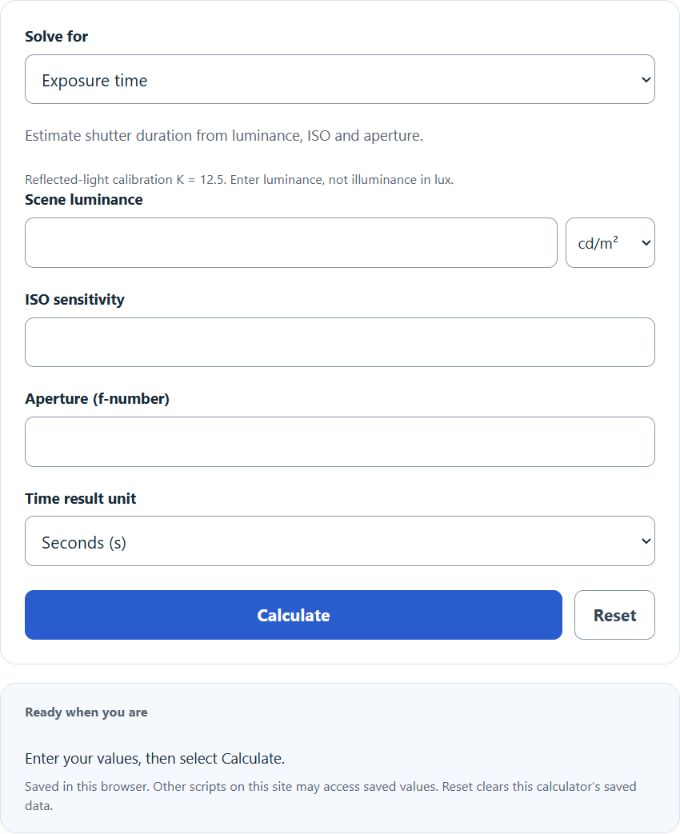
Calculate exposure time, ISO, aperture, or luminance from the other three values using a reflected-light metering model with K = 12.5 and unit conversions. Luminance is not illuminance in lux; meter calibration, scene tones and camera response can change the desired photographic exposure.
- Every Day Life And Education Calculators
- Exposure Rate Calculator
- 500 Rule Astrophotography Exposure Calculator
- Exposure Value Calculator
Exposure Time Formula
The following formula is commonly used to relate scene luminance to exposure time in photography (reflected-light metering model).
Variables:
- ET is the exposure time (seconds)
- LN is the luminance (cd/m²)
- ISO is the sensitivity setting of the camera (ISO value)
- AP is the aperture value (f-stop)
- K is a reflected-light meter calibration constant (typically 12.5 when LN is in cd/m² and ET is in seconds)
To calculate the exposure time, multiply the square of the aperture value by the calibration constant K, then divide by the product of the ISO value and luminance. Brighter luminance results in a shorter exposure time, all else equal.
What is an Exposure Time?
Exposure time, also known as shutter speed, is a photography term that refers to the length of time a camera’s shutter is open when taking a photograph. The amount of light that reaches the camera sensor is directly impacted by the exposure time. Short exposure times (like 1/2000th of a second) freeze action, while long exposure times (like 1 second or longer) capture the blur of motion.
How to Calculate Exposure Time?
The following steps outline how to calculate the Exposure Time using the given formula:
- First, determine the luminance (LN) in cd/m².
- Next, determine the sensitivity of the camera sensor (ISO).
- Next, determine the aperture value (AP) in f-stop.
- Then, substitute the values of LN, ISO, AP, and K into the formula: ET = (K × AP²) / (ISO × LN).
- Finally, calculate the Exposure Time (ET) in seconds.
- After inserting the variables and calculating the result, check your answer with the calculator above.
Example Problem:
Use the following variables as an example problem to test your knowledge:
Luminance (LN) = 50 cd/m²
Sensitivity of the camera sensor (ISO) = 800
Aperture value (AP) = f/2.8. With K = 12.5, ET = (12.5 × 2.8²) / (800 × 50) = 0.00245 seconds, approximately 1/408 of a second.