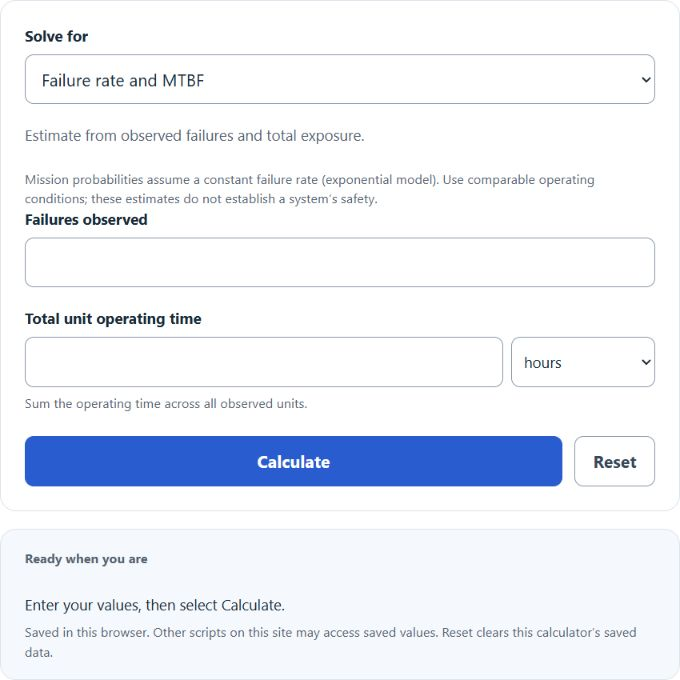
Estimate observed failure rate and MTBF from whole-number failure counts and total unit operating time. Calculate mission failure probability and reliability R(t) from MTBF and mission time under a constant-rate exponential model. A year is 365 days.
Related Calculators
- % Availability Calculator
- Error Rate Calculator
- Expected Number Of Trials Calculator
- Average Recurrence Interval Calculator
- All Statistics Calculators
Failure Rate Formula
The following formula is used to calculate the (average) failure rate over an observation period.
Variables:
- λ is the failure rate (failures per unit time)
- n is the number of failures
- t is the total operating time summed across all observed units
To estimate the observed failure rate, divide the whole-number failure count by total unit operating time. The result has units of failures per time. Zero observed failures do not establish zero underlying risk or a finite MTBF estimate.
What is Failure Rate?
Failure rate is a measure of how frequently a system or component fails over time, commonly used in reliability engineering. It is not a probability by itself because it has units (1/time). If you need a failure probability over a time interval and can assume a constant failure rate (exponential/Poisson model), a common model is:
How to Calculate Failure Rate?
The following steps outline how to calculate the failure rate.
- First, determine the number of failures (n) that have occurred.
- Next, determine the time period (t) over which the failures were observed.
- Next, gather the formula from above: λ = n / t.
- Finally, calculate the failure rate (λ) in failures per unit time.
- After inserting the variables and calculating the result, check your answer with the calculator above.
Example Problem :
Use the following variables as an example problem to test your knowledge.
number of failures (n) = 5
time period (t) = 1 year
failure rate (λ) = n / t = 5 / 1 = 5 failures/year