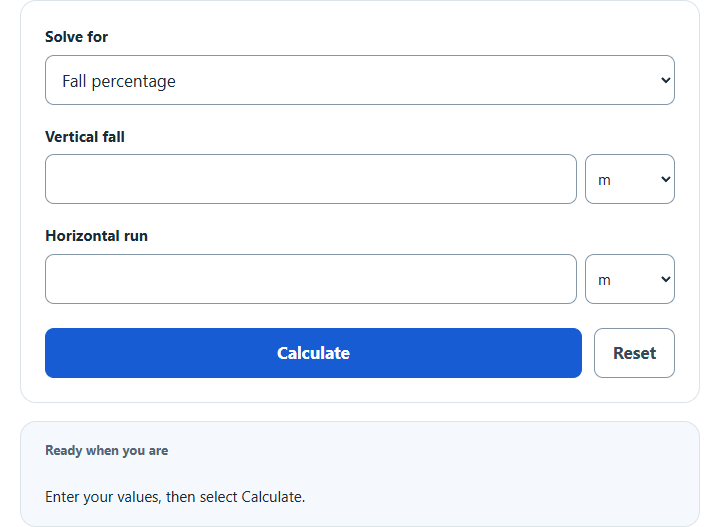
Calculate fall percentage from vertical drop and horizontal run, or work out the fall over a distance for a 1 in 60, 1:80 or percentage gradient.
Related Calculators
- Fold Decrease Calculator
- Annual Change Calculator
- Combined Percentage Calculator
- Percentage Points Calculator
- All Math and Numbers Calculators
Calculator Functions
| Function | What it does | What it requires |
|---|---|---|
| Fall percentage | Finds the fall as a percentage of the horizontal run | Requires the vertical fall and the horizontal run |
| Required vertical fall | Finds the drop needed over a run at a known slope | Requires the horizontal run and the known slope |
| Required horizontal run | Finds the run needed to reach a drop at a known slope | Requires the vertical fall and the known slope |
Lengths can be entered in m, mm, cm, in or ft, and the fall and the run do not have to use the same unit. The known slope can be entered as 1 in N, a percentage, degrees, mm/m or in/ft. Every result also shows the slope as a percentage, an angle, a 1 in N ratio, millimetres per metre and inches per foot.
Fall Percentage Formulas
| FP | Fall percentage (%) |
| F | Vertical fall |
| R | Horizontal run, in the same unit as F |
Slope is the proportion of vertical rise or fall to horizontal length, and it can be written as a ratio, a percentage or an angle [1]. The run is the level distance, not the length measured along the sloping surface.
Fall percentage
The formula above applies directly. A fall of 15 ft over 200 ft is 15 ÷ 200 × 100 = 7.5%, and 100 mm over 15 m is 0.1 ÷ 15 × 100 = 0.6667%. Mixed units are converted to metres first, using 1 ft = 0.3048 m and 1 in = 0.0254 m [2].
Required vertical fall
s is the slope as a decimal: the percentage ÷ 100, 1 ÷ N for a 1 in N ratio, the tangent of the angle, mm/m ÷ 1,000 or in/ft ÷ 12. A 1 in 100 fall over 5 m is 5 × 0.01 = 0.05 m, or 50 mm. A 10° fall over 2.5 m is 2.5 × tan 10° = 0.4408 m, or 440.8 mm.
Required horizontal run
A 100 mm fall at 2% needs 0.1 ÷ 0.02 = 5 m of run. The fall and the slope must both be greater than zero.
Fall Ratios as Percentages
A 1 in N fall drops one unit for every N units of run, so its percentage is 100 ÷ N and its fall per metre is 1,000 ÷ N millimetres.
| Fall ratio | Percentage | Per metre | Per foot | Angle |
|---|---|---|---|---|
| 1 in 40 | 2.5% | 25 mm/m | 0.3 in/ft | 1.432° |
| 1 in 50 | 2% | 20 mm/m | 0.24 in/ft | 1.146° |
| 1 in 60 | 1.667% | 16.67 mm/m | 0.2 in/ft | 0.955° |
| 1 in 80 | 1.25% | 12.5 mm/m | 0.15 in/ft | 0.716° |
| 1 in 100 | 1% | 10 mm/m | 0.12 in/ft | 0.573° |
| 1 in 200 | 0.5% | 5 mm/m | 0.06 in/ft | 0.286° |
Limits of This Estimate
- The result is geometry only. A calculated gradient does not show that a drain, ramp or paved surface performs as needed or meets a design standard.
- The run must be the horizontal distance. Entering the length measured along the slope gives a percentage that is too low, and the gap grows as the slope steepens.
- A 100% fall is a 45° slope, not a vertical drop. Percentages above 100 are valid and describe slopes steeper than 45°.
Sources
- U.S. Access Board, Guide to the ADA Accessibility Standards, Chapter 4: Ramps and Curb Ramps: slope as rise over horizontal length, written as a ratio, percentage or angle
- NIST, Special Publication 811, Appendix B.8: foot and inch in metres