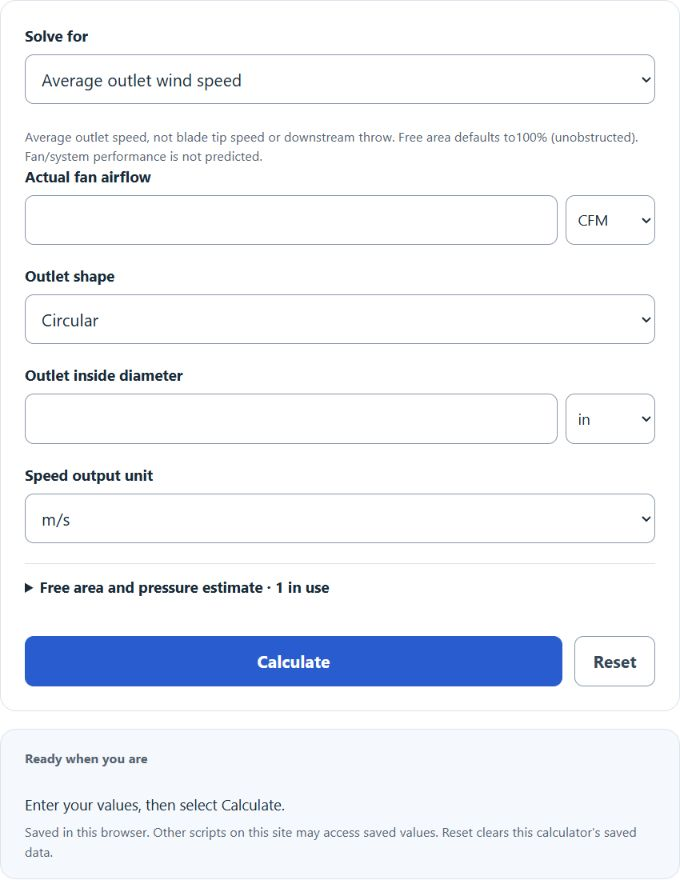
Calculate fan wind speed in mph, km/h or m/s from the fan’s airflow in CFM and its outlet size, or solve for the airflow or outlet diameter you need.
Related Calculators
- Natural Gas Velocity Calculator
- Pump Power Calculator
- Propeller Advance Ratio Calculator
- Orifice Pressure Drop Calculator
- All Physics Calculators
Fan Outlet Wind Speed Formula
The calculator finds average outlet air speed from actual volumetric airflow and effective open area. Blade tip speed and downstream throw are different quantities:
Variables:
- V is average outlet air speed (m/s when Q is m³/s and area is m²)
- Q is actual volumetric airflow at the outlet conditions
- Agross is the geometric outlet area; circular area = π × (D/2)² and rectangular area = width × height
- f is the effective free-area percentage divided by100; Aeffective is the resulting open area
Calculate gross area, multiply by the known free-area fraction, then divide actual volumetric airflow by effective area. The reverse solves use Q = V × Aeffective and D =2 × √[Q / (π × V × f)] for a circular outlet.
What is Fan Outlet Wind Speed?
Outlet wind speed here is the area-average air velocity normal to the effective opening. It is not the tangential speed of the rotating blade tip and does not predict downstream speed. Grilles, hubs, nonuniform profiles, fan geometry and system resistance affect real conditions. An optional supplied air density adds a uniform-profile dynamic-pressure estimate (0.5 × density × speed²), not a fan static-pressure prediction.
How to Calculate Average Outlet Wind Speed?
The following steps match the average outlet-speed mode; airflow and circular-diameter inverse modes use the same relation.
- First, obtain actual outlet airflow and choose its unit. Use actual-volume flow corresponding to the measured outlet conditions.
- Choose circular or rectangular outlet geometry and enter its inside dimensions.
- Set the effective free-area percentage if the opening is obstructed;100% means the full geometric area.
- Calculate V = Q / Aeffective in consistent units and choose m/s, ft/min, mph or km/h for display.
- Check the result with the calculator. Changing free area or units retains the previous result until Calculate is selected.
Example Problem :
Use the following variables as an example problem to test your knowledge.
Hypothetical circular outlet inside diameter =16 inches; effective free area =100%.
Actual airflow =2000 CFM. Effective area ≈0.129717 m²; average outlet speed ≈7.276564 m/s.
Fan Blade Tip Speed from RPM
To find how fast the blade tip moves, choose Blade tip speed from RPM, enter the fan’s rotational speed and the full diameter swept by the blade tips, then select Calculate. The result shows mph, km/h and m/s; ft/min is also available.
Tip speed = π × D × RPM / 60, where D is the blade tip diameter in meters and the result is in m/s. One turn travels πD meters; RPM divided by 60 gives turns per second.
For example, a 40 cm diameter fan rotating at 1,200 RPM has a blade tip speed of about 25.13 m/s, 90.48 km/h or 56.22 mph.
This is the tangential speed of the blade, not the air leaving it. RPM and diameter alone do not determine outlet airflow or wind speed. Use the average outlet wind speed mode with actual airflow and effective open area for that calculation.