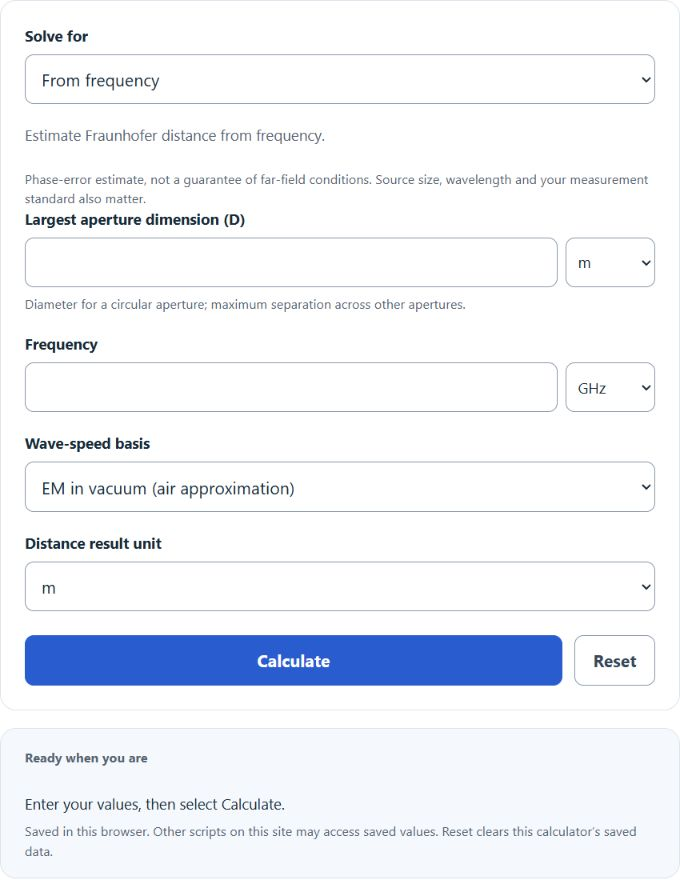
Estimate the Fraunhofer distance from aperture size and frequency or wavelength. Compare a measurement distance with the 2D²/λ criterion; the comparison alone does not establish far-field conditions.
- All Physics Calculators
- Power Loss Calculator
- Fractal Antenna Size Calculator
- Fractal Dimension Calculator
Far-Field Formula
The calculator uses the Fraunhofer far-field distance, with wavelength derived from frequency when needed.
- R — far-field (Fraunhofer) distance, meters
- D — largest aperture or antenna dimension, meters
- λ — wavelength, meters
- c — wave propagation speed (≈ 2.998 × 10⁸ m/s for EM in air; 343 m/s for sound in air at 20 °C)
- f — frequency, Hz
- R_reactive — estimated EM reactive boundary for an antenna with D > λ/2
The 2D²/λ criterion is an aperture phase-error estimate. Antenna far-field conditions also require distance large relative to D and λ; electrically small antennas need source-specific criteria. λ/2π is not a general far-field boundary. The model ignores ground reflections, multipath and atmospheric effects.
Reference Values
Typical wavelengths for common frequencies (EM in air):
| Frequency | Wavelength | Common use |
|---|---|---|
| 100 MHz | 3.00 m | FM radio |
| 915 MHz | 328 mm | ISM, RFID |
| 2.4 GHz | 125 mm | Wi-Fi, Bluetooth |
| 5.8 GHz | 51.7 mm | Wi-Fi, ISM |
| 28 GHz | 10.7 mm | 5G mmWave |
| 77 GHz | 3.90 mm | Automotive radar |
Approximate EM field-region criteria for suitable antennas (D > λ/2 for the reactive estimate); these are not universal acoustic or small-antenna boundaries:
| Region | Range from aperture | Behavior |
|---|---|---|
| Reactive near field | 0 to 0.62·√(D³/λ) | Stored energy dominates; pattern not formed |
| Radiating near field (Fresnel) | 0.62·√(D³/λ) to 2D²/λ | Pattern shape varies with distance |
| Far field (Fraunhofer) | ≥ 2D²/λ, with separation also large relative to D and λ | Pattern stable; 1/r amplitude falloff |
Worked Example
A 0.6 m parabolic dish operating at 2.4 GHz, using the rounded wave speed 3 × 10⁸ m/s:
- λ = (3 × 10⁸) / (2.4 × 10⁹) = 0.125 m
- R = 2 × (0.6)² / 0.125 = 5.76 m
- Reactive boundary = 0.62 · √(0.6³ / 0.125) ≈ 0.81 m
The rounded 2D²/λ estimate is 5.76 m; using the exact vacuum wave speed gives about 5.764 m. Choose a measurement range using the applicable antenna standard and account for reflections and other test conditions. The reactive-boundary estimate does not establish that every antenna analyzer will read incorrectly.
FAQ
Why 2D²/λ? It is the distance at which the maximum phase error across the aperture drops to π/8 radians (22.5°), the standard threshold for treating a wavefront as planar.
D is the diameter or the radius? D is the largest physical dimension of the radiating aperture. For a circular dish, that is the diameter. For a rectangular aperture, use its maximum corner-to-corner separation (diagonal).
Does this apply to acoustic transducers? The sound modes compute a geometric 2D²/λ phase-error estimate using the medium’s wave speed. Acoustic transducer near-field or natural-focus distances use source-specific criteria and must not be inferred from the EM reactive-boundary formula.
What if my test range is shorter than 2D²/λ? The distance is below the 2D²/λ estimate. Its physical field region depends on antenna size and wavelength; follow a suitable near-field transformation or range method for your source and measurement standard.