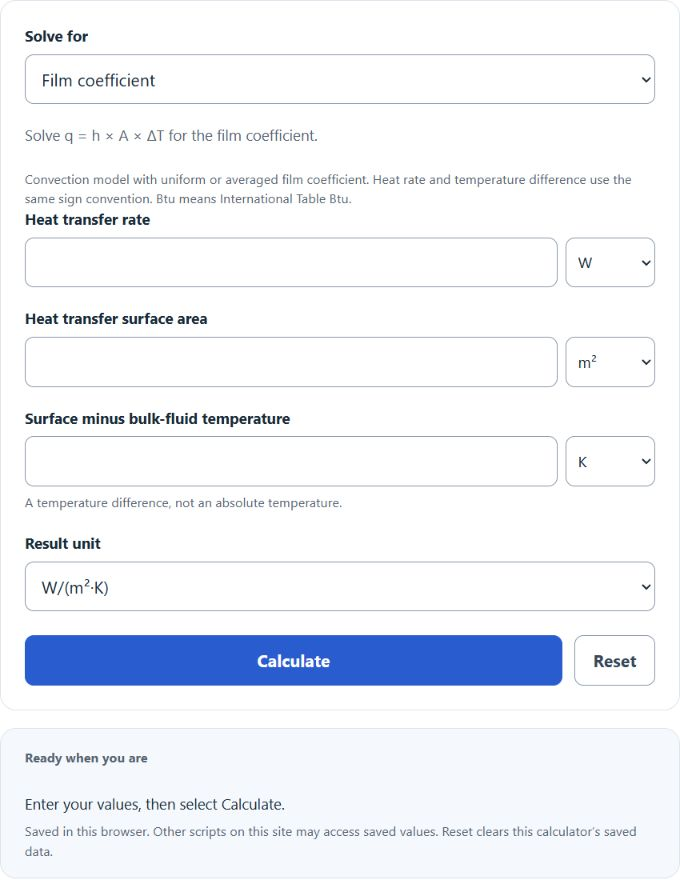
Calculate the film coefficient (convective heat transfer coefficient) h = q/(A·ΔT) in W/m²K or Btu/hr·ft²·°F, or solve for heat rate, area or ΔT.
Related Calculators
- Thermal Resistance Calculator
- Heat Exchanger Area Calculator
- Heat Exchanger Effectiveness Calculator
- Heat Load Calculator
- Heat Dissipation Calculator
- All Physics Calculators
Calculator Functions
| Function | What it does | What it requires |
|---|---|---|
| Film coefficient | Finds the film coefficient from a measured heat transfer rate | Requires heat transfer rate, heat transfer surface area and surface minus bulk-fluid temperature |
| Heat transfer rate | Finds the heat carried between a surface and a fluid | Requires film coefficient, heat transfer surface area and surface minus bulk-fluid temperature |
| Heat transfer surface area | Finds the surface area needed to transfer a given heat rate | Requires heat transfer rate, film coefficient and surface minus bulk-fluid temperature |
| Temperature difference | Finds the surface minus bulk-fluid temperature difference | Requires heat transfer rate, film coefficient and heat transfer surface area |
Heat rate can be entered in W, kW or Btu/hr, area in m², ft² or cm², the temperature difference in K, °C or °F, and the film coefficient in W/(m²·K) or Btu/(hr·ft²·°F). Each function has a result unit, and the answer also lists heat flux in W/m². One Btu/hr is 0.2930711 W and one Btu/(hr·ft²·°F) is 5.678263 W/(m²·K) [2].
Film Coefficient Formulas
| h | Film coefficient, also called the convective heat transfer coefficient (W/(m²·K)) |
| q | Heat transfer rate (W) |
| A | Heat transfer surface area (m²) |
| ΔT | Surface temperature minus bulk-fluid temperature (K) |
The film coefficient represents the thermal resistance of the nearly still layer of fluid between a surface and the moving fluid [1]. The bulk temperature is the fluid temperature far from the surface, or the average across the section for flow in a pipe [1].
Film coefficient
This is the formula above. A surface of 5 m² that gives up 120 W to a fluid 10 K cooler has h = 120 ÷ (5 × 10) = 2.4 W/(m²·K), or 0.4227 Btu/(hr·ft²·°F).
Heat transfer rate
A steam line with 103.67 ft² of surface at 280 °F in a 72 °F room, with h = 18 Btu/(hr·ft²·°F), loses 18 × 103.67 × 208 = 388,140 Btu/hr [1]. In SI units, 25 W/(m²·K) over 2 m² with a 40 K difference transfers 2,000 W.
Heat transfer surface area
Removing 2,000 W with h = 25 W/(m²·K) and a 40 K difference takes 2 m² of surface.
Temperature difference
A 2 m² surface transferring 2,000 W at h = 25 W/(m²·K) runs 40 K away from the bulk fluid. The sign follows the heat rate, so a negative heat rate gives a negative difference.
Limits of This Estimate
- The film coefficient is not a property of the fluid alone. It depends on the fluid and the flow situation, and is lower for laminar flow than for turbulent flow [1]. Values are measured and tabulated for common fluids and flow conditions [1].
- ΔT is a temperature difference, so a Fahrenheit difference is multiplied by 5/9 with no 32-degree offset [2], and a Celsius difference equals a kelvin difference.
- One film coefficient is assumed over the whole surface. A heat exchanger has a film on each side of the tube wall and is rated with an overall heat transfer coefficient, and flow inside pipes uses a log mean temperature difference [1].
- Heat rate and temperature difference must have the same sign for the film coefficient and area functions, and a zero area, coefficient or temperature difference cannot be divided by.
Sources
- U.S. Department of Energy, DOE Fundamentals Handbook: Thermodynamics, Heat Transfer, and Fluid Flow, Volume 2 (DOE-HDBK-1012/2-92): convection equation, the meaning of the film coefficient and bulk temperature, and the steam line example
- NIST Special Publication 811, Appendix B.8: Btu, square foot and Fahrenheit-interval conversion factors