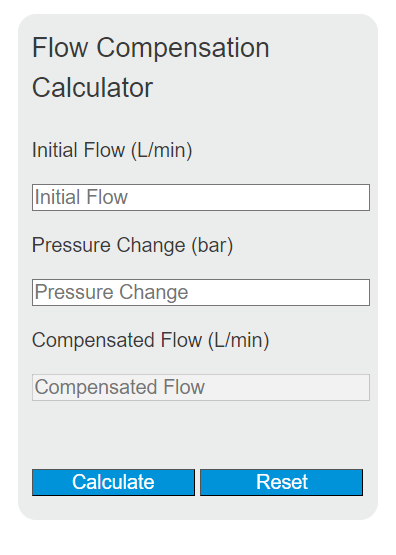
Calculate gas flow compensation, convert SCFM and ACFM, and estimate mass flow or differential pressure-adjusted flow from pressure and temperature.
Related Calculators
- CFM from Differential Pressure Calculator
- CFM Temperature Rise Calculator
- Exhaust Fan Calculator
- Duct Velocity Calculator
- All Construction Calculators
Flow Compensation Formula
For many common cases of incompressible flow through the same fixed restriction (e.g., an orifice or valve at similar operating conditions), flow varies approximately with the square root of differential pressure. A common compensation relationship is:
Variables:
- Q₂ is the compensated (target) flow rate (e.g., L/min)
- Q₁ is the known flow rate at the original condition (same flow units as Q₂)
- ΔP₁ is the original differential pressure across the restriction (any pressure unit)
- ΔP₂ is the target differential pressure across the restriction (same unit as ΔP₁)
- ρ₁ and ρ₂ are the fluid densities for the original and target conditions (kg/m³). If the fluid and temperature are the same, you can set ρ₁/ρ₂ = 1.
To calculate the compensated flow, multiply the known flow by the square root of the differential pressure ratio (and, if needed, the density ratio).
What is Flow Compensation?
Flow compensation is the process of adjusting a flow rate to account for changes in operating conditions (most commonly pressure differential and sometimes fluid density). This is particularly important in fluid systems where changes in differential pressure across a restriction can significantly affect the actual flow rate compared to the expected flow rate. By compensating for these changes, systems can maintain a more consistent flow rate, which is critical for processes that require precise flow control.
How to Calculate Compensated Flow?
The following steps outline how to calculate the Compensated Flow.
- First, determine the known flow rate (Q₁) in liters per minute (or another flow unit).
- Next, determine the original differential pressure (ΔP₁) across the restriction.
- Next, determine the target differential pressure (ΔP₂) you want to compensate to (same pressure unit as ΔP₁).
- If the fluid density changes between conditions, determine densities ρ₁ and ρ₂ (otherwise assume ρ₁/ρ₂ = 1).
- Finally, calculate the compensated flow (Q₂) using the formula above and check your answer with the calculator above.
Example Problem :
Use the following variables as an example problem to test your knowledge.
known flow (Q₁) = 50 L/min
original differential pressure (ΔP₁) = 2 bar
target differential pressure (ΔP₂) = 3 bar