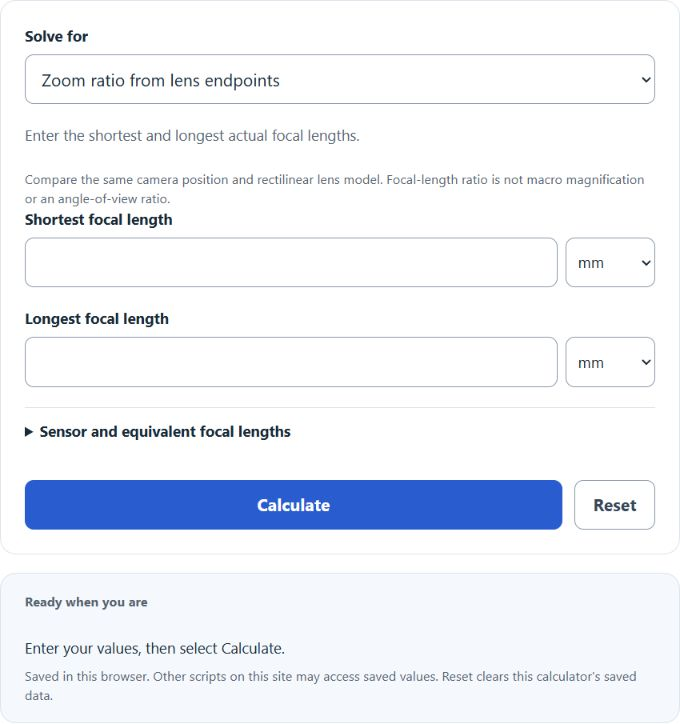
Calculate optical zoom from minimum and maximum focal lengths, reverse-solve a telephoto endpoint, and compare crop-factor equivalents and field of view.
Related Calculators
- Optical Zoom to mm Calculator
- Field of View Calculator
- Angle of View Calculator
- Vertical FOV Calculator
- Dynamic Range Calculator
- F-Stop Calculator
- All Physics Calculators
Zoom Factor Formula
The following formula is used to calculate the zoom factor (a focal-length multiplier relative to a chosen reference focal length).
Variables:
- ZF is the zoom factor (×), a dimensionless multiplier
- R is the resulting focal length (mm or in)
- B is the base (reference) focal length (mm or in)
To calculate the zoom factor, divide the resulting focal length by the base (reference) focal length. Use the same unit for both focal lengths so the units cancel.
| Base Focal Length (mm) | Zoom Factor (×) | Resulting Focal Length (mm) |
|---|---|---|
| 12 | 2.0 | 24.0 |
| 16 | 1.5 | 24.0 |
| 18 | 1.4 | 25.2 |
| 24 | 1.7 | 40.8 |
| 28 | 2.0 | 56.0 |
| 35 | 1.4 | 49.0 |
| 40 | 1.5 | 60.0 |
| 50 | 2.0 | 100.0 |
| 55 | 1.7 | 93.5 |
| 70 | 1.4 | 98.0 |
| 85 | 2.0 | 170.0 |
| 100 | 1.5 | 150.0 |
| 105 | 1.4 | 147.0 |
| 135 | 1.7 | 229.5 |
| 150 | 2.0 | 300.0 |
| 200 | 1.4 | 280.0 |
| 250 | 1.5 | 375.0 |
| 300 | 2.0 | 600.0 |
| 400 | 1.4 | 560.0 |
| 600 | 2.0 | 1200.0 |
| Formula: R = B × ZF, where R is resulting focal length, B is base focal length, and ZF is the zoom factor. Values rounded to one decimal place where applicable. | ||
What is Zoom Factor?
On this page, “zoom factor” means a focal-length multiplier: the ratio of one focal length to a chosen reference (base) focal length. On the same camera at a fixed position, a distant subject’s linear image size scales approximately with focal length, while the scene width scales inversely. The angular field of view follows 2 × atan(sensor width / (2 × focal length)), so the ratio of angles is not generally the focal-length ratio. The multiplier is dimensionless (for example, 2× or 4×). A zoom lens’s zoom ratio is its maximum focal length divided by its minimum focal length; neither value is a macro reproduction ratio.
How to Calculate Zoom Factor?
The following steps outline how to calculate the Zoom Factor.
- First, determine the resulting focal length you want to compare (R) in millimeters (or inches).
- Next, choose the base (reference) focal length (B) in the same unit. For context, a “normal” lens is often around 50 mm on full-frame, around 35 mm on many APS‑C cameras, and around 25 mm on Micro Four Thirds.
- Next, gather the formula from above: ZF = R / B.
- Finally, calculate the Zoom Factor (ZF).
- After inserting the variables and calculating the result, check your answer with the calculator above.
Example Problem :
Use the following variables as an example problem to test your knowledge.
focal length of the lens (R) = 200mm
base (reference) focal length (B) = 50mm, so ZF = 200 / 50 = 4×