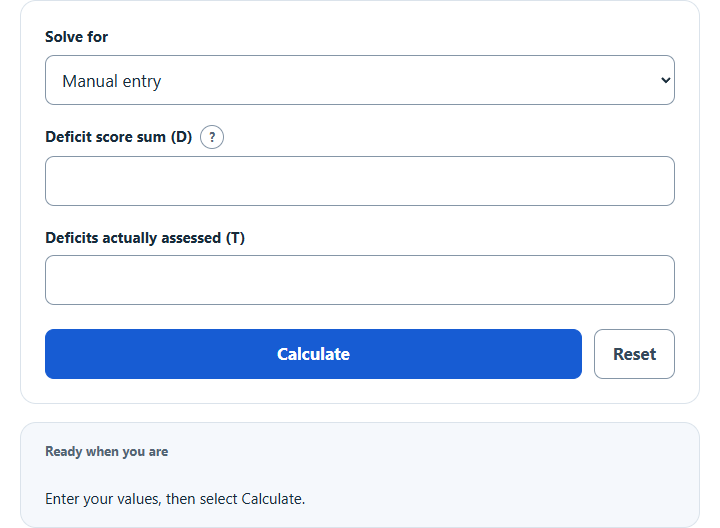
Calculate a frailty index as deficits present divided by deficits assessed, from your own counts or a 30-item checklist, as a ratio and a percentage.
Related Calculators
- Weight Loss Percentage Calculator
- Medication Days Supply Calculator
- Chronotropic Response Index Calculator
- Heart Rate Variability Calculator
- All Health and Medical Calculators
Frailty Index Formula
The following formula is used to calculate the Frailty Index.
Variables:
- FI is the Frailty Index ratio (0–1); multiply by 100 for a percentage
- D is the sum of assessed deficit scores (a count for binary scoring)
- T is the number of deficits actually assessed
To calculate the Frailty Index, divide the number of deficits present by the number of deficits actually assessed. Multiply the result by 100 to get the Frailty Index as a percentage.
What is a Frailty Index?
A Frailty Index is a tool used in geriatric medicine to quantify the health status of older individuals by measuring their vulnerability to adverse health outcomes. It is calculated by assessing a range of health-related variables, including physical and cognitive impairments, illnesses, and disabilities. The higher the score on the Frailty Index, the more frail the individual is considered to be, indicating a higher risk of mortality, hospitalization, and other negative health events.
How to Calculate Frailty Index?
The following steps outline how to calculate the Frailty Index.
- First, determine the number of deficits present (D).
- Next, determine the number of deficits actually assessed (T).
- Next, use the formula FI = D / T to calculate the Frailty Index.
- Finally, calculate the Frailty Index.
- After inserting the variables and calculating the result, check your answer with the calculator above.
Example Problem :
Use the following variables as an example problem to test your knowledge.
Deficit score sum (D) = 8
Number of deficits actually assessed (T) = 10 (arithmetic example only; fewer than 30 items is not a validated clinical assessment)