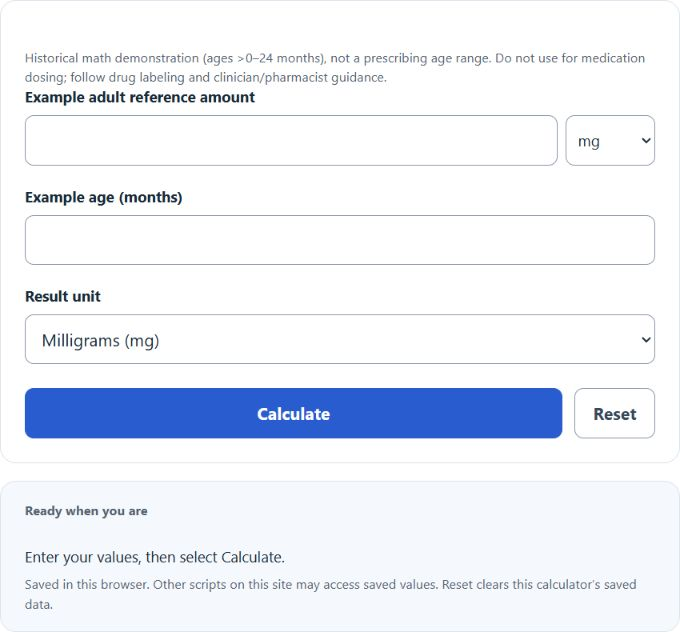
Explore the historical arithmetic of Fried’s Rule using an example adult reference amount and age in months, with mg, g, and mcg unit options. This demonstration does not recommend a medication dose.
Medical disclaimer: This calculator demonstrates Fried’s Rule for educational/historical purposes only and is not medical advice. Do not use it to dose medications for children—pediatric dosing should follow the specific drug’s official labeling and clinician/pharmacist guidance (typically weight-based mg/kg, with maximums and other adjustments). This tool does not account for formulation/concentration (mg/mL) or safe rounding to measurable doses.
- All Health and Medical Calculators
- Cowling’s Rule Calculator
- Young’s Rule Calculator
- Clark’s Rule Calculator
Fried’s Rule Formula
The following formula is used to estimate an infant’s drug dose from an adult dose using Fried’s Rule.
Variables:
- Dc is the child’s dose (in the same dose unit as Da, such as mg)
- Da is the adult dose (in the same dose unit as Dc, such as mg)
- a is the child’s age (months)
To calculate the child’s dose, multiply the adult dose by the child’s age in months. Then, divide the result by 150. This gives an estimate according to Fried’s Rule.
What is Fried’s Rule?
Fried’s Rule is a historical age-based formula: child-dose estimate = (age in months / 150) × adult reference dose. This calculator limits examples to ages greater than 0 and up to 24 months; that demonstration range is not a prescribing indication. For actual pediatric dosing, follow the specific medication’s labeling and clinician/pharmacist guidance, including weight-based calculations, dose limits, indication and organ function where applicable.
Limitations and safer approach
Age-based “rules” like Fried’s do not account for medication formulation, concentration, dosing frequency, contraindications, or drug-specific pediatric guidance. For real-world dosing, check the drug’s official prescribing information (e.g., FDA labeling) and follow a pediatrician or pharmacist’s instructions.