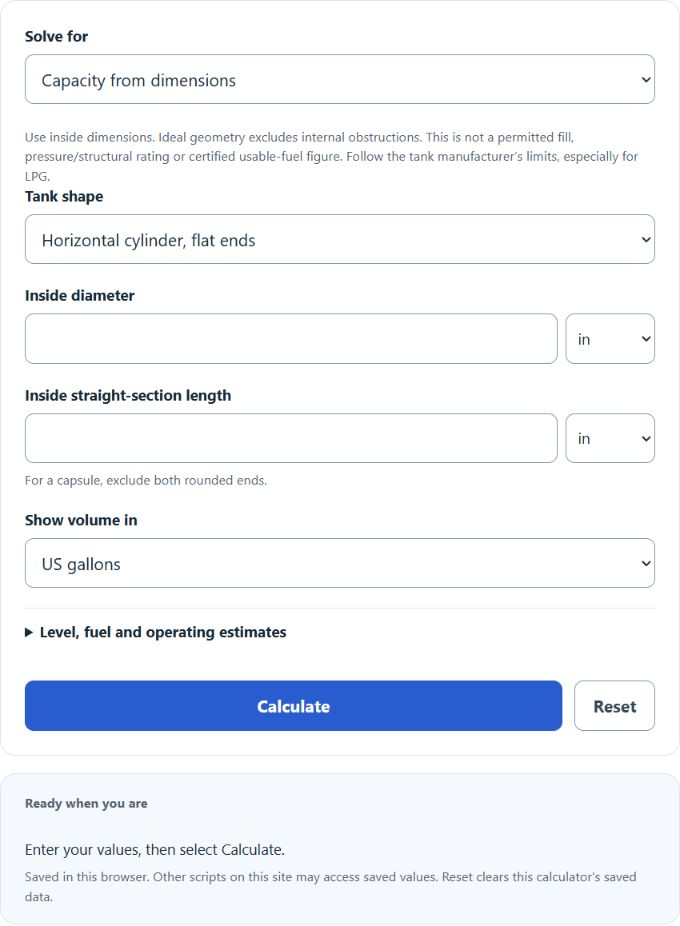
Estimate internal geometric tank volume from one of six ideal shapes, or solve the missing length or height for a target volume. Optional depth, supplied fill limit, density, price and consumption inputs estimate liquid volume, weight, cost and range or run time; they do not certify usable fuel or a safe filling limit.
Fuel Tank Capacity Formula
The calculator first finds ideal geometric volume from the selected shape and inside dimensions. The conversion below remains valid when that volume is expressed in cubic meters and the desired result is liters; it is a unit conversion, not the tank-shape formula.
Variables:
- FTC is the fuel tank capacity (liters)
- V is the volume of the tank (cubic meters)
- 1000 is the conversion factor (1000 liters per cubic meter)
Multiply geometric volume in cubic meters by 1000 to obtain liters. One US liquid gallon is exactly 3.785411784 L; one Imperial gallon is exactly 4.54609 L, so those gallon units are not interchangeable. Fuel density is not needed for tank volume; it is used only for estimated liquid weight. The nine liquid-density presets are approximate, and a supplied density override should represent the actual product and temperature.
What is a Fuel Tank Capacity?
This calculator reports ideal internal geometric capacity. A real tank may contain baffles, sumps, fittings or a different end profile, and its manufacturer-rated usable volume may differ. A selected fill percentage is only a supplied calculation assumption: there is no generic 95% default, and it does not establish a safe operating limit. In particular, liquid propane requires its applicable supplier and manufacturer filling limits; selecting propane here estimates liquid weight only. The calculator does not model pressure-vessel design, thermal expansion, certified usable fuel or safe filling procedures.
How to Calculate Fuel Tank Capacity?
Use the following steps to match the calculator to the tank geometry and the calculation you need.
- Choose capacity from dimensions or the inverse target-volume mode, then select the matching shape: horizontal cylinder, vertical cylinder, rectangular box, horizontal ellipse, horizontal obround or horizontal capsule.
- Enter the required inside dimensions, choosing inches, feet, centimeters or meters for each field. For a capsule, length is the straight cylindrical section and excludes its two hemispherical ends. The ellipse uses full inside width and height; the obround has semicircular sides joined by a rectangle.
- Choose liters, US gallons or Imperial gallons for the displayed volume and, in inverse mode, for the target. The inverse solves height for a box or vertical cylinder and length for the other shapes. A capsule target cannot be smaller than its two hemispherical ends alone; a positive straight section requires a larger target.
- In capacity mode, optional current depth is measured vertically from the internal bottom and must lie within the tank height or diameter; an out-of-range depth is rejected, not treated as full. Choose Yes for the dipstick chart to see eleven depth rows from 0% through 100% in the expandable details. Depth percentage is not generally volume percentage in horizontal curved tanks.
- Add optional fill percentage, liquid/density, price or consumption inputs only when you have the relevant values. A fill percentage is supplied rather than assumed; price-unit changes convert the entered price, while consumption-unit changes reinterpret the rate. Range or run time requires a volume basis from current depth or an explicit fill percentage. Use the tank manufacturer’s actual capacity and applicable filling instructions for operating decisions.
Example Problem :
For a geometry example, select capacity from dimensions and the rectangular box shape. Enter inside length 5 m, width 1 m and height 1 m, and select liters for the displayed capacity. Leave optional depth and fill-limit fields blank to calculate geometric capacity only.
Inside geometric volume is V = 5 m * 1 m * 1 m = 5 cubic meters.
fuel tank capacity (FTC) = 5 × 1000 = 5000 liters (≈ 1320.86 US gallons)