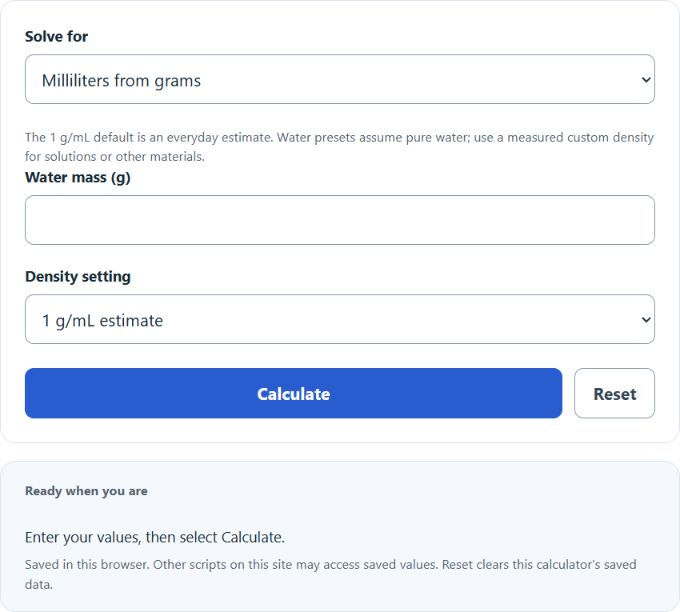
Convert grams of water to milliliters or mL to grams using an everyday 1:1 estimate, temperature-based water density, or a custom g/mL value.
Related Calculators
- Grams To Volume Calculator
- kg/h to m3/min Converter
- Lbs To Bushels Calculator
- Pounds To Barrels Calculator
- All Unit Converters
Water g ↔ mL Formula
Choose the conversion direction and density setting. The formulas below use the selected density.
1 g/mL estimate:
Water presets or custom density:
- g = mass in grams
- mL = volume in milliliters
- d = density of the ingredient in g/mL
The default 1.00 g/mL is a rounded water-density estimate, including near 4 °C. Pure-water presets use 0.9982 g/mL at 20 °C and 0.9970 g/mL at 25 °C. The ingredient table gives illustrative estimates; actual density varies with composition, temperature and packing. Verify the appropriate density for your sample.
The 1 g/mL estimate gives the same numerical value in grams and milliliters. Other density settings multiply by density for mL to g and divide by density for g to mL. Choose Custom density to enter a positive value in g/mL.
Reference Tables
Use these density values to sanity-check results or to enter a custom density.
| Ingredient | Density (g/mL) | 100 g equals | 100 mL equals |
|---|---|---|---|
| Water | 1.00 | 100 mL | 100 g |
| Milk | 1.03 | 97.1 mL | 103 g |
| Vegetable oil | 0.92 | 108.7 mL | 92 g |
| Olive oil | 0.91 | 109.9 mL | 91 g |
| All-purpose flour | 0.529 | 189 mL | 52.9 g |
| Granulated sugar | 0.845 | 118.3 mL | 84.5 g |
| Honey | 1.42 | 70.4 mL | 142 g |
| Table salt | 1.217 | 82.2 mL | 121.7 g |
Quick water conversions for common kitchen amounts.
| Water (g) | Water (mL) | Approx. kitchen measure |
|---|---|---|
| 5 g | 5 mL | 1 tsp |
| 15 g | 15 mL | 1 Tbsp |
| 120 g | 120 mL | 1/2 cup |
| 240 g | 240 mL | 1 cup |
| 500 g | 500 mL | ~2.11 cups |
| 1000 g | 1000 mL | ~4.23 cups |
Worked Examples and FAQ
Example 1: Water, 250 g to mL. Water is 1 g/mL, so 250 g = 250 mL.
Example 2: Olive oil, 200 mL to g. Density is 0.91 g/mL. 200 mL × 0.91 g/mL = 182 g.
Example 3: Flour, 150 g to mL. Density is 0.529 g/mL. 150 g ÷ 0.529 g/mL = 283.6 mL, or about 1.2 US cups.
Are grams and milliliters always the same? Their numerical values agree only when density is 1 g/mL. This is an approximation for water; other materials and more precise water conversions require the appropriate density.
What density should I use for milk? Whole milk is close to 1.03 g/mL. Skim milk is slightly higher, around 1.035 g/mL. The 1.03 value works for most recipes.
Why does flour vary so much? Flour density depends on whether it is sifted, scooped, or spooned into the cup. The 0.529 g/mL value matches the common 125 g per US cup standard. If your recipe uses 120 g or 140 g per cup, enter a custom density of 0.507 or 0.592 g/mL respectively.
How do I convert grams of a salt solution or syrup? Measure or look up the solution density at your concentration, then choose Custom density. A 50% sugar syrup, for example, is around 1.23 g/mL.
Does temperature matter? Temperature changes density. The difference may be small enough for an everyday estimate, but precise work needs density at the measured temperature; water is about 0.997 g/mL at 25 °C. Enter a custom density for other conditions.