Calculate geoid height, orthometric elevation, or ellipsoidal GPS height from any two values using h = H + N, with meters, feet, and sign guidance.
Related Calculators
- Earth Curve Calculator
- Horizon Distance Calculator
- Line of Sight Calculator
- Haversine Distance Calculator
- Angle of Elevation Calculator
- All Construction Calculators
Geoid Height Formula
Geoid height connects ellipsoidal height to orthometric height when the reference frame, vertical datum and geoid model are compatible. The practical approximation used here is:
Where:
- H = orthometric height, or elevation above the geoid / mean sea level
- h = ellipsoidal height, or height above the reference ellipsoid used by GPS
- N = geoid height, also called geoid undulation
If you already know any two of these values, the remaining variable can be found by rearranging the equation:
What Is Geoid Height?
Earth is not a perfect sphere, and sea level is not a perfectly smooth mathematical surface. GPS satellites measure position relative to a smooth reference ellipsoid, while practical elevation work usually needs height relative to the geoid, which is an equipotential gravity surface that closely matches global mean sea level. The difference between those two surfaces at a given latitude and longitude is the geoid height.
A GNSS receiver may report ellipsoidal height or apply a geoid model internally. Maps, benchmarks and engineering plans often use orthometric height. Confirm each value’s vertical reference before comparing or converting heights.
How to Use the Geoid Height Calculator
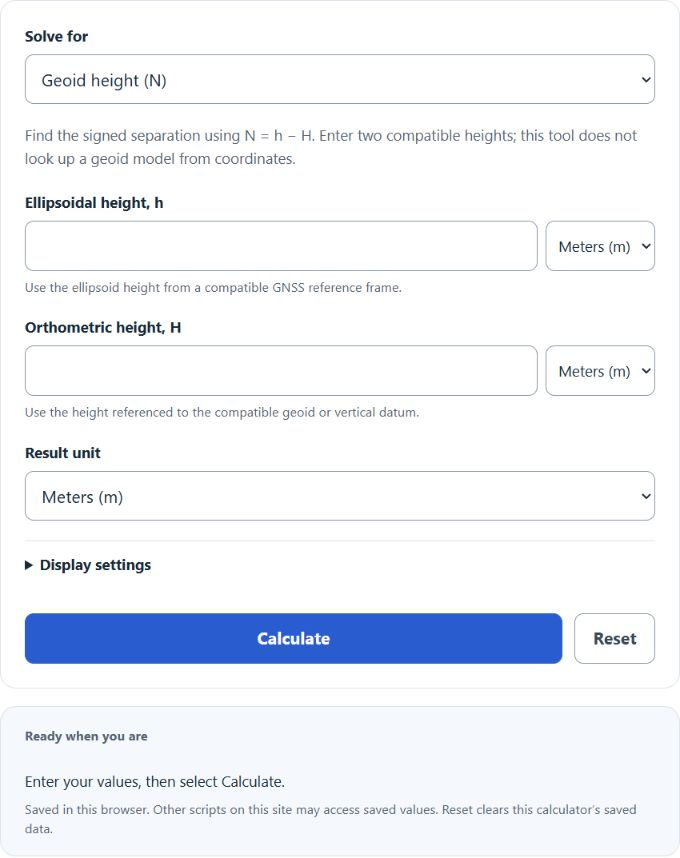
- Select the height you want to find: N, H or h.
- Enter the two known heights, including the sign of the geoid value.
- Choose meters or international feet for each input and select the result unit.
- Check that the reference frame, vertical datum and geoid model are compatible, then select Calculate.
- Use the calculated height in that compatible reference system. This tool does not obtain a geoid value from latitude and longitude.
When solving for N, the result can be used with the compatible ellipsoidal height in the conversion formula:
Variable Definitions
| Symbol | Name | Description |
|---|---|---|
| H | Orthometric Height | Elevation above the geoid, commonly treated as elevation above mean sea level. |
| h | Ellipsoidal Height | Height above the mathematical reference ellipsoid used by GPS/GNSS positioning. |
| N | Geoid Height | Vertical separation between the ellipsoid and the geoid at a specific location. |
Sign Convention for Geoid Height
The sign of N matters:
- If N is positive, the geoid is above the ellipsoid at that location.
- If N is negative, the geoid is below the ellipsoid at that location.
For compatible height references, the sign changes how ellipsoidal and orthometric heights compare:
- Positive N: orthometric height is smaller than ellipsoidal height.
- Negative N: orthometric height is larger than ellipsoidal height.
Example
Suppose a GPS receiver gives an ellipsoidal height of 412 m, and the geoid height at that latitude and longitude is 28 m. The orthometric height is:
The orthometric height is 384 m under the compatible geoid model and vertical datum used for these values.
If the geoid height were instead -15 m, then:
In that case, the orthometric height is higher than the ellipsoidal height under the same compatible height references.
Why Geoid Height Matters
Geoid height is essential whenever satellite positioning needs to be tied to real-world elevation. Common applications include:
- Land surveying: converting GNSS measurements into usable elevations for property and site work
- Civil engineering: matching GPS data to design grades, drainage plans, and benchmark elevations
- Construction: checking cut/fill, slab heights, road profiles, and utility installation depths
- Flood and drainage analysis: working with elevations that reflect gravity-driven water flow
- Mapping and GIS: aligning field GPS measurements with DEMs, contour maps, and elevation datasets
- Aviation, marine, and navigation workflows: translating positional data into consistent vertical references
Why GPS Elevation Often Looks Wrong
Many users assume GPS altitude is the same as elevation above sea level, but that is often not true. A GPS device commonly reports height relative to a reference ellipsoid, not the geoid. Because the geoid can be tens of meters above or below the ellipsoid depending on location, the difference can be large enough to matter in engineering, mapping, and field layout.
Important Notes on Accuracy
- Geoid height varies by location; even nearby points can have slightly different values.
- Different vertical datums and geoid models are not automatically interchangeable; verify compatibility with the GNSS reference frame.
- This calculator uses two known height values. It does not query a geoid model or accept coordinates.
- Select the correct unit for each height. This tool converts meters and international feet to a common unit before applying the formula.
- This arithmetic does not establish survey accuracy. Height measurement quality, geoid model accuracy and datum compatibility determine whether the result is suitable for your use.
Common Related Terms
- Geoid: gravity-based surface that approximates mean sea level
- Reference Ellipsoid: smooth mathematical model of Earth used for positioning
- Orthometric Height: practical elevation above the geoid
- Ellipsoidal Height: satellite-derived height above the ellipsoid
- Undulation: another name for geoid height
- Vertical Datum: the framework that defines how elevations are referenced
Frequently Asked Questions
Is geoid height the same as elevation?
No. Geoid height is the separation between the ellipsoid and the geoid. Elevation is typically orthometric height above mean sea level.
Can geoid height be negative?
Yes. A negative value means the geoid lies below the reference ellipsoid at that location.
Why do I need latitude and longitude?
Coordinates are needed by a geoid model service to look up a local geoid value. This calculator instead solves N = h − H from two supplied compatible heights, or converts heights when N is already known; it does not require latitude or longitude.
Do all GPS devices show orthometric height?
No. Some devices apply a geoid model internally, while others display ellipsoidal height unless corrected. It is important to know which vertical reference your device is using.
What unit should I use?
Choose meters or international feet independently for each input. The calculator converts them automatically and displays the answer in your selected result unit. One international foot is exactly 0.3048 meters.