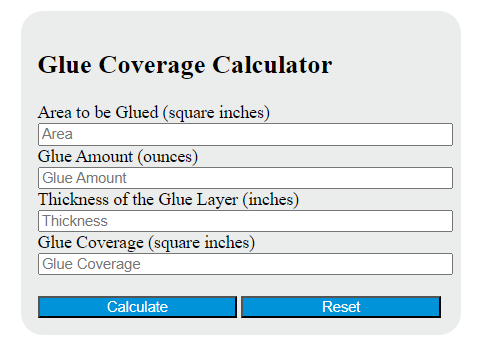
Calculate adhesive needed, coverage area, or spread rate from project area and product coverage, with waste allowance, unit conversions, and container estimates.
Related Calculators
- Material Cost Calculator
- Sand Filling Quantity + Coverage Calculator
- Paint Ratio Calculator
- Vapor Barrier Cost Calculator
- All Construction Calculators
Glue Coverage Formula
The following formulas are used to calculate glue coverage area. (Use consistent units; if glue amount is entered by weight, convert to volume using density first.)
Variables:
- GC is the glue coverage area (e.g., in², ft², m²)
- V is the glue volume
- G is the glue amount by mass (e.g., g, oz)
- ρ is the glue density (mass per volume, e.g., g/mL)
- T is the thickness of the glue layer
To calculate glue coverage area, convert the glue amount to a volume (if needed) and then divide that volume by the desired glue-layer thickness.
What is Glue Coverage?
Glue coverage refers to the extent to which an adhesive (glue) is spread over the surfaces that are to be joined together. It is an important factor in ensuring a strong bond between the materials. Insufficient glue coverage may result in weak joints and potential failure of the bond, while excessive glue can lead to wastage and messy work. Therefore, achieving optimal glue coverage is crucial in various applications such as woodworking, construction, and manufacturing.
How to Calculate Glue Coverage?
The following steps outline how to calculate the Glue Coverage.
- Determine the glue amount (G) (by volume or by weight).
- If using glue by weight, determine the glue density (ρ) so you can convert weight to volume.
- Determine the desired thickness of the glue layer (T).
- Convert glue weight to volume if needed: V = G / ρ.
- Calculate the coverage area: GC = V / T.
- After calculating the result, check your answer with the calculator above.
Example Problem :
Use the following variables as an example problem to test your knowledge.
glue amount (G) = 2 oz (by weight)
glue density (ρ) = 1.05 g/mL
thickness of the glue layer (T) = 0.01 in
Solution: Convert 2 oz to grams (2 oz × 28.3495 = 56.70 g). Then V = 56.70 / 1.05 = 54.00 mL = 54.00 × 0.0610237 = 3.295 in³. Finally, GC = 3.295 / 0.01 = 329.5 in² (about 2.29 ft²).