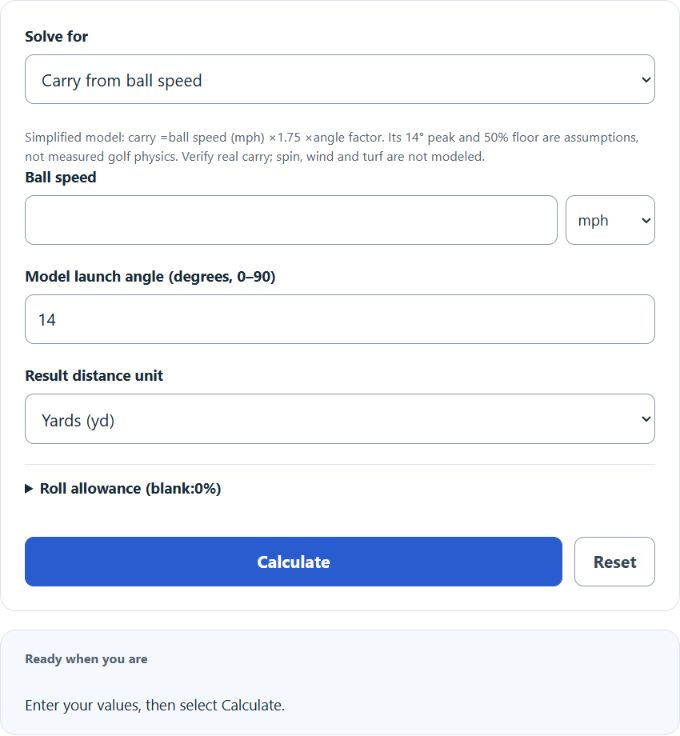
Estimate driver carry and total distance from ball speed and launch, or reverse-solve the ball and club speed needed for a target.
Golf Drive Distance Formula
The calculator evaluates a simplified illustrative model. Its 1.75 yards-per-mph coefficient, 14° peak and 50% angle-factor floor are assumptions, not a validated ball-flight model.
To estimate ball speed from club speed, the calculator uses:
To solve for ball speed from a known drive distance:
To estimate club speed from ball speed:
- Carry = model distance to first landing, in yards. Total =carry ×(1+roll allowance /100); divide a total target by that multiplier before solving speed.
- BS = ball speed, in miles per hour
- CS = club speed, in miles per hour
- LA = launch angle, in degrees
- f(LA) = launch angle factor
- 1.75 = simplified yards-per-mph distance factor
- SF = smash factor (ball speed /club speed);1.48 is an editable assumption
This is a simplified estimate. Real drive distance also depends on spin rate, wind, altitude, turf firmness, ball type, strike quality, and carry versus rollout. The model treats 14 degrees as the most efficient launch angle and reduces distance as launch moves farther from that value.
Illustrative Model Speed and Distance Ranges
These are formula examples at 14°, 1.48 smash factor and 10% roll allowance. They are not measured golfer categories or typical-distance benchmarks.
| Illustrative input band | Club Speed | Estimated Ball Speed | Model total distance |
|---|---|---|---|
| 75–85 mph example | 75 to 85 mph | 111 to 126 mph | 213.68 to 242.17 yards |
| 85–95 mph example | 85 to 95 mph | 126 to 141 mph | 242.17 to 270.66 yards |
| 95–105 mph example | 95 to 105 mph | 141 to 155 mph | 270.66 to 299.15 yards |
| 105–115 mph example | 105 to 115 mph | 155 to 170 mph | 299.15 to 327.64 yards |
Launch Angle Reference for Driver
Launch angle changes how much of your ball speed turns into useful distance.
| Launch Angle | General Meaning | Distance Effect in This Model |
|---|---|---|
| Below 8° | Very low launch | Reduced efficiency |
| 8° to 12° | Low to moderate launch | Model factor rises toward 14° |
| 12° to 16° | Near the model’s assumed peak | Highest efficiency near 14° |
| Above 16° | High launch | Model factor decreases away from 14° |
How to Use the Result
This model can differ materially from real distance. Its angle factor is a chosen curve; real optimal launch depends on speed and spin. Club-speed solves use your entered smash factor, initially 1.48. A lower factor reduces modeled ball speed for the same club speed.
Choose the desired solve, then enter the visible measurements. Compare these illustrative outputs with measured carry; do not treat the result as a physical flight prediction.