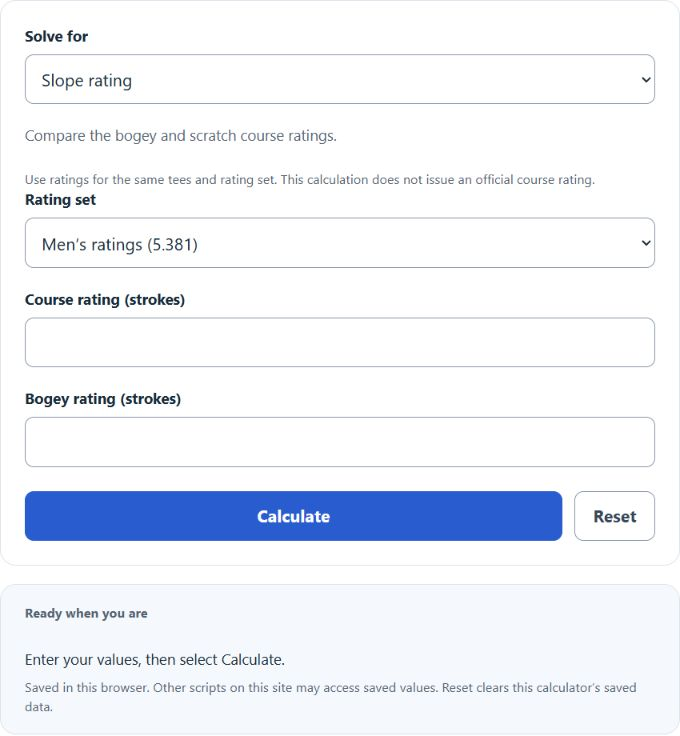
Calculate a slope estimate from course and bogey ratings, or estimate either rating from slope. Choose the matching men’s or women’s rating set.
Golf Slope Formula
The golf slope rating measures how much harder a specific set of tees plays for a bogey golfer compared with a scratch golfer. It is a relative-difficulty number used in handicap calculations, so it should not be confused with par or with the course rating itself.
Use k = 5.381 for men’s ratings and k = 4.24 for women’s ratings. The calculator rounds slope to the nearest whole number, with .5 rounded up as its estimation convention. Official ratings are issued by the authorized golf association. With rounded published inputs, the inverse formulas estimate rather than uniquely recover the original rating:
Variable Definitions
- Slope Rating (SR)
- A measure of the relative playing difficulty of a course for a bogey golfer compared with a scratch golfer. Higher values indicate the course is more demanding for the average higher-handicap player.
- Course Rating (CR)
- The expected score for a scratch golfer from a specific tee set under normal playing conditions.
- Bogey Rating (BR)
- The expected score for a bogey golfer from that same tee set under normal playing conditions.
How to Use the Golf Slope Calculator
- Use values from the same tee box. Mixing numbers from different tees will give an incorrect slope.
- Choose the value to solve and the matching rating set, then enter the two displayed ratings.
- Select Calculate to display the result. Calculation details show the formulas and unrounded values.
- The calculator shows whole-number slope estimates and one-decimal course or bogey rating estimates. Use the authorized course rating for handicapping.
Example Calculation
Suppose a men’s tee rating set has a course rating of 72.5 and a bogey rating of 98.3.
Rounded to the nearest whole number, the slope rating is 139.
How to Interpret a Slope Rating
A standard slope is 113. Values below 113 indicate a course that is less difficult for bogey golfers relative to standard difficulty, while values above 113 indicate a course that is more difficult.
| Slope Rating | General Interpretation |
|---|---|
| 55-90 | Relatively forgiving for bogey golfers; smaller difficulty gap between bogey and scratch players. |
| 91-112 | Below standard relative difficulty. |
| 113 | Standard relative difficulty. |
| 114-130 | Above standard relative difficulty for bogey golfers compared with scratch golfers. |
| 131-155 | Above standard relative difficulty; the rating alone does not identify which features cause it. |
Course Rating vs. Bogey Rating vs. Slope Rating
- Course rating estimates how a scratch golfer should score.
- Bogey rating estimates how a bogey golfer should score.
- Slope rating measures the size of the gap between those two difficulty levels.
This distinction matters because a course can have a moderate course rating but still carry a high slope if the layout punishes misses, poor recovery shots, or inconsistent distance control. In other words, slope tells you how sharply the course difficulty rises as player skill level drops.
What Affects Slope Rating?
- Length that becomes more demanding for shorter hitters
- Narrow landing areas and penal rough
- Forced carries over water or bunkers
- Tree lines and recovery difficulty after errant shots
- Green size, firmness, contour, and approach-shot demands
- Elevation changes, doglegs, and strategic layup requirements
Because these factors impact bogey golfers more than scratch golfers, each tee set at the same course can have a different slope rating.
Common Input Mistakes
- Using par instead of course rating. Par is not part of the slope formula.
- Mixing tee sets. The course rating and bogey rating must come from the same tees.
- Entering slope as bogey rating. These are different values with different meanings.
- Using unmatched rating tables. Make sure all numbers come from the same scorecard or handicap reference.
- Assuming higher slope always means higher scores for everyone. Slope measures relative difficulty for bogey golfers, not absolute scoring difficulty for every player.
Golf Slope Rating FAQ
Is a higher slope rating always harder?
It is harder for bogey golfers relative to scratch golfers. A higher slope means the course tends to punish less accurate or less consistent players more severely.
Can two tee boxes on the same course have different slope ratings?
Yes. Each tee set is rated separately, so moving forward or backward can change both the course rating and the slope rating.
Why can a course have a modest course rating but a high slope?
Because the slope rating reflects the gap in difficulty between scratch and bogey golfers. A layout may still be manageable for highly skilled players while becoming significantly tougher for players who miss fairways, lose distance, or struggle around the greens.
When is this calculator most useful?
It is useful for checking the slope formula or estimating a missing rating from the other two numbers. Select the matching rating set and use values from the same tees. Rounded published inputs may not reproduce the official rating exactly.