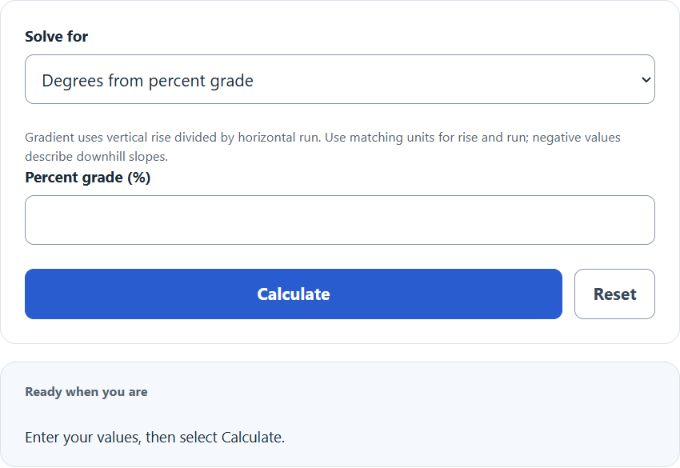
Convert a gradient to degrees from a percent grade, a 1 in N or 1:N ratio, or rise and run, or convert degrees back to a percent gradient.
Related Calculators
- Slope to Degrees Calculator
- Average Gradient Calculator
- Gradient to Slope Calculator
- Slope Calculator
- Degrees to Percent Calculator
- Angle to Slope Calculator
- Percent Slope Calculator
- All Unit Converters
Calculator Functions
| Function | What it does | What it requires |
|---|---|---|
| Degrees from percent grade | Converts a percent grade into a slope angle in degrees | Requires the percent grade |
| Degrees from ratio (1 in N or 1:N) | Converts a 1 in N or 1:N gradient into degrees | Requires N, the horizontal run for one unit of rise |
| Degrees from decimal gradient | Converts a gradient written as rise divided by run into degrees | Requires the decimal gradient |
| Degrees from rise and run | Finds the slope angle from two measured distances | Requires the vertical rise and the horizontal run in the same unit |
| Gradient from degrees | Converts an angle in degrees into a percent grade | Requires an angle between −90° and 90° |
Every result also shows the angle in degrees, minutes and seconds, the decimal gradient and the equivalent 1 in N ratio. Negative entries describe a downhill slope.
Gradient to Degrees Formulas
| θ | Slope angle (degrees) |
| m | Decimal gradient: vertical rise divided by horizontal run |
| π | 3.14159…, which converts the arctangent from radians to degrees |
The angle is the inverse tangent of rise divided by run [1]. Each function first turns its input into the decimal gradient m.
Degrees from percent grade
Percent grade is rise divided by run, multiplied by 100 [1]. A 10% grade gives θ = arctan(0.10) = 5.71°. A 100% grade is 45°, not 90°, because rise equals run.
Degrees from ratio (1 in N or 1:N)
A 1 in 12 gradient gives θ = arctan(1 ÷ 12) = 4.76°. A slope written as 2:1 run to rise is 1 in 2.
Degrees from decimal gradient
The entry is m, so the main formula applies directly. A gradient of 0.5 gives θ = arctan(0.5) = 26.57°, and a gradient of 1 gives 45°.
Degrees from rise and run
A rise of 1 over a run of 4 gives θ = arctan(0.25) = 14.04°. The run cannot be zero, because a vertical face has no finite gradient.
Gradient from degrees
tan(θ × π ÷ 180)
An angle of 30° gives 100 × tan(30°) = 57.74%, a decimal gradient of 0.5774, or about 1 in 1.73.
Gradient to Degrees Conversion Table
| Gradient (1 in N) | Percent grade | Degrees |
|---|---|---|
| 1 in 1 | 100% | 45.00° |
| 1 in 2 | 50% | 26.57° |
| 1 in 3 | 33.33% | 18.43° |
| 1 in 4 | 25% | 14.04° |
| 1 in 5 | 20% | 11.31° |
| 1 in 6 | 16.67% | 9.46° |
| 1 in 7 | 14.29% | 8.13° |
| 1 in 8 | 12.5% | 7.13° |
| 1 in 10 | 10% | 5.71° |
| 1 in 12 | 8.33% | 4.76° |
| 1 in 14 | 7.14% | 4.09° |
| 1 in 16 | 6.25% | 3.58° |
| 1 in 20 | 5% | 2.86° |
| 1 in 30 | 3.33% | 1.91° |
| 1 in 40 | 2.5% | 1.43° |
| 1 in 60 | 1.67% | 0.95° |
| 1 in 100 | 1% | 0.57° |
The second table starts from a percent grade.
| Percent grade | Degrees |
|---|---|
| 1% | 0.57° |
| 2% | 1.15° |
| 3% | 1.72° |
| 4% | 2.29° |
| 5% | 2.86° |
| 6% | 3.43° |
| 8% | 4.57° |
| 10% | 5.71° |
| 12% | 6.84° |
| 15% | 8.53° |
| 16% | 9.09° |
| 20% | 11.31° |
| 25% | 14.04° |
| 30% | 16.70° |
| 50% | 26.57° |
| 60% | 30.96° |
| 100% | 45.00° |
Limits of This Estimate
- The run is horizontal distance, measured as if the ground were flat, not the distance travelled along the slope [1]. Entering the sloped distance as the run understates the angle.
- A gradian, also called a gon or grade, is a unit of angle and not a slope: 1 gon is 0.9° [2], so 100 gon is a right angle. This calculator converts slopes and does not convert gradians.
- The degrees, minutes and seconds line is rounded to the nearest arcsecond, so a very small slope can show 0″ while the decimal answer is not zero.
Sources
- U.S. Geological Survey, To Determine Percent of Slope and Angle of Slope: percent slope as rise over run times 100, and the angle as the inverse tangent of rise over run
- NIST Special Publication 811, Guide to the SI, Appendix B.8: the gon as an angle unit equal to 0.9°