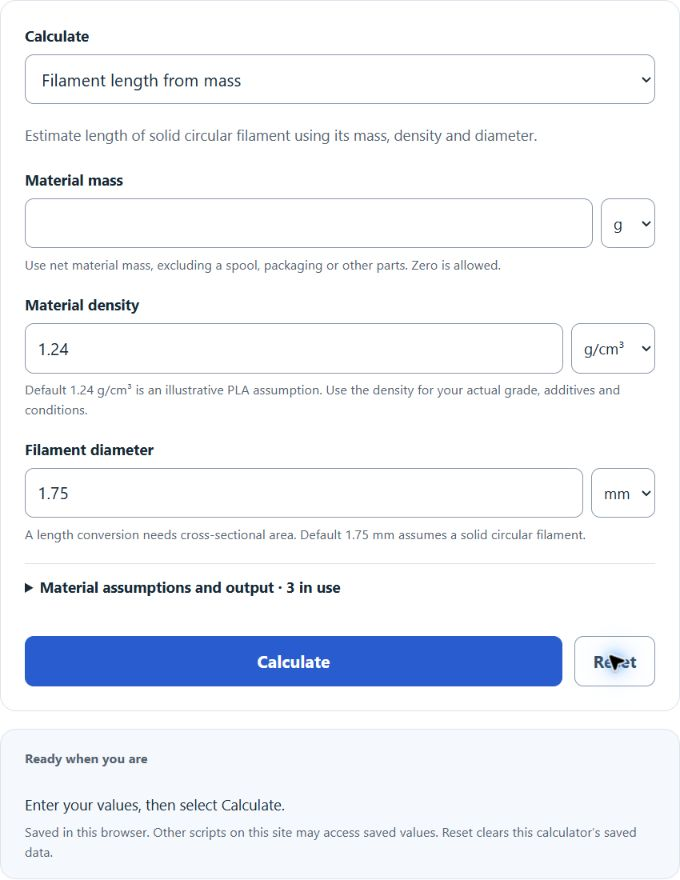
Calculate material volume from mass and density, or estimate the length of solid circular filament using mass, density and diameter. The calculator also supports the reverse mass calculations. Grams measure mass; mm measure length, and mm³ measure volume.
Grams To mm Formula
Density gives material volume: V = M / D, using grams and g/mm³ to obtain mm³. Filament length additionally requires circular cross-sectional area: L = V / [π(d/2)²] = M / [Dπ(d/2)²], with diameter d and length L in mm. These follow the mass-density definition and cylinder volume formula.
Variables:
- V is the volume in cubic millimeters (mm^3)
- M is the mass in grams (g)
- D is the density in grams per cubic millimeter (g/mm^3)
Divide mass in grams by density in g/mm³ to obtain material volume in mm³. If density is given in g/cm³, divide that density by 1,000 first: 1.24 g/cm³ = 0.00124 g/mm³. Volume is not a linear length; a filament-length result also needs its diameter.
| Mass (g) | Length (mm) |
|---|---|
| 1 | 335.284 |
| 2 | 670.567 |
| 5 | 1676.418 |
| 10 | 3352.836 |
| 20 | 6705.672 |
| 25 | 8382.090 |
| 30 | 10058.509 |
| 50 | 16764.181 |
| 75 | 25146.271 |
| 100 | 33528.362 |
| 150 | 50292.543 |
| 200 | 67056.724 |
| 250 | 83820.905 |
| 300 | 100585.086 |
| 400 | 134113.448 |
| 500 | 167641.810 |
| 750 | 251462.715 |
| 1000 | 335283.619 |
| 1500 | 502925.429 |
| 2000 | 670567.239 |
| * Computed at full precision, then rounded to 3 decimals. Assumes solid cylindrical PLA filament (ρ = 1.24 g/cm³) with 1.75 mm diameter. Derived linear density ≈ 0.002983 g/mm (≈ 2.983 g/m), so 1 g ≈ 335.284 mm. These are nominal mathematical values under the stated assumptions, not measurement precision guarantees. | |
What Does “Grams to mm” Mean?
Grams and millimeters measure different quantities, so there is no universal g-to-mm conversion. Density converts mass to material volume in mm³. For solid circular filament, dividing that volume by π(d/2)² gives length in mm. Hollow or noncircular shapes require their actual cross-sectional area. Use net material mass and an appropriate density for the material grade and conditions.
How to Calculate Grams To mm?
Use V = M / D for material volume. To find solid circular filament length, also use its diameter and L = V / [π(d/2)²].
- First, determine the mass in grams (M).
- Next, determine the density in grams per cubic millimeter (D).
- Next, use the formula V = M / D to calculate the volume in cubic millimeters (V).
- For a filament-length result, determine diameter d in mm, calculate area π(d/2)² in mm², then divide V by that area to obtain length L in mm.
- After inserting the variables and calculating the result, check your answer with the calculator above.
Example Problem :
Use the following variables as an example problem to test your knowledge.
mass in grams (M) = 50
Assume PLA density D = 0.00124 g/mm³ (1.24 g/cm³) and solid circular filament diameter d = 1.75 mm. For M = 50 g, material volume V = 50 / 0.00124 = 40,322.580645 mm³. Filament length L = V / [π(1.75/2)²] = 16,764.180971 mm, approximately 16.764181 m. Density presets are illustrative planning assumptions; verify your actual material and diameter.