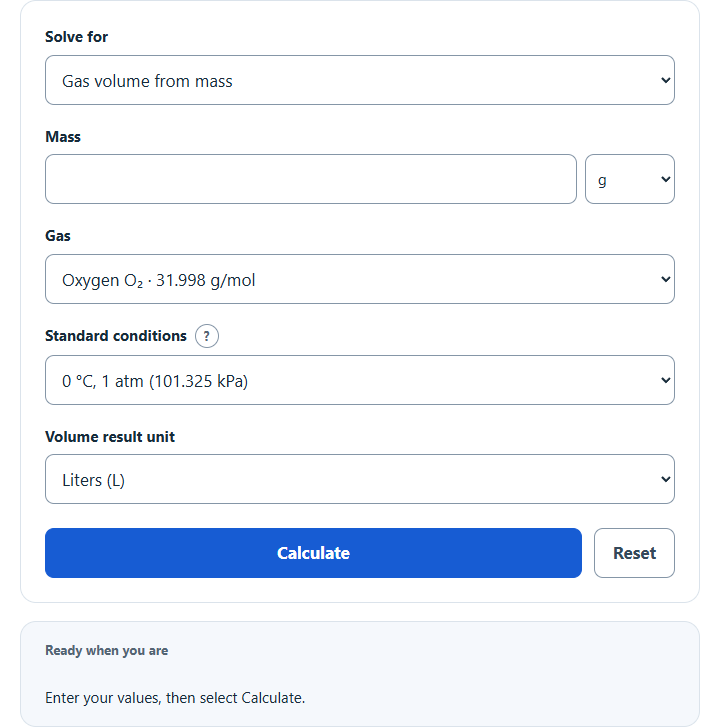
Convert grams of a gas to liters at STP by picking the gas or entering its molar mass, or find the mass or molar mass from a gas volume at STP.
- All Chemistry Calculators
- CO2 Flow Rate Calculator
- Volume To Moles Calculator
- Moles To Liters Calculator
Calculator Functions
| Function | What it does | What it requires |
|---|---|---|
| Gas volume from mass | Converts a mass of gas to the volume it occupies at standard temperature and pressure | Requires the mass, the gas (or its molar mass) and the standard conditions |
| Mass from gas volume | Converts a gas volume at standard temperature and pressure to its mass | Requires the gas volume, the gas (or its molar mass) and the standard conditions |
| Molar mass from mass and volume | Finds the molar mass of a gas from the mass of a measured volume at standard temperature and pressure | Requires the mass, the gas volume and the standard conditions |
Mass can be in g, kg or lb and volume in L, mL, US gallons or m³. The gas is picked from a list of twelve, or Other gas takes any molar mass. Standard conditions are 0 °C with either 1 atm (101.325 kPa) or 1 bar (100 kPa). The first two functions also show the amount of gas in moles and the molar volume used.
Grams to STP Formulas
| V | Gas volume at standard conditions (L) |
| m | Mass of gas (g) |
| M | Molar mass of the gas (g/mol) |
| Vm | Molar volume of an ideal gas: 22.414 L/mol at 0 °C and 1 atm [1], or 22.711 L/mol at 0 °C and 1 bar [2] |
The molar volume is not rounded in the calculation. It is worked out as Vm = R × T ÷ P, with R = 8.314462618 J/(mol·K) [3], T = 273.15 K and P = 101,325 Pa for 1 atm or 100,000 Pa for 1 bar [4].
Gas volume from mass
Mass divided by molar mass gives moles, and each mole occupies one molar volume. For 7.71 g of fluorine gas (F₂, 37.997 g/mol) at 0 °C and 1 atm, 7.71 ÷ 37.997 = 0.2029 mol, and 0.2029 × 22.414 = 4.548 L. At 1 bar the same mass occupies 4.608 L. The rounded classroom value of 22.4 L/mol gives 4.545 L.
| Gas | Molar mass (g/mol) | Liters per gram at 0 °C, 1 atm |
|---|---|---|
| Oxygen O₂ | 31.998 | 0.7005 |
| Nitrogen N₂ | 28.014 | 0.8001 |
| Dry air | 28.965 | 0.7738 |
| Carbon dioxide CO₂ | 44.009 | 0.5093 |
| Hydrogen H₂ | 2.016 | 11.1180 |
| Helium He | 4.0026 | 5.5999 |
| Argon Ar | 39.948 | 0.5611 |
| Methane CH₄ | 16.043 | 1.3971 |
| Ammonia NH₃ | 17.031 | 1.3161 |
| Fluorine F₂ | 37.997 | 0.5899 |
| Chlorine Cl₂ | 70.906 | 0.3161 |
| Carbon monoxide CO | 28.010 | 0.8002 |
Mass from gas volume
The volume divided by the molar volume gives moles, and moles times molar mass gives grams. For 10 L of oxygen at 0 °C and 1 atm, 10 ÷ 22.414 × 31.998 = 14.276 g.
Molar mass from mass and volume
A gas sample of 1.25 g that fills 1 L at 0 °C and 1 atm has a molar mass of 1.25 × 22.414 ÷ 1 = 28.017 g/mol, close to nitrogen. Mass and volume must both be above zero.
Limits of This Estimate
- The result is an ideal-gas estimate. Real gases deviate from it, and the deviation is not modeled.
- The substance has to be a gas at the selected conditions. The formula does not predict condensation, and it does not convert the volume of a solid or liquid.
- STP has two common definitions. A volume at 1 bar is 1.325% larger than at 1 atm, so the conditions a problem or data sheet uses need to match the setting.
- Dry air is a mixture, and 28.965 g/mol is a mean value for it. These estimates are based on the best available data and estimations.
Sources
- NIST, CODATA Value: molar volume of ideal gas (273.15 K, 101.325 kPa): 22.414 L/mol at 0 °C and 1 atm
- NIST, CODATA Value: molar volume of ideal gas (273.15 K, 100 kPa): 22.711 L/mol at 0 °C and 1 bar
- NIST, CODATA Value: molar gas constant: value of R
- NIST, Guide for the Use of the International System of Units (SP 811), Appendix B.8: pascals in a standard atmosphere and a bar