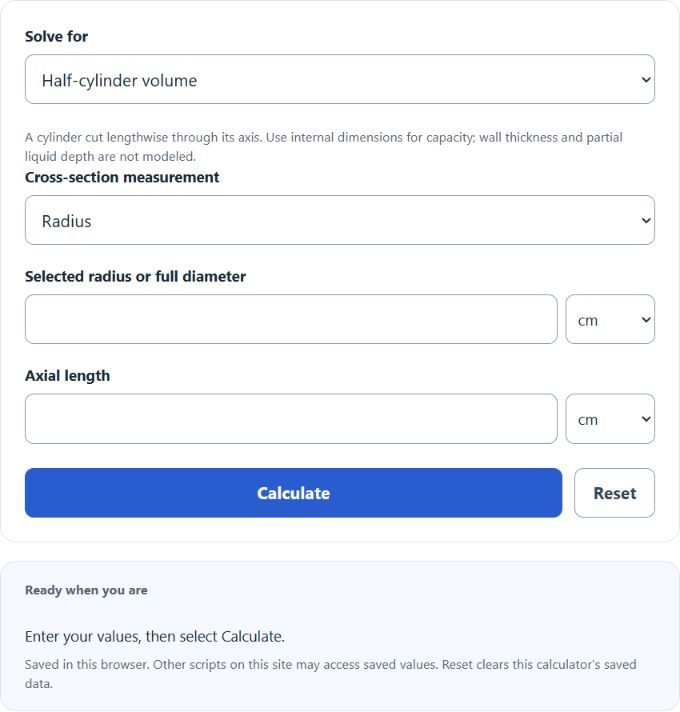
Calculate half-cylinder volume, radius, or length with diameter input, mixed units, liters, gallons, cubic units, and curved, flat, end, and total surface areas.
Related Calculators
- Circumference to Volume Calculator
- Disc Volume Calculator
- Circle Volume Calculator
- Arc Height (sagitta) Calculator
- All Math and Numbers Calculators
Half Cylinder Volume Formula
A half cylinder, also called a semicylinder, is a cylinder that has been split lengthwise through its central axis. Its volume is exactly half of the volume of a full cylinder with the same radius and height. Use the formula below when you know the radius of the semicircular end and the length or height of the shape.
Where:
| Variable | Meaning | Typical Units |
|---|---|---|
| V | Volume of the half cylinder | cm³, m³, in³, ft³, L |
| r | Radius of the semicircular base | cm, m, in, ft |
| h | Height or length of the cylinder | cm, m, in, ft |
If your dimensions are entered in one unit system, the resulting volume will be in the corresponding cubic unit. For container capacity, use the inside radius and the inside height.
Equivalent Relationships
The calculator can also be understood by breaking the shape into a semicircular cross-section and extending it along its height.
Here, A is the area of the semicircular end face. This approach is useful in geometry, tank sizing, trough design, duct sections, and half-round structural components.
How to Calculate Half Cylinder Volume
- Measure the radius of the semicircular end.
- Measure the height or length of the half cylinder.
- Square the radius.
- Multiply by the height.
- Multiply by π.
- Divide the result by 2.
In compact form, the process is simply: radius squared, then multiply by height, then multiply by π, then halve the result.
Example
Suppose a half cylinder has a radius of 5 cm and a height of 10 cm.
So the half cylinder holds approximately 392.70 cubic centimeters.
Rearranging the Formula
If the volume is known and you need to solve for another variable, use these rearranged forms.
Solve for Height
Solve for Radius
These forms are especially helpful when designing a part to meet a target capacity or when reverse-checking field measurements.
Unit Guidance
When calculating by hand, convert radius and axial length to the same unit first. This calculator converts each selected input unit automatically. For volume use V = πr²h/2; the full-cylinder relationship is explained in OpenStax’s cylinder volume and surface-area lesson.
Common output units include cubic inches, cubic feet, cubic centimeters, cubic meters, and liters.
If you are calculating the volume of a trough or half-round tank and want the result in liters, it is often easiest to work in centimeters or meters and convert the final cubic result.
Common Mistakes
- Using diameter instead of radius: if you measured the full width of the semicircle, convert it first.
- Halving the wrong dimension: do not divide the radius or height by 2 unless the physical measurement itself is half that size.
- Mixing units: keep all linear measurements in the same unit system.
- Using outside measurements for capacity: wall thickness matters when estimating how much a container can hold.
- Using the formula for the wrong shape: this formula applies only to a cylinder cut lengthwise, not to a half sphere or a partial pipe segment with a different fill level.
Diameter Conversion
If your measurement is given as diameter instead of radius, convert first using:
After converting to radius, substitute that value into the half-cylinder volume formula.
When This Calculator Is Useful
- Estimating the capacity of half-round tanks and troughs
- Calculating material volume in semicylindrical molds or forms
- Planning concrete, resin, or fill requirements in curved channels
- Checking geometric dimensions in fabrication, machining, and drafting
- Solving classroom geometry and mensuration problems
Half Cylinder Volume FAQ
Is a half cylinder always half the volume of a full cylinder?
Yes, if the cylinder is split lengthwise through its axis, the resulting shape has exactly half the original cylinder’s volume.
What if I only know the cross-sectional area?
Multiply the semicircular area by the height of the shape to get the volume.
What unit should the answer be in?
The volume result is shown in liters, with cubic meters, cubic centimeters, cubic feet, cubic inches and US gallons also reported. Radius is shown in centimeters and length in meters, with additional unit conversions. Each selected input unit is converted before calculation, so mixed input units are supported.
Can this be used for partially filled horizontal tanks?
Not by itself. A partially filled horizontal cylinder depends on liquid depth, not simply half of the cylinder shape. This formula is for the geometry of a true half cylinder.