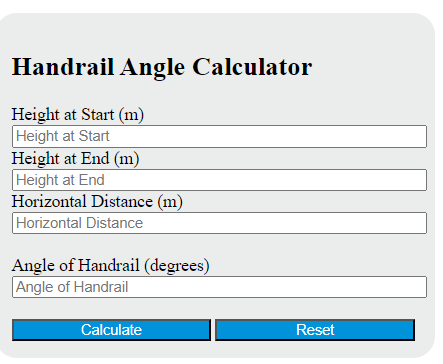
Calculate a handrail angle from rise and run, solve for rise or run, and find rail length, slope percentage, and ratio in US or metric units.
Related Calculators
- Slope Per Foot Calculator
- 3-4-5 Rule Calculator
- Fence Slope Calculator
- Fence Post Distance Calculator
- All Construction Calculators
Handrail Angle Formula
The handrail angle is the slope of the rail measured from the horizontal. In stair layout, it is the same basic geometric relationship as stair pitch: vertical rise divided by horizontal run. If you know the height at the start, the height at the end, and the horizontal distance between those points, you can calculate the angle directly.
- A = handrail angle
- H1 = height at the start of the handrail
- H2 = height at the end of the handrail
- D = horizontal distance between the two points
Use consistent units for every linear measurement. Heights and horizontal distance can be entered in inches, feet, meters, or other units, but they must represent the same real-world scale after conversion.
Rearranged Forms for the Missing Variable
This calculator can solve for any one unknown when the other three values are known. These equivalent forms show how the variables relate to one another.
What the Inputs Represent
- Height at Start: the elevation of the rail at the lower or first measured point.
- Height at End: the elevation of the rail at the upper or second measured point.
- Horizontal Distance: the plan-view run, not the diagonal handrail length.
- Angle of Handrail: the slope relative to level, usually most useful in degrees for construction and layout.
If you already know the rise and run of the stair, you can treat the change in height as the rise and the horizontal distance as the run. The calculator simply applies right-triangle trigonometry to that geometry.
How to Use the Calculator Correctly
- Measure the handrail height at the start point from a consistent reference surface.
- Measure the handrail height at the end point from that same reference method.
- Measure the horizontal distance between those two points, not the sloped rail itself.
- Enter any three values and let the calculator solve for the fourth.
- Use degrees for saw setup, layout, and most field applications; use radians only if your workflow specifically requires them.
Rise, Rail Length, and Slope Percentage
In many projects, the angle is only one part of the layout. You may also want the net rise, the sloped handrail length, and the slope percentage for comparison.
- R is the vertical rise between the two handrail points.
- L is the actual sloped length of the handrail between those points.
- Slope % is useful when comparing stairs, ramps, and site grades.
Example
Suppose a handrail starts at 34 inches, ends at 104 inches, and spans 100 inches horizontally. The rise is 70 inches, so the handrail angle is:
If you also want the diagonal rail length for estimating stock length:
This means the rail rises at a moderate stair pitch and would require a little over 122 inches of material before allowing for trim, fitting, or waste.
Related Cut-Angle Formulas
Once the handrail angle is known, it can be used to derive common transition and trim-cut relationships used in stair work and finish carpentry.
Using the same 35.0° handrail angle:
These derived values are especially helpful when a sloped rail transitions into a level run, post, or trim assembly.
Common Stair Geometry Reference
The table below shows how typical rise-and-run combinations translate into handrail angle and related cut values.
| Rise | Run | Rise/Run | Handrail Angle | Level Miter | Plumb Miter |
|---|---|---|---|---|---|
| 7 | 11 | 0.636 | 32.5° | 16.2° | 28.8° |
| 7 | 10 | 0.700 | 35.0° | 17.5° | 27.5° |
| 7.5 | 10 | 0.750 | 36.9° | 18.4° | 26.6° |
| 7.75 | 10 | 0.775 | 37.8° | 18.9° | 26.1° |
| 1 | 12 | 0.083 | 4.8° | 2.4° | 42.6° |
Practical Interpretation
- A greater height difference increases the angle.
- A longer horizontal distance decreases the angle.
- If the start and end heights are equal, the rail is level.
- If the end height is lower than the start height, the angle will be negative, which indicates direction rather than a change in steepness.
- For material takeoff, always distinguish between horizontal distance and actual rail length.
Common Measurement Mistakes
- Using the sloped handrail length in place of horizontal distance.
- Measuring start and end heights from different reference points.
- Mixing units before conversion.
- Rounding the angle too early when cut precision matters.
- Confusing angle from horizontal with angle from vertical.
Design and Layout Notes
Handrail angle affects more than appearance. It influences bracket alignment, fitting geometry, transition cuts, post connections, and user comfort on stairs or ramps. Use the calculator to establish the geometric relationship first, then verify final dimensions against your drawings, hardware requirements, and local building standards before fabrication or installation.