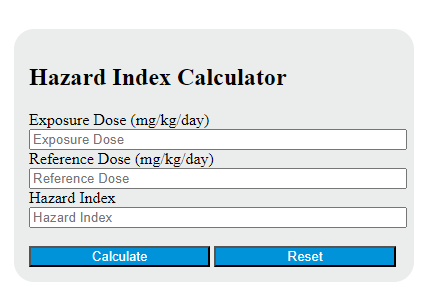
Enter the exposure dose and reference dose for each contaminant into the calculator to determine the Hazard Index. This calculator can also evaluate any of the variables given the others are known.
- All Health and Medical Calculators
- mg/kg/Day Calculator
- PPM Calculator
- Exposure Rate Calculator
- Concentration Ratio Calculator
- Therapeutic Index Calculator
Hazard Index Formula
The hazard index (HI) is a dimensionless screening metric used to compare an estimated exposure dose with a reference dose. For a single contaminant, the result is numerically the same as a hazard quotient (HQ). For multiple contaminants, the total hazard index is the sum of the individual quotients.
HQ = \frac{ED}{RfD}HI = \sum_{i=1}^{n} \frac{ED_i}{RfD_i}In practical terms, this calculator is most useful when you already know the exposure dose and the matching reference dose for the same contaminant, pathway, and exposure basis. If you are only entering one exposure dose and one reference dose, you are calculating a single-contaminant HI/HQ. If you are evaluating several contaminants, calculate each quotient first and then add them together.
What Each Variable Means
| Term | Meaning | Typical Unit |
|---|---|---|
| HI | Total hazard index for one or more contaminants | Unitless |
| HQ | Hazard quotient for a single contaminant | Unitless |
| ED | Exposure dose or estimated intake | mg/kg/day, g/kg/day, or µg/kg/day |
| RfD | Reference dose used as the comparison benchmark | mg/kg/day, g/kg/day, or µg/kg/day |
Rearranged Equations
If any two values are known, the third can be found directly.
ED = HI \times RfD
RfD = \frac{ED}{HI}How to Calculate Hazard Index
- Determine the exposure dose for the contaminant.
- Determine the matching reference dose using the same dose basis.
- Convert units if needed so both values are expressed identically.
- Divide the exposure dose by the reference dose.
- If several contaminants contribute to the same non-cancer endpoint, add the individual quotients.
Unit Consistency Matters
The numerator and denominator must use the same units before dividing. Because a dose is divided by a dose, the final HI has no units.
1 \text{ mg/kg/day} = 1000 \text{ \mu g/kg/day}1 \text{ g/kg/day} = 1000 \text{ mg/kg/day}How to Interpret the Result
| HI Result | General Interpretation |
|---|---|
| Less than 1 | The estimated exposure is below the selected reference-dose benchmark. |
| Equal to 1 | The estimated exposure is equal to the benchmark value. |
| Greater than 1 | The result indicates potential concern and usually justifies closer review of the assumptions, inputs, and exposure scenario. |
An HI above 1 does not automatically mean adverse effects will occur. It is a screening flag, not a diagnosis or probability of harm. The usefulness of the result depends on the quality of the exposure estimate, the appropriateness of the reference dose, and whether combined contaminants are truly comparable.
Example Calculation
If the exposure dose is 0.12 mg/kg/day and the reference dose is 0.40 mg/kg/day, the hazard index is:
HI = \frac{0.12}{0.40}HI = 0.30
If you instead know the target HI and the reference dose, solve for the allowable exposure dose like this:
ED = 0.30 \times 0.40
ED = 0.12 \text{ mg/kg/day}Cumulative Hazard Index for Multiple Contaminants
When several contaminants contribute to the same type of non-cancer effect, the individual quotients are added to produce a cumulative HI.
HI = \frac{0.05}{0.10} + \frac{0.03}{0.20} + \frac{0.02}{0.25}HI = 0.50 + 0.15 + 0.08 = 0.73
This cumulative value stays below 1, so the combined exposure remains below the selected benchmark for that set of assumptions.
Common Input Errors
- Mixing mg/kg/day and µg/kg/day without converting first.
- Using an exposure dose and reference dose based on different pathways or different exposure durations.
- Treating the hazard index as a cancer-risk calculation instead of a non-cancer screening metric.
- Adding quotients for contaminants that do not belong in the same cumulative grouping.
- Entering a reference dose of zero or a value that is not on the same basis as the exposure estimate.
When This Calculator Is Most Useful
- Comparing a measured or estimated daily intake against a benchmark dose.
- Screening a single contaminant for potential non-cancer concern.
- Summarizing the combined effect of multiple contaminants after each quotient is calculated.
- Back-solving for a missing exposure dose or reference dose when the target HI is known.