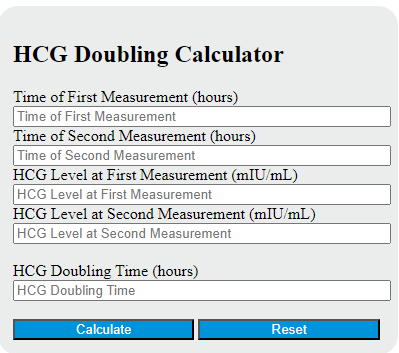
Calculate beta hCG doubling time, half-life, percent change, and estimated 24- and 48-hour change from two quantitative blood test results.
Medical disclaimer: This calculator is for educational purposes only and does not provide medical advice or a diagnosis. hCG values vary widely and must be interpreted by a clinician along with your symptoms, exam findings, and ultrasound/gestational timing. Seek urgent care immediately for severe abdominal/pelvic pain, shoulder pain, dizziness/fainting, or heavy bleeding. Contact your OB/GYN, midwife, or healthcare provider for interpretation.
- Crude Birth Rate Calculator
- All Health and Medical Calculators
- Rmi (Risk Of Malignancy Index) Calculator
HCG Doubling Formula
The HCG Doubling Calculator estimates how quickly a quantitative hCG value changes between two measurements. It uses two hCG results and the elapsed time between them to calculate the estimated doubling time. This is a mathematical growth calculation, so accuracy depends on using consistent time units, consistent hCG units, and the correct elapsed interval between tests.
Where:
- DT = estimated doubling time
- t1 = elapsed time of the first measurement
- t2 = elapsed time of the second measurement
- HCG1 = first hCG measurement
- HCG2 = second hCG measurement
The output keeps the same time unit used for the elapsed measurements. If your times are entered in hours, the doubling time will be in hours. If your times are entered in days, the doubling time will be in days.
What the Formula Is Measuring
Doubling time answers a simple question: how long would it take for the measured value to multiply by two at the observed rate of change? The formula first converts the change between the two hCG values into a growth factor, then uses a base-2 logarithm to determine how many doublings happened during the measured interval.
If the second value is exactly double the first, one full doubling occurred over the interval. If the second value is four times the first, then two doublings occurred over that same interval.
Rearranged Forms
Because the calculator can solve for any missing variable when enough information is known, the same relationship can be rewritten in several useful ways:
How to Calculate HCG Doubling Time
- Choose a time unit and keep it the same for both measurements.
- Enter the elapsed time for the first measurement. If it is the baseline draw, this is often zero.
- Enter the elapsed time for the second measurement using the same unit.
- Enter the first and second quantitative hCG values.
- Calculate the result. The output is the estimated doubling time in your chosen time unit.
| Input Rule | Why It Matters |
|---|---|
| Use elapsed time, not clock time | The formula needs the interval between measurements, not the timestamp shown on the report. |
| Keep one time unit throughout | Mixing hours and days changes the scale of the answer and makes the result unreliable. |
| Use positive hCG values | The logarithm in the formula only works with positive numbers. |
| Make sure the second measurement happens after the first | The interval must move forward in time for the interpretation to make sense. |
| Use the same hCG unit for both values | The calculation compares the second reading to the first as a ratio, so the measurements should be on the same scale. |
How to Read the Result
| Observed Pattern | Mathematical Meaning | Effect on Doubling Time |
|---|---|---|
| The second value is exactly double the first | One full doubling occurred during the interval | The doubling time matches the elapsed interval |
| The second value is more than double the first | More than one doubling occurred during the interval | The doubling time is shorter than the elapsed interval |
| The second value increased but did not double | Less than one full doubling occurred during the interval | The doubling time is longer than the elapsed interval |
| The two values are unchanged | No growth occurred over the interval | The doubling time is undefined because there was no doubling at all |
| The second value is lower than the first | The value decreased instead of increasing | The computed result becomes negative, which represents decline rather than doubling |
Example
Suppose the first hCG measurement is 1,000 at the starting time and the second measurement is 2,000 after 48 hours. The second value is exactly double the first, so the interval contains one full doubling.
The estimated doubling time is 48 hours.
Now suppose the first measurement is 1,000 and the second is 4,000 after 72 hours. That change represents two doublings over the 72-hour interval.
The estimated doubling time is 36 hours.
Common Reasons for Unexpected Results
- Negative result: The second hCG value is lower than the first, so the trend is falling rather than doubling.
- Undefined result: The two hCG values are the same, which makes the denominator zero.
- Very large doubling time: The second value rose only slightly, so the calculation indicates slow growth over the observed interval.
- Strange output after entering valid numbers: The most common cause is inconsistent time units or entering clock times instead of elapsed times.
- Mismatch with lab interpretation: This calculator only performs the math and does not account for clinical context.
Practical Notes
- This calculator is most useful when comparing two quantitative blood hCG measurements taken at different times.
- If you want to compare multiple measurements, calculate the trend between each pair of tests rather than trying to force all values into one interval.
- A shorter doubling time means the measured increase happened more quickly; a longer doubling time means the increase happened more slowly.
- The formula describes the trend between two points only. It does not predict future values with certainty.
Frequently Asked Questions
What does a negative doubling time mean?
A negative value means the second measurement is lower than the first. Mathematically, that indicates decline rather than growth.
Why can the result be undefined?
If the two hCG values are identical, the growth ratio is one. The base-2 logarithm of one is zero, and dividing by zero makes the doubling time undefined.
Can I use hours or days?
Yes. The important part is consistency. Use the same time unit for the first measurement, second measurement, and final result.
Does the calculator diagnose pregnancy health?
No. It is an educational math tool that converts two measurements into a growth-time estimate. Clinical interpretation depends on the full context, including symptoms, timing, imaging, and professional medical evaluation.
Educational use only: this calculator estimates a mathematical trend and should not be used as a diagnosis or as a substitute for medical care.