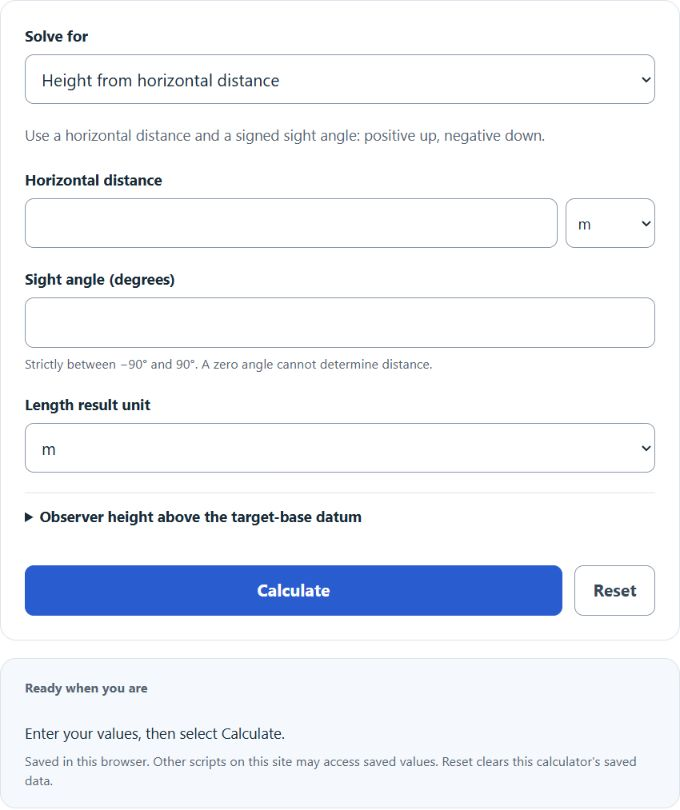
Estimate height or horizontal distance from an angle and measured distance, or find height from two angles and a baseline measurement.
- All Math and Numbers Calculators
- All Distance Calculators
- Vertical Distance Calculator
- Angle of Elevation Calculator
- Distance Angle Calculator
- Line of Sight Calculator
Height Distance Formula
The calculator supports height from horizontal or line-of-sight distance, horizontal distance from known height, a signed sight angle, and height from two angles along a baseline. All length inputs are converted to common units.
Find height (horizontal distance known):
Find height (line-of-sight distance known):
Find the signed sight angle: θ = atan2(H − e, d), converted from radians to degrees.
Find horizontal distance:
Find height from two angles along the same line:
- h = total height of the target above ground
- H = known target height in distance mode
- d = horizontal distance from observer to target base
- s = line-of-sight (slope) distance to target
- θ = angle from eye level to the target (positive up, negative down)
- e = observer eye height above ground
- b = baseline, the distance moved straight toward the target between sightings
- α = angle measured from the farther position
- β = angle measured from the nearer position
Single-station sight angles are strictly between −90° and 90°; elevation is positive and depression is negative. A zero angle cannot determine distance. The two-angle method requires a horizontal baseline, equal observer elevations and 0° < α < β < 90°. Observer height e must be measured above the target-base datum; local eye height alone is insufficient if the ground elevations differ. The target must lie vertically above the measured base. Curvature and refraction are excluded.
Reference Tables
Use these to sanity-check inputs and results before trusting a number.
| Object | Typical height |
|---|---|
| Standard door | 2.0 m / 6.6 ft |
| One residential story | 3.0 m / 10 ft |
| Utility pole | 12 m / 40 ft |
| Mature oak tree | 20 m / 65 ft |
| Five-story building | 15 m / 50 ft |
| Cell tower | 30-60 m / 100-200 ft |
| Angle of elevation | Rise per 100 m horizontal | Rise per 100 ft horizontal |
|---|---|---|
| 5° | 8.7 m | 8.7 ft |
| 15° | 26.8 m | 26.8 ft |
| 30° | 57.7 m | 57.7 ft |
| 45° | 100 m | 100 ft |
| 60° | 173.2 m | 173.2 ft |
| 75° | 373.2 m | 373.2 ft |
Example Problems
Example 1 — Find a tree's height. You stand 25 m from the base of a tree. The angle from eye level to the top is 32°. Your eye height is 1.7 m.
Rise = 25 × tan(32°) = 15.62 m. Total height = 15.62 + 1.7 = 17.32 m.
Example 2 — Find distance to a flagpole. A flagpole is 18 m tall. From eye level (1.6 m), you measure an angle of elevation of 22° to the top.
Distance = (18 − 1.6) / tan(22°) = 16.4 / 0.4040 = 40.6 m.
Example 3 — Two-angle method. You sight the top of a building at 28°, walk 40 m straight toward it, and sight again at 48°. Eye height 1.7 m.
Rise = 40 × tan(28°) × tan(48°) / (tan(48°) − tan(28°)) = 40 × 0.5317 × 1.1106 / (1.1106 − 0.5317) = 40.81 m. Total = 42.5 m.
FAQ
Do I need to enter observer height? Blank means zero: the observer’s horizontal level is then the height datum. Enter the observer’s elevation above the target base to get base-to-top height. On level ground this equals eye height above the ground. A target below the stated base datum is rejected.
What if the target is below me? Enter a negative angle (angle of depression). The result will reflect a downward rise.
Why must the nearer angle be larger in two-angle mode? For a target above eye level, equal eye elevations and a straight horizontal approach, 0° < α < β < 90°. Equal angles are singular; nearly equal angles are very sensitive to measurement error. This method does not model two depression angles.
How accurate is this? Height error depends on angle as well as distance: approximately d × sec²(θ) × angle error in radians. At 50 m, a +1° error changes height by about 0.87 m from 0°, 1.78 m from 45°, and 32.12 m from 80°. Near-vertical sightings, nearly equal two-station angles, leaning targets and offset crowns can produce large errors. This planar model is not a long-range survey correction.
Sources: OpenStax right-triangle trigonometry; NIST length definitions; USDA Forest Service tree-height measurement errors.