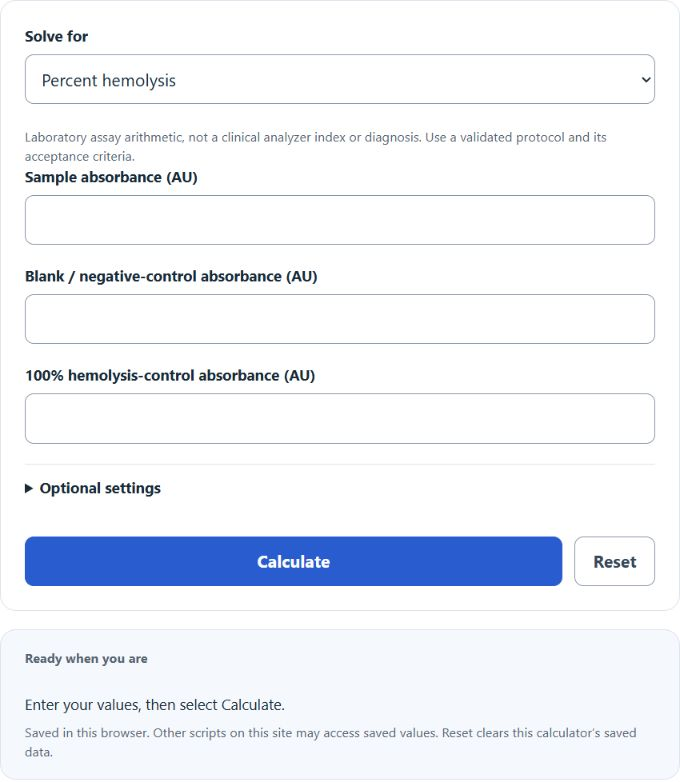
Calculate assay percent hemolysis from sample, blank, and complete-lysis control absorbance, or estimate free hemoglobin with the Harboe/Allen method. The optional acceptance limit must come from your validated protocol; no universal severity categories apply.
- All Health and Medical Calculators
- Concentration from Absorbance Calculator
- Absorbance to Transmittance Calculator
- Percent Transmittance to Absorbance Calculator
- Extinction Coefficient Calculator
- Retic Index Calculator
Hemolysis Index Formula
The following formula is used to calculate a normalized hemolysis index (fractional hemolysis) from a blank/negative control (A2) and a 100% hemolysis positive control (A3). If you want percent hemolysis, multiply the index by 100.
Variables:
- HI is the normalized hemolysis index (fractional hemolysis; unitless, typically 0 to 1). Percent hemolysis = HI × 100.
- A1 is the absorbance of the test sample
- A2 is the absorbance of the blank/negative control sample
- A3 is the absorbance of the 100% hemolysis (positive control) sample
To calculate the hemolysis index, subtract the absorbance of the blank sample from the absorbance of the test sample. Then subtract the absorbance of the blank sample from the absorbance of the 100% hemolysis sample. Divide the first result by the second result to get the hemolysis index (fraction). Multiply by 100 to express the result as percent hemolysis.
What is a Hemolysis Index?
In many in vitro hemolysis assays, a hemolysis index (often reported as percent hemolysis) is a normalized measure of red blood cell lysis based on the sample’s absorbance relative to a blank/negative control and a “100% hemolysis” positive control. Higher values indicate greater measured lysis under compatible assay conditions. Values outside 0–100% are reported without clamping and require review of controls and interference.
Note: Automated clinical chemistry analyzers may also report a “hemolysis index” for patient specimens, but those analyzer indices are instrument- and method-specific and are not calculated from A1/A2/A3 using a prepared 100% hemolysis control. The percent calculation requires the complete-lysis control to exceed the blank; all readings must use compatible wavelength, path and assay conditions. A published assay protocol describes this control-normalized calculation. For the separate Harboe/Allen estimate, free Hb (mg/dL) = 8.36 × (2A415 − A380 − A450) × D / L, where D is total volume divided by sample volume and L is optical path in cm. The coefficient follows the mg/L expression and dilution convention in Chan et al.; this is an assay estimate, not a clinical diagnosis.
How to Calculate Hemolysis Index?
The following steps outline how to calculate the Hemolysis Index (HI).
- First, determine the absorbance of the test sample (A1).
- Next, determine the absorbance of the blank/negative control sample (A2).
- Next, determine the absorbance of the 100% hemolysis (positive control) sample (A3).
- Next, use the formula HI = (A1 – A2) / (A3 – A2) to calculate the hemolysis index (fractional hemolysis).
- Finally, if you need percent hemolysis, multiply HI by 100.
Example Problem:
Use the following variables as an example problem to test your knowledge.
A1 (absorbance of the test sample) = 0.8
A2 (absorbance of the blank sample) = 0.2
A3 (absorbance of the 100% hemolysis sample) = 1.0
HI = (0.8 − 0.2) / (1.0 − 0.2) = 0.6 / 0.8 = 0.75, which corresponds to 75% hemolysis.