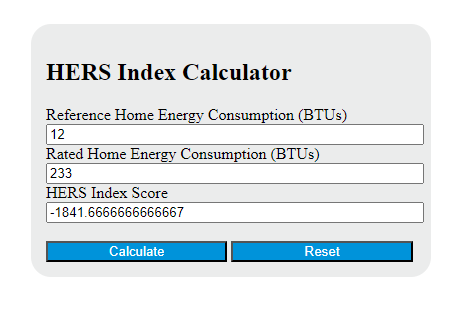
Calculate an estimated HERS Index from rated and reference-home annual energy use, include renewable generation, or solve for a missing energy value.
Related Calculators
- W/m2K To U Value Calculator
- Thermal Mass Calculator
- Baseboard Heat Calculator
- Water Heater Size Calculator
- All Construction Calculators
HERS Index Formula
The HERS Index compares a rated home’s energy consumption to a reference home’s energy consumption. This calculator estimates the score from that ratio, so it is useful for quick comparisons, scenario testing, and solving for one missing value when the other two are known.
Because the score is based on a ratio multiplied by 100, it can be interpreted directly:
- H = 100 means the rated home uses the same amount of energy as the reference home.
- H < 100 means the rated home uses less energy than the reference home.
- H > 100 means the rated home uses more energy than the reference home.
- Lower scores indicate better energy performance.
Variables
- H = HERS Index score
- Erated = energy consumption of the rated home
- Ereference = energy consumption of the reference home
Any consistent energy unit can be used, including BTU, kWh, therms, or MJ. The only requirement is that both energy values use the same unit.
Rearranged Formulas
If you know the score and one energy value, you can solve for the other:
How to Use the Calculator
- Enter the Reference Home Energy Consumption.
- Enter the Rated Home Energy Consumption.
- Leave the third field blank if you want the calculator to solve for the missing value.
- Make sure both energy values are in the same unit before calculating.
How to Interpret the Score
| Score | Meaning |
|---|---|
| 0 | Extremely low net energy use relative to the reference benchmark. |
| 50 | The rated home uses about half as much energy as the reference home. |
| 80 | The rated home uses about 80% of the reference home’s energy. |
| 100 | The rated home matches the reference home’s energy use. |
| 120 | The rated home uses about 20% more energy than the reference home. |
Energy Savings Relative to the Reference Home
If you want to convert the score into an energy reduction percentage, use:
Equivalent form using the two energy values:
For example, a score of 80 corresponds to roughly 20% lower energy use than the reference home.
Example Calculation
If a reference home uses 5,000 BTU and the rated home uses 4,000 BTU, the score is:
This means the rated home uses 80% of the reference home’s energy, or about 20% less energy than the reference benchmark.
Practical Notes
- Do not mix units. If the reference value is in kWh, the rated value must also be in kWh.
- The reference value must be greater than zero. Division by zero is not valid.
- Negative energy values are not meaningful for this calculation.
- Lower is better only because the rated home is using less energy relative to the same benchmark.
- This calculator is best used for quick estimation and comparison. Formal home energy ratings depend on standardized inputs and rating procedures.
Common Questions
- What does a HERS score above 100 mean?
- It means the rated home is using more energy than the reference home.
- What does a HERS score of 100 mean?
- It means the rated home and reference home have equal energy consumption.
- Can I use any energy unit?
- Yes. BTU, kWh, therms, and MJ all work, provided both inputs use the same unit.
- Why is the score dimensionless?
- The units cancel when one energy value is divided by the other, leaving only a scaled index.