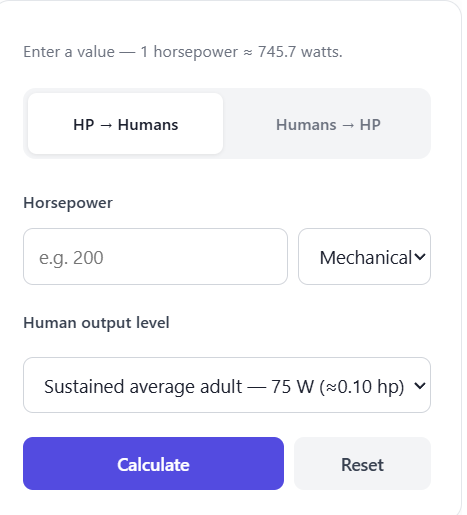
Enter a horsepower value to see how many people it would take to produce the same power output, or enter a number of people to convert their combined effort into horsepower.
Related Calculators
- All Automotive Calculators
- Horsepower To Dog Power Calculator
- Horsepower To Turtle Power Calculator
- Bicycle Horsepower Calculator
Formula
HP → Humans:
N = (HP × Whp) ÷ Wp
Humans → HP:
HP = (N × Wp) ÷ Whp
where N = number of people, HP = horsepower, Whp = watts per horsepower (745.7 mechanical, 735.5 metric, 746 electrical), Wp = sustained watts per person.
Interpretation
The result tells you how many average humans, working at a chosen output level, would be needed to match a given horsepower — or the reverse. The output level matters more than the HP unit. A healthy adult sustains roughly 75–100 W for hours, a trained cyclist holds 250 W for an hour, and short sprint bursts can exceed 1,000 W for a few seconds. Use the higher values only for short durations; for anything over a few minutes, stick near 75–150 W per person.
- ~75 W: All-day sustainable output for an average adult.
- 100–150 W: Steady manual labor or a fit amateur cyclist.
- 250–400 W: Trained-athlete output, minutes to an hour.
- 1,000+ W: Peak sprint, sustainable for seconds only.
Quick Reference Table
| Horsepower | Watts | People at 75 W | People at 150 W |
|---|---|---|---|
| 1 hp | 745.7 W | ~10 | ~5 |
| 10 hp | 7,457 W | ~99 | ~50 |
| 100 hp | 74,570 W | ~994 | ~497 |
| 200 hp | 149,140 W | ~1,989 | ~994 |
| 500 hp | 372,850 W | ~4,971 | ~2,486 |
FAQ
Is one horsepower really the power of one horse or one person?
Neither, strictly. James Watt defined horsepower from draft-horse work rates, and it equals roughly 10 sustained humans at 75 W — not one. A real horse can briefly produce 10–15 hp in a peak burst.
Which horsepower unit should I pick?
Use mechanical (745.7 W) for U.S. automotive and general use, metric (735.5 W, also called PS or CV) for European car specs, and electrical (746 W) for motor nameplates. For this conversion the difference is under 1.5%.
Why do my numbers change so much when I switch human output levels?
Because sustainable human power spans more than an order of magnitude — from about 75 W all day to over 1,000 W for seconds. Match the level to the duration you care about, or the result will be misleading.
Can a group of people actually replace an engine?
Only on paper. Humans can't synchronize like pistons, lose efficiency quickly, and need food, rest, and cooling. The conversion is useful for intuition and comparisons, not for practical propulsion.