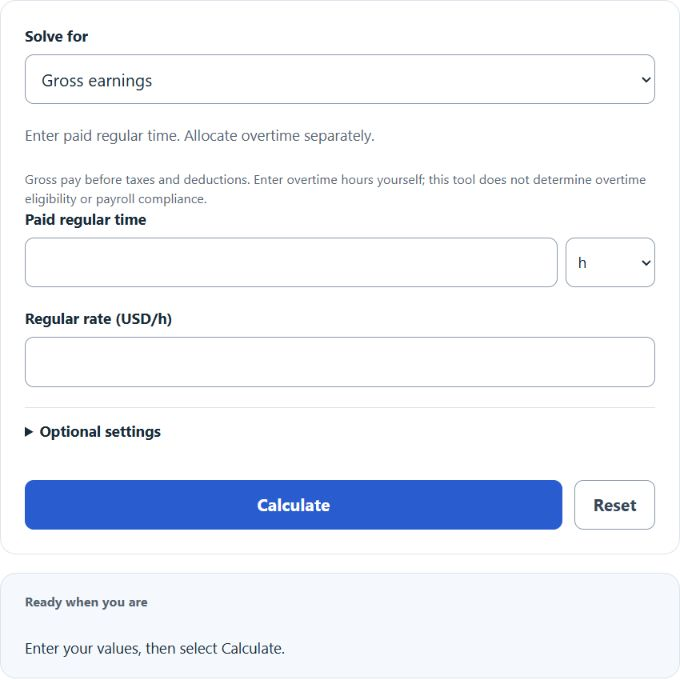
Select gross earnings, regular hours, regular rate, overtime hours or overtime rate to find. Enter paid regular time and allocate overtime separately. Hourly to salary estimates weekly, average monthly and annual gross pay using your paid weeks per year.
| Hours to Earnings | Earnings to Hours |
|---|---|
| 1 hr = $15.00 | $50 = 3.33 hrs |
| 2 hrs = $30.00 | $100 = 6.67 hrs |
| 4 hrs = $60.00 | $200 = 13.33 hrs |
| 8 hrs = $120.00 | $300 = 20.00 hrs |
| 10 hrs = $150.00 | $500 = 33.33 hrs |
| 20 hrs = $300.00 | $750 = 50.00 hrs |
| 40 hrs = $600.00 | $1,500 = 100.00 hrs |
| E = H x R | |
| Hours to Earnings | Earnings to Hours |
|---|---|
| 1 hr = $20.00 | $50 = 2.50 hrs |
| 2 hrs = $40.00 | $150 = 7.50 hrs |
| 4 hrs = $80.00 | $250 = 12.50 hrs |
| 8 hrs = $160.00 | $500 = 25.00 hrs |
| 10 hrs = $200.00 | $1,000 = 50.00 hrs |
| 20 hrs = $400.00 | $2,000 = 100.00 hrs |
| 40 hrs = $800.00 | $4,000 = 200.00 hrs |
| E = H x R | |
- All Personal Finance Calculators
- Man Hours To Man Days Calculator
- Hours To Units Calculator
- Billing Time Rounding Comparison Calculator
- Work Hours Allocation Calculator
Watch the full explainer with transcript and worked examples.
Hours To Money Formula
Multiply total hours worked by the hourly rate to get gross earnings:
E = gross earnings ($), H = paid hours, R = hourly rate ($/hr). For covered, nonexempt employees, federal overtime generally requires at least 1.5 times the regular rate for hours worked over 40 in a workweek. Exceptions and higher state standards may apply. This calculator uses your entered regular and overtime allocation:
E = (Regular Hours x R) + (Overtime Hours x 1.5R)
Example: 45 hrs at $20/hr = (40 x $20) + (5 x $30) = $800 + $150 = $950 gross
US Median Hourly Wages by Occupation
| Occupation | Median Hourly | Annual equivalent (hourly x 2,080) |
|---|---|---|
| Software Developer | $63.59/hr | $132,267/yr |
| Registered Nurse | $41.38/hr | $86,070/yr |
| Accountant / Auditor | $38.41/hr | $79,893/yr |
| Electrician | $29.61/hr | $61,589/yr |
| Truck Driver (Heavy) | $26.12/hr | $54,330/yr |
| All US Occupations (median) | $23.11/hr | $48,069/yr |
| Construction Laborer | $21.78/hr | $45,302/yr |
| Retail Salesperson | $16.19/hr | $33,675/yr |
| Food Preparation Worker | $15.59/hr | $32,427/yr |
| Federal Minimum Wage | $7.25/hr | $15,080/yr |
| Sources: BLS OEWS May 2023 historical median hourly wages. Annual equivalents use the displayed hourly rate x 2,080 hours, rounded to dollars; they are not separate BLS annual medians. Federal minimum wage is $7.25/hr, effective July 24, 2009. Many states have higher minimum wages. | ||
Work Hours Required to Cover Monthly Expenses
At an illustrative gross wage of $22/hr, these example monthly expenses can be expressed in work hours. The amounts are assumptions, not national averages. Gross hours exclude income tax deductions.
| Monthly Expense | Example Monthly Cost | Gross Work Hours | Work Days (8-hr) |
|---|---|---|---|
| Rent | $2,000 | 90.9 hrs | 11.4 days |
| Groceries | $519 | 23.6 hrs | 3.0 days |
| Transportation (car, gas, insurance) | $537 | 24.4 hrs | 3.1 days |
| Utilities (electric, gas, water) | $370 | 16.8 hrs | 2.1 days |
| Total (rent + food + transport + utilities) | $3,426 | 155.7 hrs | 19.5 days |
| Illustrative assumptions, not measured national averages. A 40-hour week over 52 paid weeks averages 173.3 hrs/month and $3,813 gross/month at $22/hr. These example expenses consume about 90% of gross before taxes. | |||
Effective Hourly Rate
Your nominal hourly rate covers paid hours. These illustrative scenarios include unpaid commute and preparation time in the total time spent, reducing the effective rate without changing gross pay:
| Scenario | Extra Daily Time | Total Hrs/Day | Effective Rate | Annualized Rate Difference |
|---|---|---|---|---|
| Remote, no commute | 0 min | 8.0 hrs | $22.00/hr | $0/yr |
| Short commute + prep (45 min) | 45 min | 8.75 hrs | $20.11/hr | $3,922/yr |
| Commute + prep (75 min) | 75 min | 9.25 hrs | $19.03/hr | $6,184/yr |
| Long commute + prep (2 hrs) | 120 min | 10.0 hrs | $17.60/hr | $9,152/yr |
| Formula: Effective rate = (8 paid hrs x nominal rate) / total daily hrs. Annualized rate difference = (nominal – unrounded effective rate) x 2,080 hrs, rounded to dollars. This illustrative comparison does not reduce actual gross pay; commute and prep times are example assumptions. | ||||