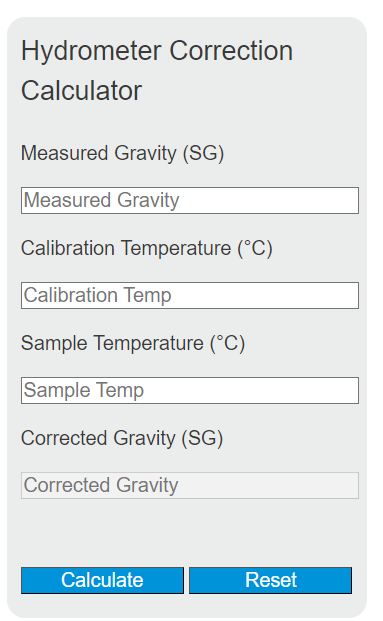
Correct hydrometer specific gravity or Brix readings for sample temperature, reverse the adjustment, and see correction factors and thermometer sensitivity.
Related Calculators
- Percentage Strength Calculator
- Mole Percent to Weight Calculator
- Volume Fraction Calculator
- Molarity to Weight Percent Calculator
- All Chemistry Calculators
Hydrometer Correction Formula
A hydrometer reading is only exact at the instrument’s calibration temperature. If the sample is warmer or cooler than that reference point, the observed specific gravity should be adjusted to estimate the gravity at the calibration temperature. This is especially useful in brewing when recording original gravity, final gravity, attenuation, and alcohol estimates.
In this calculator, the temperature-correction function is:
The polynomial uses temperature in degrees Fahrenheit. If your measurements are in Celsius, convert first:
As a rule of thumb, when the sample is warmer than the hydrometer’s calibration temperature, the corrected gravity will usually be slightly higher than the raw reading. When the sample is cooler, the corrected gravity will usually be slightly lower.
Variable Meanings
| Term | Meaning |
|---|---|
| Measured Gravity | The specific gravity read directly from the hydrometer at the sample’s actual temperature. |
| Calibration Temperature | The reference temperature printed for the hydrometer. Common brewing hydrometers are calibrated near 60°F or 68°F. |
| Sample Temperature | The temperature of the liquid at the moment the reading is taken. |
| Corrected Gravity | The adjusted specific gravity after compensating for the temperature difference between the sample and the hydrometer calibration point. |
How to Calculate Corrected Gravity
- Take the hydrometer reading from the sample and record the measured gravity.
- Find the calibration temperature marked for the hydrometer.
- Measure the actual sample temperature.
- Convert the temperatures to Fahrenheit if they were recorded in Celsius.
- Evaluate the temperature-correction function at the sample temperature and again at the calibration temperature.
- Multiply the measured gravity by the ratio of those two correction values to get the corrected gravity.
Example Calculation
Suppose the observed gravity is 1.050, the hydrometer is calibrated to 68°F, and the sample temperature is 77°F. The corrected gravity is:
Evaluating the correction function gives approximately:
That change looks small, but even a difference of one gravity point can matter when comparing batches, tracking fermentation performance, or calculating efficiency.
How to Interpret the Result
| Condition | Expected Effect |
|---|---|
| Sample warmer than calibration temperature | Corrected gravity is usually higher than the observed reading. |
| Sample cooler than calibration temperature | Corrected gravity is usually lower than the observed reading. |
| Sample very close to calibration temperature | Correction is usually small, but using the adjusted value keeps records consistent. |
| Large temperature difference | The adjustment becomes more important, and overall reading uncertainty also tends to increase. |
When This Calculator Is Most Useful
- Checking original gravity on wort that has not fully cooled to the hydrometer calibration temperature
- Comparing final gravity readings taken on different days at different room temperatures
- Logging brewing data consistently across batches
- Reducing small temperature-driven errors before estimating attenuation or alcohol content
Tips for Better Hydrometer Readings
- Whenever possible, cool the sample close to the hydrometer’s calibration temperature before reading.
- Read the scale at eye level to reduce parallax error.
- Gently spin the hydrometer in the test jar to help remove clinging bubbles.
- Degas carbonated or actively fermenting samples before taking a reading.
- Use a clean test jar and a representative sample of the liquid.
- Confirm that your instrument is a specific gravity hydrometer and not a different scale such as Plato or Brix.
Important Scope Note
This correction model is intended for water-based brewing solutions such as wort and beer. It is useful for normal brewing hydrometer temperature adjustment, but it is not a universal correction for every liquid or every hydrometer type. Specialty hydrometers used for other fluids may require different correction methods.
Common Questions
Do I need to correct every hydrometer reading?
Not always, but it is a good habit whenever the sample temperature is not the same as the calibration temperature. Even small corrections improve consistency in brewing records.
Why does temperature affect specific gravity readings?
Because liquid density changes with temperature. A warmer sample is less dense than the same sample at the calibration point, so the hydrometer floats differently and the raw reading shifts.
Can temperature correction fix a poor sample?
No. Temperature correction only adjusts for the effect of temperature. It does not fix bubbles, foam, carbonation, contamination, or an incorrect meniscus reading.
What if my hydrometer is calibrated in Celsius?
Use the actual calibration value marked on the hydrometer. The calculator can still apply the same correction after converting the temperatures to the form required by the equation.