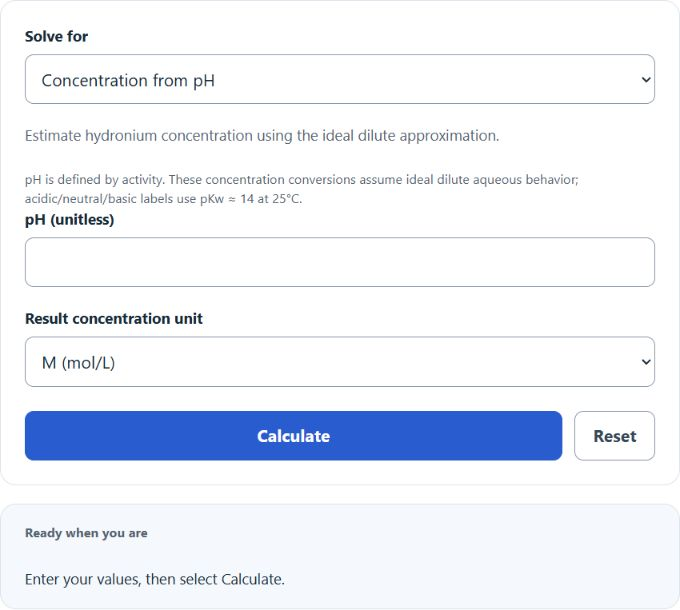
Calculate hydronium ion concentration from pH or find pH from [H3O+] in M, mM, or μM, with acidic, neutral, or basic classification under an ideal aqueous 25°C assumption.
Hydronium Ion Concentration Formula
Hydronium ion concentration, written as [H3O+], is related to aqueous acidity. Formally, pH is the negative base-10 logarithm of hydrogen-ion activity. This calculator approximates activity by concentration relative to 1 mol/L for ideal dilute solutions, converting in either direction. In this approximation, a 1-unit pH change corresponds to a tenfold concentration change.
If the hydronium ion concentration is already known, the inverse relationship is used to find pH:
For ideal dilute aqueous solutions at 25°C, the usual approximations relate pH, pOH, and the concentration ion-product of water. Neutrality is approximately pH 7 at this temperature and changes with temperature:
What the Variables Mean
- [H3O+] = hydronium ion concentration
- pH = negative base-10 logarithm of hydrogen-ion activity; here approximated from hydronium concentration relative to 1 mol/L
- M = mol/L, or moles per liter
- mM = millimolar
- µM = micromolar
How to Calculate Hydronium Ion Concentration from pH
- Identify the pH of the solution.
- Place the pH value in the exponent with a negative sign.
- Raise 10 to that power.
- Express the result in molarity, millimolar, or micromolar as needed.
This process is useful in acid-base chemistry, titrations, buffer calculations, water quality analysis, biology, and lab preparation.
How to Calculate pH from Hydronium Ion Concentration
- Enter the hydronium concentration in molarity.
- Take the base-10 logarithm of the concentration.
- Apply a negative sign to the result.
- The final value is the solution pH.
Because the pH scale is logarithmic, small numerical changes in pH correspond to large concentration changes. A solution with pH 4 has ten times more hydronium ions than a solution with pH 5, and one hundred times more than a solution with pH 6.
Examples
Example 1: Converting pH to hydronium concentration
If a solution has a pH of 3.25, the concentration is:
That same value can be written in millimolar form as:
Example 2: Converting hydronium concentration to pH
If the solution has a hydronium concentration of 2.0 × 10⁻⁵ M, then:
Quick Reference Values
| pH | Approximate [H3O+] | General Interpretation |
|---|---|---|
| 1 | 0.1 M | Strongly acidic |
| 3 | 1 × 10⁻³ M | Acidic |
| 5 | 1 × 10⁻⁵ M | Acidic |
| 7 | 1 × 10⁻⁷ M | Neutral at 25°C |
| 9 | 1 × 10⁻⁹ M | Basic |
| 11 | 1 × 10-11 M | Basic |
| 13 | 1 × 10-13 M | Strongly basic |
Why Hydronium Concentration Matters
- Chemistry: describes solution acidity and reaction conditions; concentration alone does not determine an acid’s intrinsic strength
- Biology: pH-sensitive enzymes and cellular processes depend on it
- Environmental science: water and soil acidity affect ecosystems
- Industrial processes: cleaning, manufacturing, and formulation often require strict pH control
- Laboratory work: buffer preparation and titration calculations rely on accurate concentration values
Common Mistakes
- Forgetting the negative sign in the exponent when converting pH to concentration
- Using the natural logarithm instead of the base-10 logarithm when calculating pH
- Confusing units such as M, mM, and µM
- Assuming pH changes linearly instead of logarithmically
- Entering concentration values without scientific notation when the number is very small
Practical Notes
In many introductory chemistry problems, [H+] and [H3O+] are treated as equivalent for dilute aqueous solutions. Real solutions can deviate from ideal behavior, especially at high concentrations, but the formulas above are the standard approach for most classroom, laboratory, and general calculation purposes.