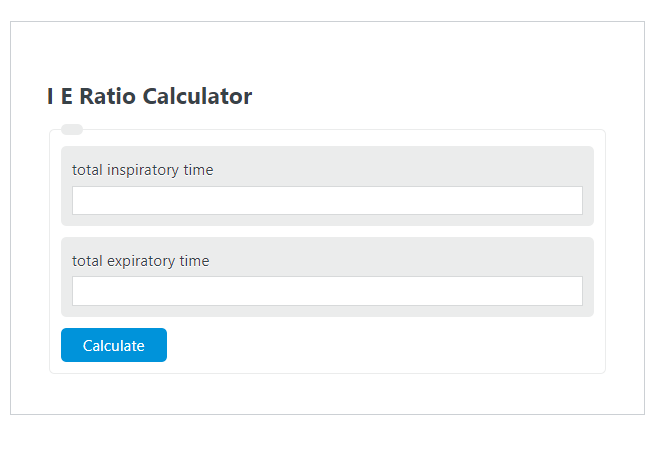
Calculate inspiratory-to-expiratory ratio and related breath-cycle timing from the mode-specific values you enter. The result is educational arithmetic and does not recommend ventilator settings.
I:E Ratio Formula
The inspiratory-to-expiratory ratio compares total inspiratory time with expiratory time during one breath cycle. Let RR be respiratory rate in breaths per minute, Tcycle be the full cycle time, Ti be total inspiratory time, and Te be expiratory time. All time values are handled in seconds:
For any target ratio written I:E = a:b, both parts must appear in the general formula:
The inspiratory duty cycle is 100 × Ti ÷ Tcycle, and the expiratory duty cycle is 100 × Te ÷ Tcycle. The decimal form is Ti ÷ Te. These are mathematical descriptions of timing, not recommendations for a ventilator setting.
What Inspiratory and Expiratory Time Mean
Ti in a complete breath-timing calculation means the total time assigned to inspiration. Depending on the ventilation mode and device display, that total may include an inspiratory pause after flow has stopped. Inspiratory flow time and total inspiratory time are therefore not always interchangeable. Te is the time from the end of inspiration to the start of the next inspiration under the selected timing definition.
Confirm what the device or source means by Ti before copying a number. A ratio computed from flow time alone may not match a ventilator display that includes a pause. Trigger delay, patient effort, spontaneous cycling, and breath-to-breath variation can also make a single set of entered times an incomplete representation of the waveform.
How to Use the I:E Ratio Calculator
- Respiratory rate + Ti: enter breaths per minute and total inspiratory time in seconds. Ti must be shorter than the calculated full cycle. The calculator solves Te and the ratio.
- Respiratory rate + target I:E: enter RR and both positive ratio parts. The calculator allocates the cycle between inspiration and expiration without assuming that the I part equals 1.
- Direct Ti + Te: enter both positive times in seconds. The calculator adds them for cycle time, calculates RR, and displays the normalized ratio and duty cycles.
Keep the computed Ti and Te visible when reviewing a result. A rounded colon ratio can hide small differences in the underlying durations. If an input came from a ventilator, also document the mode, flow pattern, pause definition, and whether the breath was mandatory, assisted, or spontaneous.
Worked Example: Respiratory Rate and Ti
At 20 breaths per minute, the full cycle lasts 60 ÷ 20 = 3.0 seconds. If total Ti is 0.8 seconds, Te is:
Dividing both ratio parts by 0.8 gives approximately 1:2.75. The inspiratory duty cycle is 0.8 ÷ 3.0 × 100 = 26.67%. These values reproduce the entered timing; they do not determine whether the timing is appropriate for a patient.
Worked Example: Arbitrary Target Ratio
At RR 15 breaths per minute, cycle time is 4 seconds. For a mathematical target of 2:1, use both ratio parts:
This example demonstrates why the shortcut Ti = Tcycle ÷ (1 + E) works only when the inspiratory ratio part is exactly 1. It would calculate the wrong allocation for 2:1, 2:3, or another arbitrary pair.
Decimal Ratio, Colon Ratio, and Duty Cycle
A colon ratio and a decimal ratio express the same relationship in different forms. For I:E = 1:2, Ti ÷ Te = 0.5. If Ti is one second and Te is two seconds, the full cycle is three seconds, so the inspiratory duty cycle is 33.33% and the expiratory duty cycle is 66.67%. Rounding may make the two displayed percentages total 99.99% or 100.01%; the calculator uses unrounded values internally.
When Ti exceeds Te, this page normalizes the display around the shorter side and identifies an inverse timing pattern. For example, Ti 2 seconds and Te 1 second appears as 2:1. “Inverse” describes the numerical relationship only. It does not establish a reason for using that pattern or assess its risks.
Clinical Context Without Prescribing Settings
I:E ratio cannot be evaluated in isolation. Timing interacts with ventilation mode, inspiratory flow and waveform, resistance, compliance, patient effort, synchrony, respiratory rate, tidal volume, and pressures. Expiratory flow may or may not return to baseline before the next breath. That information comes from the patient and waveforms, not from the colon ratio alone.
Patient-ventilator assessment also considers gas exchange, plateau pressure, PEEP and auto-PEEP, hemodynamic effects, comfort, and the clinical objective. A mathematically longer expiratory time does not prove complete emptying, and a particular ratio does not prove adequate ventilation or prevent air trapping. Conversely, prolonged inspiration may be used only in defined contexts with close assessment. Setting changes require qualified clinical judgment and applicable local protocols.
The calculator also cannot reconstruct a waveform from summary values. Two breaths with identical Ti and Te may have different peak flows, pressure profiles, pauses, leaks, triggers, or patient efforts. In a spontaneous or assisted mode, measured timing may change from breath to breath rather than follow one fixed cycle. Use the result to check arithmetic or translate timing formats, then return to the actual patient, device definitions, and displayed waveforms for clinical assessment.
Common Input Errors
- Entering inspiratory flow time when total Ti includes an inspiratory pause.
- Entering milliseconds as though they were seconds.
- Typing a colon expression such as “1:2” into one numeric ratio-part field.
- Using Ti equal to or longer than the cycle calculated from RR, which leaves no positive Te.
- Relying on a rounded ratio while ignoring the displayed Ti and Te.
- Assuming a displayed timing relationship is a patient-specific prescription.
Frequently Asked Questions
Is 1:2 universally normal or recommended?
No. It is a familiar mathematical example, not a universal target. Appropriate timing depends on the patient, ventilation mode, mechanics, waveform findings, and clinical goals.
How does an inspiratory pause affect the ratio?
If the selected mode or device includes the pause in total inspiration, it increases Ti and decreases the time remaining for expiration at the same RR. Verify the device definition before calculating.
Can I:E ratio show air trapping?
No. The ratio gives scheduled durations. Evaluating incomplete exhalation or auto-PEEP requires patient assessment and waveform or measurement data.
Why does the ventilator show a slightly different ratio?
The device may use greater internal precision, a different Ti definition, real-time measured timing, or different rounding. Compare the actual Ti and Te definitions before treating the displays as inconsistent.
What does inverse ratio mean?
It means inspiratory time is numerically longer than expiratory time, such as 2:1. The label alone does not indicate appropriateness or safety.
Medical note: This calculator provides educational timing arithmetic and must not be used as a ventilator-setting prescription or a substitute for skilled bedside assessment.
Primary and current sources: 2024 AARC Patient-Ventilator Assessment clinical practice guideline; the AARC clinical practice guideline index; evidence-based invasive-ventilation guideline; and the NHLBI ARDSNet/FACTT protocol as historical protocol context rather than a universal target.