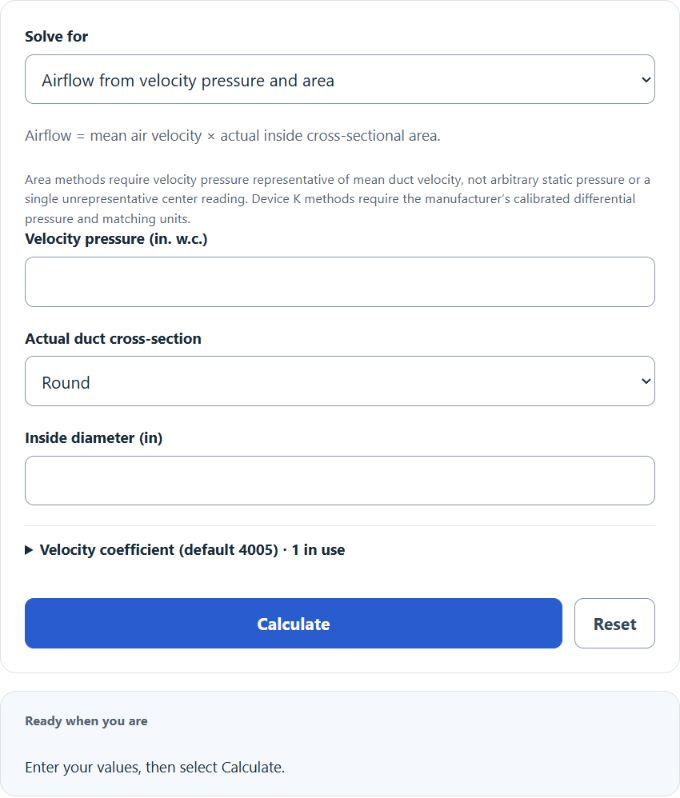
Calculate airflow, velocity pressure, or air velocity using actual duct area and representative velocity pressure. Device-coefficient modes instead use a manufacturer-calibrated differential pressure.
Inches of Water to CFM Formula
The core equation relating velocity pressure to volumetric air flow through a round duct is:
Where CFM is cubic feet per minute, d is the round duct’s inside diameter in inches, and Pv is velocity pressure in inches of water column (in. WC). The division by 576 converts d2 from square inches to square feet (576 = 242, since 1 ft2 = 144 in2 and the area formula includes pi/4, so the net divisor for pi*d2 is 576).
The formula breaks into two components: cross-sectional duct area (in ft2) multiplied by air velocity (in ft/min). The velocity term, V = 4005 x sqrt(Pv), is derived from Bernoulli’s equation for incompressible flow and assumes standard air conditions.
Velocity Pressure vs. Static Pressure
A common mistake in this conversion is confusing static pressure with velocity pressure. These are distinct quantities in duct airflow, and only velocity pressure relates directly to air speed.
Static pressure (Ps) acts equally in all directions and represents the resistance to airflow from friction against duct walls, fittings, filters, coils, and other obstructions. HVAC technicians measure static pressure to evaluate total system resistance. Typical residential systems operate below 0.5 in. WC total external static pressure.
Velocity pressure (Pv) is the nonnegative dynamic pressure associated with air speed. Area modes use velocity pressure, not arbitrary static pressure. Device K modes use the pressure difference specified by the device manufacturer.
Total pressure (Pt) is the sum of the two: Pt = Ps + Pv. A pitot-static tube inserted into a duct measures total pressure on its forward-facing port and static pressure on its side ports. The difference between these readings gives velocity pressure directly.
Where the 4005 Constant Comes From
The constant 4005 is not arbitrary. It is derived from Bernoulli’s equation applied to air at standard conditions: 70 degrees F, 29.92 in. Hg barometric pressure, and a resulting density of 0.075 lb/ft3. Starting from V = sqrt(2 * gc * Pv / rho), where gc is the gravitational constant (32.174 ft*lbm/(lbf*s2)) and pressure is converted from inches of water to lb/ft2 (1 in. WC = 5.1922 lb/ft2), the full calculation yields:
V = sqrt(2 x 32.174 x 5.1922 / 0.075) x 60 = approximately 4005 ft/min per sqrt(in. WC).
The factor of 60 converts from ft/s to ft/min. This constant is valid only at standard air density. At higher altitudes or temperatures, air is less dense and the constant increases, meaning the same velocity pressure corresponds to higher actual air speed.
Air Density Correction Factors
When conditions differ from standard air (70 degrees F, sea level), the 4005 constant must be adjusted. The corrected velocity factor is Kcorrected = 4005 x sqrt(0.075 / rhoactual). The table below provides correction multipliers for common conditions. Multiply 4005 by the factor to get the adjusted constant.
| Elevation (ft) | Barometric (in. Hg) | Air Density (lb/ft3) | Correction Factor | Adjusted K |
|---|---|---|---|---|
| 0 (sea level, 70 F) | 29.92 | 0.0750 | 1.000 | 4,005 |
| 0 (sea level, 100 F) | 29.92 | 0.0710 | 1.028 | 4,116 |
| 1,000 | 28.86 | 0.0723 | 1.019 | 4,079 |
| 2,000 | 27.82 | 0.0697 | 1.037 | 4,154 |
| 3,000 | 26.82 | 0.0672 | 1.056 | 4,231 |
| 4,000 | 25.84 | 0.0647 | 1.077 | 4,312 |
| 5,000 | 24.90 | 0.0624 | 1.096 | 4,391 |
| 6,000 | 23.98 | 0.0601 | 1.117 | 4,474 |
| 7,000 | 23.09 | 0.0578 | 1.139 | 4,562 |
| 8,000 | 22.22 | 0.0557 | 1.160 | 4,647 |
| 10,000 | 20.58 | 0.0516 | 1.206 | 4,828 |
| Density values at 70 F unless noted. Correction = sqrt(0.075 / actual density). | ||||
For example, an HVAC system at 5,000 ft elevation in Denver would use K = 4390 instead of 4005, resulting in approximately 9.6% higher calculated velocity for the same velocity pressure reading.
CFM Reference Table by Duct Diameter
The table below shows calculated CFM values across multiple common round duct diameters and velocity pressures. All values use K = 4005 (standard air).
| Pv (in. WC) | Velocity (FPM) | 6 in. | 8 in. | 10 in. | 12 in. | 14 in. | 16 in. | 18 in. | 24 in. |
|---|---|---|---|---|---|---|---|---|---|
| 0.05 | 896 | 176 | 313 | 488 | 703 | 957 | 1,250 | 1,583 | 2,813 |
| 0.10 | 1,266 | 249 | 442 | 691 | 995 | 1,354 | 1,768 | 2,238 | 3,979 |
| 0.15 | 1,551 | 305 | 541 | 846 | 1,218 | 1,658 | 2,166 | 2,741 | 4,873 |
| 0.20 | 1,791 | 352 | 625 | 977 | 1,407 | 1,915 | 2,501 | 3,165 | 5,627 |
| 0.25 | 2,003 | 393 | 699 | 1,092 | 1,573 | 2,141 | 2,796 | 3,539 | 6,291 |
| 0.30 | 2,194 | 431 | 766 | 1,196 | 1,723 | 2,345 | 3,063 | 3,876 | 6,891 |
| 0.40 | 2,533 | 497 | 884 | 1,382 | 1,989 | 2,708 | 3,537 | 4,476 | 7,958 |
| 0.50 | 2,832 | 556 | 989 | 1,545 | 2,224 | 3,027 | 3,954 | 5,004 | 8,897 |
| 0.75 | 3,468 | 681 | 1,211 | 1,892 | 2,724 | 3,708 | 4,843 | 6,129 | 10,896 |
| 1.00 | 4,005 | 786 | 1,398 | 2,184 | 3,146 | 4,281 | 5,592 | 7,077 | 12,582 |
| 1.50 | 4,905 | 963 | 1,712 | 2,675 | 3,852 | 5,244 | 6,849 | 8,668 | 15,410 |
| 2.00 | 5,664 | 1,112 | 1,977 | 3,089 | 4,448 | 6,055 | 7,908 | 10,009 | 17,794 |
| 3.00 | 6,937 | 1,362 | 2,421 | 3,783 | 5,448 | 7,416 | 9,686 | 12,258 | 21,793 |
| 4.00 | 8,010 | 1,573 | 2,796 | 4,369 | 6,291 | 8,563 | 11,184 | 14,155 | 25,164 |
| CFM rounded to the nearest whole number. Formula: CFM = (pi * d2 / 576) x 4005 x sqrt(Pv). | |||||||||
Illustrative Duct Velocities by Application
Duct velocity selection depends on noise, pressure losses, system use and applicable design requirements. The following retained velocity ranges are illustrative examples, not verified ASHRAE or SMACNA recommendations. The pressure column is calculated from each listed main-duct range using Pv = (V/4005)²; it is not a static-pressure limit.
| Application | Main Ducts (FPM) | Branch Ducts (FPM) | Approx. Pv Range (in. WC) |
|---|---|---|---|
| Residential | 600 – 900 | 400 – 600 | 0.022 – 0.050 |
| Commercial offices, libraries | 1,000 – 1,300 | 600 – 900 | 0.062 – 0.105 |
| Retail, restaurants | 1,200 – 1,500 | 800 – 1,000 | 0.090 – 0.140 |
| Industrial / manufacturing | 1,500 – 2,500 | 1,000 – 1,800 | 0.140 – 0.390 |
| Dust collection (woodworking) | 3,500 – 4,500 | 3,500 – 4,000 | 0.764 – 1.262 |
| Fume exhaust (welding, lab hoods) | 2,000 – 3,000 | 1,500 – 2,500 | 0.249 – 0.561 |
Select duct velocities and friction rates through the applicable design method and equipment requirements. This calculator does not establish acceptable noise, transport velocity, ventilation or system performance.
Measuring Velocity Pressure in the Field
Velocity pressure is measured with a pitot-static tube connected to a differential manometer. The pitot tube has two ports: a forward-facing hole that reads total pressure and side holes that read static pressure. The manometer displays the difference, which equals velocity pressure.
Pitot geometry, minimum usable pressure and required measurement locations depend on the instrument and applicable procedure. Follow its documentation; at low velocities a suitable alternative instrument may be needed. This calculator does not validate a measurement setup.
A single center-of-duct reading may not represent the mean velocity. Follow the applicable instrument and traverse procedure. Convert each measured velocity pressure to velocity first, then average the velocities with the required weighting and multiply by actual cross-sectional area. Averaging pressures before taking the square root gives a different, generally incorrect result.
Rectangular Duct Equivalent Diameters
For rectangular airflow calculations, select Rectangular and enter actual inside width and height: area = width × height / 144 ft² when dimensions are in inches. The equal-friction equivalent diameter below serves a separate duct-resistance comparison; do not substitute its round area for the actual rectangular airflow area.
deq = 1.30 x (a x b)0.625 / (a + b)0.250
Where a and b are the rectangular duct dimensions in inches. This equivalent diameter produces the same friction loss per unit length, not the same cross-sectional area. The table below provides common rectangular-to-round equivalents.
| Rectangular (in.) | Equivalent Round (in.) | Area Rect. (in.2) | Area Round (in.2) |
|---|---|---|---|
| 8 x 6 | 7.6 | 48 | 45 |
| 10 x 8 | 9.8 | 80 | 75 |
| 12 x 8 | 10.7 | 96 | 89 |
| 12 x 10 | 12.0 | 120 | 112 |
| 14 x 8 | 11.5 | 112 | 103 |
| 16 x 10 | 13.7 | 160 | 148 |
| 16 x 12 | 15.1 | 192 | 179 |
| 18 x 12 | 16.0 | 216 | 201 |
| 20 x 12 | 16.8 | 240 | 222 |
| 24 x 12 | 18.3 | 288 | 262 |
| 24 x 16 | 21.3 | 384 | 357 |
| 24 x 24 | 26.2 | 576 | 541 |
| 30 x 18 | 25.2 | 540 | 499 |
| 36 x 24 | 32.0 | 864 | 803 |
| Equivalent round diameter based on equal friction loss, per ASHRAE. deq = 1.30 x (a*b)0.625 / (a+b)0.250. | |||
The displayed equal-friction correlation compares resistance for equal airflow and length. Its equivalent round area is not the rectangular cross-sectional area; use the actual rectangular area when multiplying by mean velocity.
FAQ
Can you convert static pressure directly to CFM?
No. Static pressure measures resistance to flow, not air velocity. You cannot derive air speed from static pressure alone. The conversion requires velocity pressure, which is the portion of total pressure attributable to kinetic energy. In a duct, velocity pressure = total pressure minus static pressure. If you only have a static pressure reading from a system gauge, you would need additional information (such as fan curve data or duct geometry) to estimate airflow.
Why does the same velocity pressure give different CFM for different duct sizes?
At a fixed air density and coefficient, representative velocity pressure determines air speed, while airflow also depends on actual area. Doubling round diameter quadruples area and CFM for the same mean velocity. A single local pressure measurement need not represent mean duct velocity.
When do I need to apply the altitude/temperature correction?
The standard velocity coefficient C = 4005 assumes air density about 0.075 lb/ft³. Correct it when actual density differs: C = 4005 × sqrt(0.075/rho). Use a coefficient appropriate to the measurement units and conditions. In the illustrative 5,000 ft row, the corrected velocity is about 9.6% above the standard-coefficient result.
Is this formula valid for flexible duct?
The area × mean-velocity relationship also applies to flexible ducts when actual area and representative velocity are known. Compression, bends and sag affect area, flow profile and resistance; use applicable measurements and design guidance rather than an assumed universal friction multiplier.