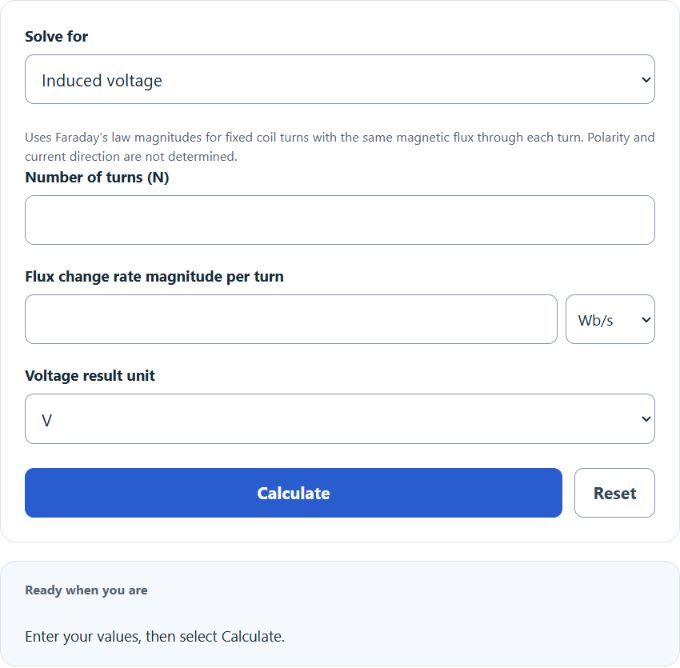
Choose induced voltage, number of turns, or flux change rate per turn to solve using Faraday’s law magnitudes, with V or mV and Wb/s or mWb/s units.
Related Calculators
- Inductor Voltage Spike Calculator
- 3 Phase Ohms Law Calculator
- Capacitor Ripple Calculator
- Bypass Capacitor Calculator
- All Physics Calculators
Induced Voltage Formula
The calculator uses Faraday’s law in magnitude form for fixed turns experiencing equal magnetic flux. Choose the quantity to solve, then enter the other two values.
- E = induced voltage, in volts (V)
- N = number of coil turns
- dΦ/dt = magnitude of the rate of change of magnetic flux per turn, in webers per second (Wb/s)
The calculator treats induced voltage as a nonnegative magnitude. In full Faraday’s law, the negative sign shows direction by Lenz’s law. The calculator does not determine polarity or current direction.
Common Units and Conversions
Use consistent units before comparing results. The calculator converts millivolts and milliwebers per second to base units internally.
| Quantity | Unit | Conversion |
|---|---|---|
| Voltage | mV to V | 1 mV = 0.001 V |
| Voltage | V to mV | 1 V = 1000 mV |
| Flux change rate | mWb/s to Wb/s | 1 mWb/s = 0.001 Wb/s |
| Flux change rate | Wb/s to mWb/s | 1 Wb/s = 1000 mWb/s |
How Coil Turns Affect Induced Voltage
| If This Changes | Result | Reason |
|---|---|---|
| Number of turns doubles | Induced voltage doubles | E is directly proportional to N |
| Flux change rate doubles | Induced voltage doubles | E is directly proportional to dΦ/dt |
| Flux is constant | Induced voltage is 0 | No changing flux means no induction |
Quick Example
If a coil has 200 turns and the magnetic flux changes at 0.03 Wb/s, the induced voltage is:
E = 200 × 0.03 = 6 V
If you know the voltage and turns instead, divide the voltage by the number of turns to find the required flux change rate.