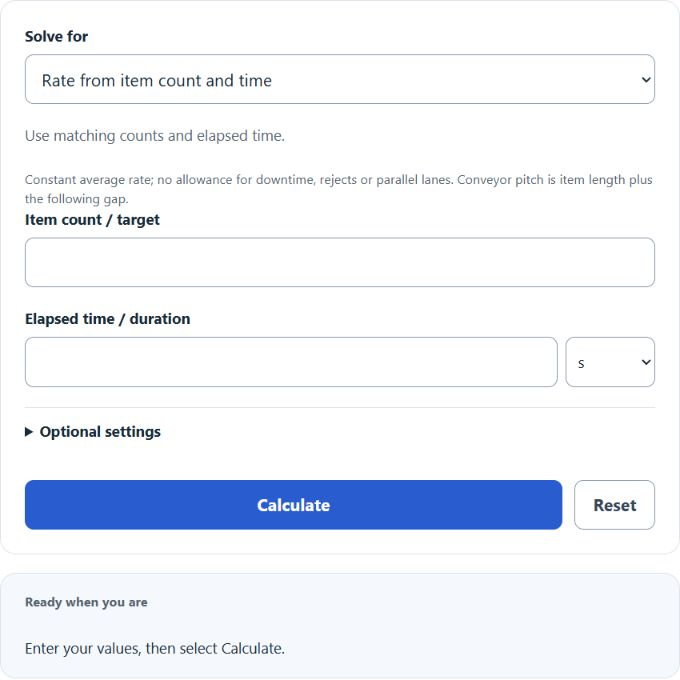
Calculate production rate, cycle time, output, or time needed from items and run time, and convert between items/sec, items/min, and items/hour.
Related Calculators
- Bush Hog Acres Per Hour Calculator
- Revolutions Per Hour Calculator
- Hz To Period Calculator
- Samples To ms Calculator
- All Unit Converters
Items Per Second Formula
The calculator uses one base relationship and rearranges it for each mode.
- IPS = items per second (the production rate)
- N = total number of items produced
- t = elapsed time in seconds
- Cycle time = 1 / IPS, in seconds per item
Choose a task: rate from count and elapsed time, rate/cycle-time conversion, output over a duration, time to finish a batch, or conveyor throughput. Conveyor throughput is belt speed divided by item pitch (item length plus the following gap), for one lane without slip.
Reference Tables
The first table converts common units. The second contains illustrative ranges only, not verified equipment benchmarks; use measured rates or manufacturer specifications for planning.
| Items/sec | Items/min | Items/hour | Sec/item |
|---|---|---|---|
| 0.1 | 6 | 360 | 10 |
| 0.5 | 30 | 1,800 | 2 |
| 1 | 60 | 3,600 | 1 |
| 2 | 120 | 7,200 | 0.5 |
| 5 | 300 | 18,000 | 0.2 |
| 10 | 600 | 36,000 | 0.1 |
| 100 | 6,000 | 360,000 | 0.01 |
| Setting | Illustrative IPS range |
|---|---|
| Hand assembly station | 0.05 to 0.5 |
| Automated bottle filler | 5 to 30 |
| High-speed canning line | 15 to 40 |
| Pick-and-place SMT machine | 20 to 80 |
| Game crafting (Minecraft auto-farm) | 1 to 20 |
| API request throughput | 10 to 10,000+ |
Worked Examples
Example 1: Find the rate. A line produces 1,800 units in 30 minutes. Convert 30 minutes to 1,800 seconds. IPS = 1,800 / 1,800 = 1 item per second. Cycle time is 1 second per item.
Example 2: Find the time. You need 12,000 parts and the machine runs at 4 items per second. t = 12,000 / 4 = 3,000 seconds, or 50 minutes.
FAQ
What is the difference between items per second and cycle time? For a positive rate they are reciprocals. If IPS is 2, cycle time is 0.5 seconds per item. A zero rate has no finite cycle time.
Does this account for downtime or defects? No. The formula gives a theoretical rate. To get effective output, multiply by your uptime percentage and yield rate.
Can I use it for non-physical items like requests or transactions? Yes. Any countable event works. Replace “items” with messages, requests, clicks, or packets.
Why does converting from a cycle time use division? Cycle time is seconds per item, so IPS = 1 / cycle time. The rate/cycle-time conversion task handles this automatically when you pick a “sec/item,” “min/item,” or “hour/item” unit.