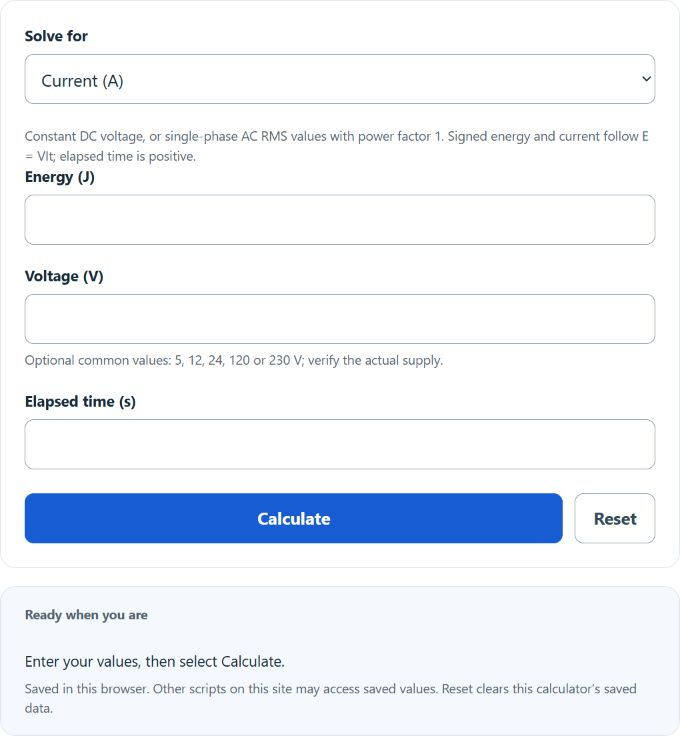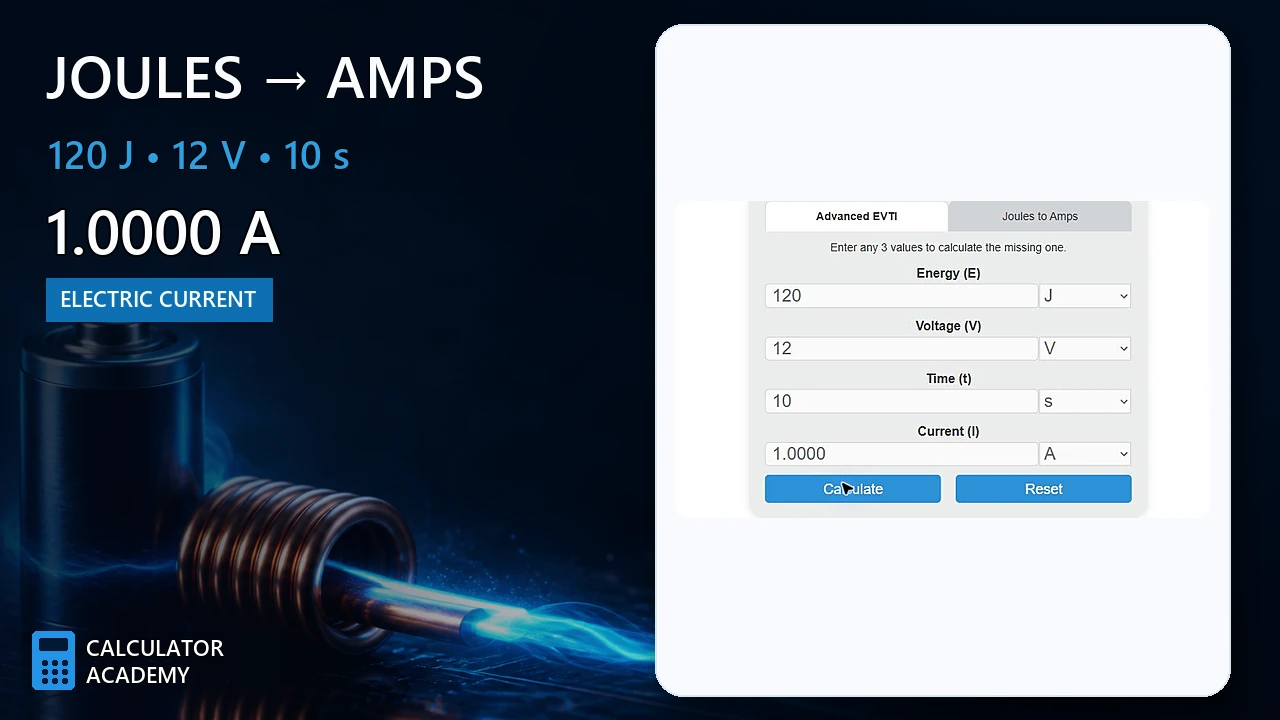
Select current, energy, voltage, or elapsed time, then enter the other three values. The calculator uses E = VIt for constant DC or single-phase RMS AC with power factor 1.
| Joules to Amps | Amps to Joules |
|---|---|
| 1 joule = 0.0833 amps | 0.1 amps = 1.2 joules |
| 5 joules = 0.4167 amps | 0.5 amps = 6 joules |
| 10 joules = 0.8333 amps | 1 amp = 12 joules |
| 20 joules = 1.6667 amps | 2 amps = 24 joules |
| 50 joules = 4.1667 amps | 5 amps = 60 joules |
| 100 joules = 8.3333 amps | 10 amps = 120 joules |
| 250 joules = 20.8333 amps | 15 amps = 180 joules |
| 500 joules = 41.6667 amps | 20 amps = 240 joules |
| 1000 joules = 83.3333 amps | 30 amps = 360 joules |
| 3600 joules = 300 amps | 50 amps = 600 joules |
| Formulas: I = E ÷ (V × t) and E = I × V × t. Table assumes t = 1 s and V = 12 V (DC, or AC with PF = 1). | |
| Joules to Amps | Amps to Joules |
|---|---|
| 10 joules = 0.0833 amps | 0.1 amps = 12 joules |
| 50 joules = 0.4167 amps | 0.25 amps = 30 joules |
| 100 joules = 0.8333 amps | 0.5 amps = 60 joules |
| 200 joules = 1.6667 amps | 1 amp = 120 joules |
| 500 joules = 4.1667 amps | 2 amps = 240 joules |
| 1000 joules = 8.3333 amps | 5 amps = 600 joules |
| 1500 joules = 12.5 amps | 10 amps = 1200 joules |
| 2000 joules = 16.6667 amps | 15 amps = 1800 joules |
| 3600 joules = 30 amps | 20 amps = 2400 joules |
| 10000 joules = 83.3333 amps | 30 amps = 3600 joules |
| Formulas: I = E ÷ (V × t) and E = I × V × t. Table assumes t = 1 s and V = 120 V (AC with PF = 1, or DC equivalent). | |
Joules to Amps Formula
The following formula is used to convert joules to amps.
$$I = \frac{E}{V \times t}$$Variables:
- I is the current (amps)
- E is the energy (joules)
- V is the voltage (volts)
- t is the time (seconds)
To convert joules to amps, divide the energy in joules by the product of voltage in volts and time in seconds. This formula is a rearrangement of the fundamental electrical energy equation E = I x V x t, which defines a joule in electrical terms as the energy delivered by one ampere of current flowing through one volt of potential difference for one second.
Why Joules Cannot Be Directly Converted to Amps
Joules and amps measure fundamentally different physical quantities. A joule is a unit of energy, defined in SI base units as kg*m2*s-2. An ampere is a unit of electric current, defined as one coulomb of charge passing a point per second. Because energy and current exist in different dimensional spaces, a direct one-to-one conversion between them is physically impossible. The conversion always requires two additional parameters: voltage (the energy per unit charge) and time (the duration of current flow). This three-variable dependency is what makes the joules-to-amps relationship contextual rather than fixed.
The Role of Voltage and Time in the Conversion
Voltage acts as the bridge between energy and charge. One volt equals one joule per coulomb (1 V = 1 J/C), meaning voltage tells you how much energy each unit of charge carries. Time determines the rate at which that charge flows. Together, they convert a static quantity of energy into a dynamic rate of charge movement. At higher voltages, the same energy produces less current because each charge carrier already holds more energy. At longer time intervals, the same energy produces less current because the delivery is spread over a greater duration. This inverse relationship with both voltage and time is critical for circuit design, where engineers must balance energy delivery against component current ratings.
Energy Budgets Across Standard Voltage Classes
Different electrical systems operate at standardized voltages, which determines how much current a given energy budget produces. The following reference data shows how 1,000 joules of energy translates into current across common voltage classes, assuming a 1-second delivery window.
This table illustrates a key engineering principle: low-voltage systems require dramatically higher currents to deliver the same energy, which is why power transmission lines operate at thousands of volts. A 3.3 V microcontroller circuit would need over 300 amps to transfer 1,000 joules in one second, a current that would vaporize most traces on a printed circuit board. At 480 V DC or single-phase RMS AC with power factor 1, the same energy needs only about 2 amps.
Joule Heating: Where Energy and Current Intersect Physically
When current flows through any conductor with resistance, electrical energy converts directly into thermal energy. This phenomenon, called Joule heating or ohmic heating or I2R loss, is described by the formula Q = I2 x R x t, where Q is the heat energy in joules, I is the current in amps, R is the resistance in ohms, and t is the time in seconds. The squared relationship with current means that doubling the current quadruples the heat produced, a fact with enormous practical consequences.
Joule heating is the operating principle behind electric stovetop elements (which dissipate roughly 12,960,000 joules per hour at 15 amps on a 240 V circuit), incandescent light bulbs (which convert about 95% of their electrical energy into heat rather than light), electric water heaters (which use 4,500-watt elements drawing about 18.75 amps at 240 V to transfer 270,000 joules of electrical energy per minute to the heating element), and industrial arc furnaces that melt steel using tens of thousands of amps.
On the unwanted side, Joule heating causes power transmission losses. The U.S. Energy Information Administration estimates that approximately 5% of electricity transmitted and distributed in the United States was lost during 2018–2022. These losses occur in conductors, transformers, and other equipment. This is why long-distance power lines operate at 115 kV to 765 kV: for a fixed power delivery, raising the voltage by a factor of 10 reduces the current by a factor of 10, which reduces I2R losses by a factor of 100.
Current Thresholds and the Human Body
Electrical injury depends on the current passing through the body, its path, and the duration of contact. Body resistance varies substantially; wet or broken skin can greatly increase current at the same voltage.
There is no single current threshold that predicts the outcome for every person or exposure. Milliampere-level currents can cause loss of muscle control, respiratory paralysis, or ventricular fibrillation. Current-effect tables describe particular exposure conditions, rather than guaranteed safe or fatal limits.
At a constant 120 V, a current of 0.1 A for 2 seconds would transfer 24 joules. This calculation does not establish a fatal-energy threshold or determine whether an electrical exposure is safe. Do not use this calculator to assess shock safety.
AC Power Factor and Its Effect on the Joules-to-Amps Conversion
The formula I = E / (V x t) applies to constant DC, or to single-phase AC at power factor 1 using RMS voltage and current. Here E is real electrical energy transferred over the interval; power factor does not describe the fraction converted to useful output. In real AC systems, inductive loads like motors, transformers, and fluorescent ballasts cause the current waveform to lag behind the voltage waveform. This phase difference means the circuit draws more current than the formula predicts for a given amount of real energy transfer.
For steady single-phase AC, the corrected formula is I = E / (V_RMS x t x PF), where PF is the positive power factor. For example, PF = 0.85 requires about 18% more current than PF = 1 for the same real energy, voltage, and time; PF = 0.7 requires over 40% more. For balanced three-phase total energy, use I_line = E / (sqrt(3) x V_line-to-line x t x PF). Utilities penalize commercial customers with low power factors because the excess current increases I2R losses in transmission lines without delivering additional useful work.
This distinction matters for anyone using the joules-to-amps calculator for AC circuit design. If the load is a heater, resistor, or incandescent bulb, PF is effectively 1 and the basic formula applies. For steady single-phase motor-driven, switched-mode, or reactive loads, divide the calculator result by the load’s power factor. Balanced three-phase total energy also requires the sqrt(3) factor and line-to-line voltage.
Energy Content of Common Electrical Events
Placing joule values in everyday context helps build intuition for the conversion. The following reference data provides the approximate energy involved in familiar electrical events, along with the current each would produce at 120 V over 1 second.
The extreme current values in the table reveal why the time variable matters so much. A laptop battery may store around 200,000 joules, but its actual current depends on battery voltage and the time over which that energy is discharged. A lightning bolt transfers about a billion joules, but the discharge lasts only 0.0002 seconds, producing peak currents around 20,000 to 200,000 amps through an extremely brief, violent channel of ionized air.
Unit Relationships: Joules, Watts, Coulombs, and Amp-Hours
The joule sits at the center of a web of related electrical units, and understanding these relationships prevents common conversion errors.
A watt is one joule per second (1 W = 1 J/s). Power in watts describes the rate of energy transfer, while joules describe the total quantity. A 60-watt light bulb consumes 60 joules every second, or 216,000 joules per hour.
A coulomb is one ampere-second (1 C = 1 A*s). It measures total charge, while amps measure the rate of charge flow. One joule equals one volt times one coulomb (1 J = 1 V x 1 C), which means at 1 volt, transferring 1 coulomb of charge requires exactly 1 joule of energy.
An amp-hour (Ah) equals 3,600 coulombs (since 1 hour = 3,600 seconds). To convert joules to amp-hours: Ah = E / (V x 3,600). A 12 V car battery rated at 60 Ah stores 12 x 60 x 3,600 = 2,592,000 joules (about 720 watt-hours).
An electron-volt (eV) is the energy gained by a single electron crossing a 1-volt potential. It equals 1.602 x 10⁻¹⁹ joules. This unit is used in semiconductor physics and particle physics where individual charge carriers matter, and it connects the macroscopic joules-to-amps formula to the quantum scale behavior of electrons in circuits.