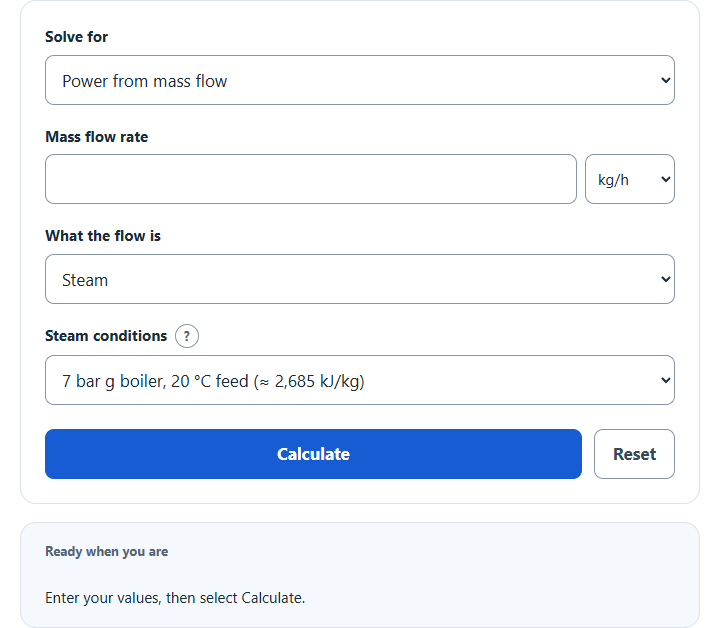
Convert kg/h to kW for steam using typical boiler enthalpies, or for fuel, heated fluids or any energy per kg, and convert kW back to kg/h of steam.
- All Unit Converters
- Specific Heat Calculator
- Mass Flow Rate Calculator
- kJ/kg to kW Calculator
- Enthalpy Calculator
- Heat Input Calculator
- Output Power Calculator
Calculator Functions
| Function | What it does | What it requires |
|---|---|---|
| Power from mass flow | Converts a mass flow in kg/h to power in kW | Requires the mass flow rate and what the flow is: steam, burned fuel, a heated or cooled fluid, or a known energy per kg |
| Mass flow from power | Converts power in kW to the mass flow in kg/h that carries it | Requires the power and the same choice of what the flow is |
Mass flow can be in kg/h, t/h, kg/s, g/s or lb/h, and power in kW, W or MW. Steam uses one of four preset enthalpy changes or a custom one. Fuel needs its calorific value, a heated or cooled fluid needs its specific heat and temperature change, and the last option takes any energy per kilogram. Every result lists the energy per kilogram used, the flow in kg/s and the kg/h per kW.
kg/h to kW Formulas
| P | Power (kW) |
| ṁ | Mass flow rate (kg/h) |
| e | Energy transferred per kilogram (kJ/kg) |
| 3600 | Seconds in an hour, which turns kJ/h into kW |
kg/h and kW measure different things, so no single factor links them. The answer depends on e: what the flow is and what happens to it.
Power from mass flow
For steam, e is the enthalpy change of each kilogram. The four presets are:
| Steam conditions | e (kJ/kg) | kW per 1,000 kg/h | kg/h per kW |
|---|---|---|---|
| 7 bar g boiler, 20 °C feed | 2,685 | 745.8 | 1.341 |
| 7 bar g boiler, 80 °C feed | 2,434 | 676.1 | 1.479 |
| Boiling at 100 °C | 2,257 | 626.9 | 1.595 |
| Condensing at 7 bar g | 2,048 | 568.9 | 1.758 |
The two boiler presets are the enthalpy of saturated steam at 7 bar gauge, about 2,768 kJ/kg [2], minus the enthalpy of the feedwater, about 84 kJ/kg at 20 °C and 335 kJ/kg at 80 °C [3]. They give the heat a boiler has to put into the water. The other two are latent heats, the heat released when steam condenses or absorbed when water boils at that pressure: about 2,047 kJ/kg at 7 bar gauge [2] and 2,256 kJ/kg at 100 °C [3].
| Steam flow (kg/h) | kW to raise it (20 °C feed) | kW released on condensing |
|---|---|---|
| 100 | 74.6 | 56.9 |
| 200 | 149.2 | 113.8 |
| 500 | 372.9 | 284.4 |
| 850 | 634.0 | 483.6 |
| 1,000 | 745.8 | 568.9 |
| 1,700 | 1,267.9 | 967.1 |
| 2,000 | 1,491.7 | 1,137.8 |
| 5,000 | 3,729.2 | 2,844.4 |
| 10,000 | 7,458.3 | 5,688.9 |
For burned fuel, e is the calorific value, so P = ṁ × CV ÷ 3.6 with CV in MJ/kg. 100 kg/h of a 42 MJ/kg fuel is 100 × 42 ÷ 3.6 = 1,166.67 kW of fuel energy input.
For a liquid or gas that is heated or cooled without changing phase, e is the mean specific heat cp in kJ/(kg·K) times the temperature change ΔT. Water at 5,000 kg/h heated by 50 K with cp = 4.2 takes 5,000 × 4.2 × 50 ÷ 3600 = 291.67 kW. A negative ΔT gives a negative power, which is heat removed.
Mass flow from power
A 100 kW load on boiler steam raised from 20 °C feedwater needs 100 × 3600 ÷ 2685 = 134.08 kg/h, or 1.34 kg/h for each kW. Power and e need the same sign, and e cannot be zero.
Limits of This Estimate
- Boiler efficiency, blowdown and pipe losses are not included. Fuel results are the energy input rate on the calorific value entered, higher or lower, before any conversion loss.
- The steam presets are rounded values for dry saturated steam. Superheated steam, wet steam, a different pressure or sub-cooled condensate change the enthalpy difference, and the custom option takes that value.
- The heated or cooled fluid option assumes one mean specific heat and no boiling or condensing between inlet and outlet.
Sources
- Spirax Sarco, Methods of Estimating Steam Consumption: heat transfer rate from mass flow, specific heat and temperature rise, and steam flow from heat rate and latent heat
- NIST Chemistry WebBook, saturation properties for water from 0.80 to 0.82 MPa: enthalpy of saturated water and steam near 7 bar gauge
- NIST Chemistry WebBook, saturation properties for water from 20 to 100 °C: enthalpy of feedwater at 20 °C and 80 °C, and of boiling at 100 °C