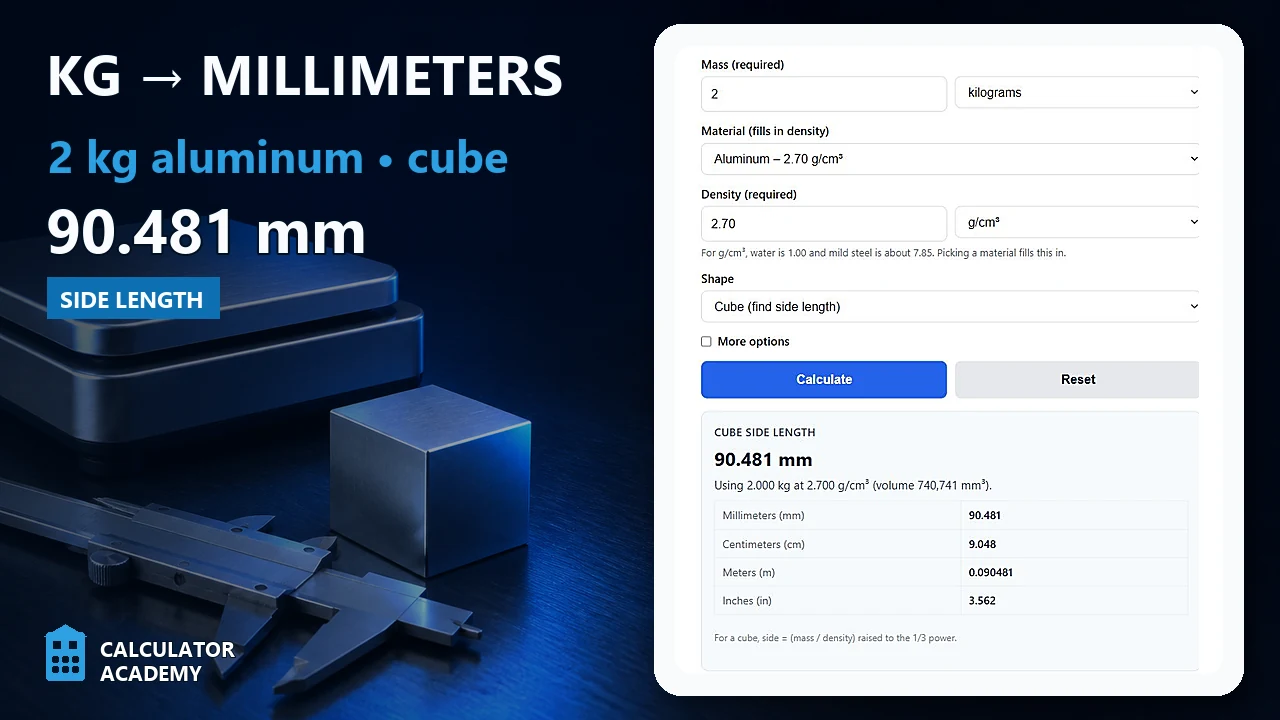
Calculate mm dimensions from kg and density, including cube side, sphere diameter, cylinder length, sheet size, and linear density conversions.
| kg to mm³ | mm³ to kg |
|---|---|
| 0.01 kg = 10,000 mm³ | 500 mm³ = 0.0005 kg |
| 0.1 kg = 100,000 mm³ | 1,000 mm³ = 0.001 kg |
| 0.5 kg = 500,000 mm³ | 10,000 mm³ = 0.01 kg |
| 1 kg = 1,000,000 mm³ | 50,000 mm³ = 0.05 kg |
| 2 kg = 2,000,000 mm³ | 100,000 mm³ = 0.1 kg |
| 5 kg = 5,000,000 mm³ | 500,000 mm³ = 0.5 kg |
| 10 kg = 10,000,000 mm³ | 1,000,000 mm³ = 1 kg |
| 25 kg = 25,000,000 mm³ | 5,000,000 mm³ = 5 kg |
| 50 kg = 50,000,000 mm³ | 10,000,000 mm³ = 10 kg |
| 100 kg = 100,000,000 mm³ | 50,000,000 mm³ = 50 kg |
| Formula (water, ρ = 1 g/cm³): V(mm³) = m(kg) × 1,000,000 | m(kg) = V(mm³) ÷ 1,000,000. | |
| kg to mm³ | mm³ to kg |
|---|---|
| 0.5 kg = 63,694 mm³ | 120,000 mm³ = 0.942 kg |
| 1 kg = 127,389 mm³ | 300,000 mm³ = 2.355 kg |
| 2 kg = 254,777 mm³ | 750,000 mm³ = 5.888 kg |
| 5 kg = 636,943 mm³ | 1,500,000 mm³ = 11.775 kg |
| 10 kg = 1,273,885 mm³ | 2,500,000 mm³ = 19.625 kg |
| Formula (steel): V = m ÷ ρ | m = V × ρ (ρ = 7.85 × 10⁻⁶ kg/mm³). | |
Kg To mm³ Formula
The following formula converts a mass in kilograms to volume in cubic millimeters for any uniform material, given its density.
- V = volume (mm³)
- M = mass (kg)
- ρ = density (kg/mm³). To convert from g/cm³, multiply by 10⁻⁶ (e.g., 7.85 g/cm³ = 7.85 × 10⁻⁶ kg/mm³).
What is Kg to mm³?
Mass (kg) measures how much matter is present; volume (mm³) measures how much space it occupies. For any uniform material, density connects them: V = M / ρ. The mm³ unit applies where precision at small scale matters: CNC toolpaths, 3D printer slicer outputs, and laboratory pipette measurements. One cubic millimeter equals 0.001 cm³ or 0.001 mL, roughly the volume of a medium grain of table salt. Because kg (mass) and mm (length) measure different physical dimensions, no fixed conversion factor exists between them; the density of the specific material is always required.
| Material | Density (g/cm³) | 1 kg in mm³ | Context |
|---|---|---|---|
| Oak wood | 0.71 | 1,408,451 | Floats; density varies by species and moisture content |
| Ice (0°C) | 0.917 | 1,090,513 | Floats in liquid water; 9% less dense than liquid water |
| HDPE plastic | 0.95 | 1,052,632 | Floats; pipes, containers, cutting boards |
| Water (4°C) | 1.000 | 1,000,000 | Reference: 1 kg = 1 L = 1,000 cm³ exactly |
| ABS plastic | 1.05 | 952,381 | Common FDM filament; sinks in water |
| PLA plastic | 1.24 | 806,452 | 1 kg spool yields 806,452 mm³ of printable material |
| PETG plastic | 1.27 | 787,402 | 2.4% less volume per kg than PLA |
| PVC (rigid) | 1.40 | 714,286 | Pipes, window profiles, electrical conduit |
| Concrete | 2.30 | 434,783 | Range 2.2 to 2.4 g/cm³ depending on mix design |
| Glass (soda-lime) | 2.50 | 400,000 | Standard flat and container glass |
| Aluminum (6061) | 2.70 | 370,370 | 2.91x more volume than steel per kg; aerospace preference |
| Titanium (grade 5) | 4.43 | 225,734 | Higher strength-to-weight than steel; biomedical implants |
| Steel (mild, 1020) | 7.85 | 127,389 | Standard structural reference for mass-to-volume estimates |
| Brass (CW614N) | 8.60 | 116,279 | Fittings, valves, musical instruments |
| Copper (pure) | 8.96 | 111,607 | Electrical wiring; third most conductive element |
| Silver (pure) | 10.49 | 95,329 | Highest electrical conductivity of all elements by volume |
| Lead | 11.34 | 88,183 | Radiation shielding, lead-acid batteries |
| Gold (24k) | 19.32 | 51,761 | 19.3x denser than water; 1 kg fits in a 37.2 mm cube |
| Formula: mm³ per kg = 1,000,000 / density (g/cm³). Materials below 1 g/cm³ float in water. Values at ~20°C unless noted. | |||
3D Printing: Mass to Volume
FDM filament is sold by mass (kg), but slicers report material consumption in mm³. Density bridges the two. At a typical flow rate of 3 to 5 mm³/s, 1 kg of PLA (806,452 mm³) provides roughly 45 to 75 hours of continuous extrusion. The same mass of PETG yields 787,402 mm³, about 2.4% less volume, because it is slightly denser. To estimate prints per spool: divide spool volume (mm³) by the slicer-reported volume per print. A 30,000 mm³ PLA body uses 37.2 g per copy (30,000 / 806,452 × 1,000), giving roughly 26 copies from a 1 kg spool.
How to Calculate Kg to mm³
- Determine the mass (M) in kilograms (kg).
- Identify the material density (ρ) in g/cm³ from the table above or a reference source. Multiply by 10⁻⁶ to convert to kg/mm³ (e.g., aluminum 2.70 g/cm³ = 2.70 × 10⁻⁶ kg/mm³).
- Divide: V (mm³) = M (kg) / ρ (kg/mm³). Alternatively, read mm³ per kg from the table above and multiply by the mass.
- Verify with the calculator above by selecting the material from the dropdown or entering the density manually.
Example Problem:
A steel bracket weighs 2.5 kg. Mild steel density: 7.85 g/cm³ = 7.85 × 10⁻⁶ kg/mm³.
V = 2.5 / (7.85 × 10⁻⁶) = 318,471 mm³ (about 318 cm³, roughly a 6.8 cm cube). If the same bracket were aluminum instead, it would occupy 370,370 × 2.5 = 925,926 mm³, or 2.91x larger volume for identical mass.