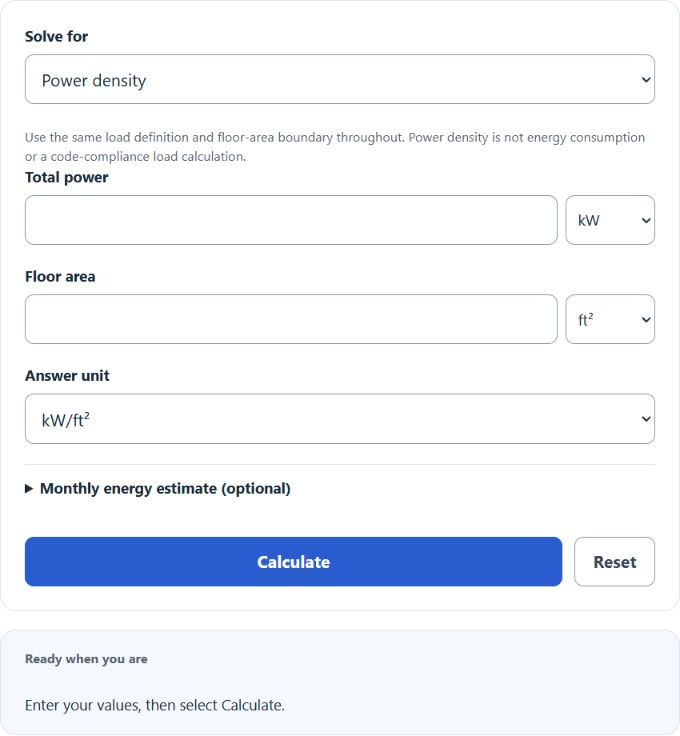
Calculate kW per square foot from total power and area, or solve for total power or area, with kW, W, square-foot, square-meter, energy, and cost results.
- All Construction Calculators
- Power Per Square Meter Calculator
- Lighting Power Density (LPD) Calculator
kW Per Square Foot Formula
Variables:
- KWSF is the kW Per Square Foot (kW/ft²)
- P is the total power (kW)
- A is the total area (ft²)
To calculate kW per square foot, divide power in kilowatts by area in square feet. To convert to W/ft², multiply by 1,000. To convert to kW/m², multiply by 10.764.
How to Calculate kW Per Square Foot
The following steps outline how to calculate kW per square foot.
- Determine or measure the total connected load in kilowatts (kW).
- Measure the floor area in square feet (ft²).
- Apply the formula: KWSF = P / A.
- Compare only with a documented benchmark using the same load definition and area boundary. The illustrative table below is not a design limit.
- Check your answer with the calculator above.
Example Problem:
Use the following variables as an example problem to test your knowledge.
total power (kW) = 70
total area (ft²) = 10,000
KWSF = 70 / 10,000 = 0.007 kW/ft² (equivalent to 7 W/ft²)
Power Density Reference by Building Type
Illustrative power-density ranges only; these values are not verified design criteria or code limits. Actual connected load and measured demand depend on equipment, operating conditions and the chosen area boundary. Data-center rows refer to room area, not rack footprint.
| Building Type | W/ft² | kW/ft² | Primary Load Drivers |
|---|---|---|---|
| Parking Garage | 0.5-1 | 0.0005-0.001 | Lighting only |
| Warehouse | 1-2 | 0.001-0.002 | Lighting, minimal HVAC |
| Residential (single family) | 3-6 | 0.003-0.006 | Lighting, appliances, HVAC |
| Office Building | 6-9 | 0.006-0.009 | Lighting (~1.3 W/ft²), workstations, HVAC |
| Retail | 4-8 | 0.004-0.008 | Lighting, HVAC, refrigeration cases |
| Medical / Healthcare | 7-20 | 0.007-0.020 | Medical imaging, redundant HVAC, lighting |
| Restaurant / Food Service | 15-30 | 0.015-0.030 | Commercial kitchen equipment, ventilation |
| Hospital | 20-25 | 0.020-0.025 | Life safety, 24/7 HVAC, medical equipment |
| Data Center (standard) | 50-100 | 0.050-0.100 | IT equipment, CRAC/CRAH cooling, UPS overhead |
| Data Center (hyperscale / HPC) | 150-400 | 0.150-0.400 | Dense GPU/CPU compute, liquid cooling infrastructure |
Use current applicable standards and documented equipment schedules for design. These illustrative ranges must not be treated as sourced code requirements.
Frequently Asked Questions
What is a typical kW per square foot for an office building?
There is no single reliable total-load benchmark for every office. Connected capacity, measured demand and lighting-only density are different measures. Use a documented benchmark for the same building type and measurement boundary; consult the current applicable energy code separately.
How does kW per square foot relate to NEC load calculations?
Electrical load calculations use the current locally adopted code, occupancy, actual equipment schedules, demand factors and voltage/power-factor assumptions. Watts and volt-amperes are different quantities. This arithmetic power-density calculator does not determine feeder, service or protection ratings.
Why do data centers have far higher power density than other buildings?
Data centers concentrate IT equipment into minimal floor space. A single 42U server rack drawing 15-20 kW occupies roughly 6-7 ft², yielding 2-3 kW/ft² at the rack footprint. Floor-level density using the room envelope method runs 50-200 W/ft² for most facilities, with aisles, cooling equipment, and support space reducing the average. High-performance computing installations with liquid cooling exceed 300 W/ft² on a room basis. A useful rule: for every 1 W/ft² of IT load, a data center needs roughly 1.2-1.5 W/ft² of total power input when accounting for cooling and power distribution overhead (PUE of 1.2-1.5).