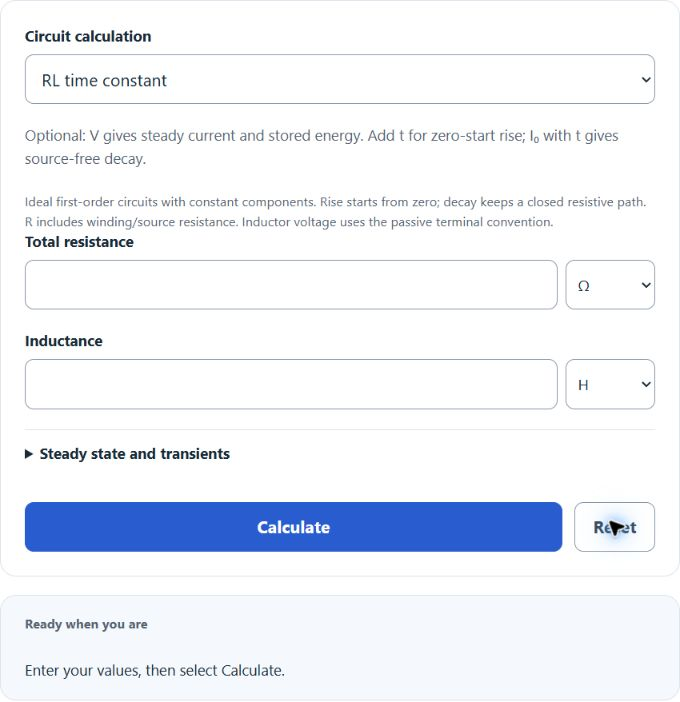
Calculate RL and RC time constants, steady current, current rise or decay, and inductor or capacitor voltage for circuit transients.
L/R Time Constant Formula
The L/R time constant describes how quickly current changes in a first-order RL circuit. It is especially useful for estimating startup current rise, current decay in a closed resistive path after the source is removed, relay and solenoid response, and the transient behavior of coils, chokes, and inductive loads.
Where:
- τ = time constant in seconds
- L = inductance in henries
- R = total circuit resistance in ohms
If you know any two of the three values, you can solve for the third:
What the Time Constant Means
In an RL circuit, current does not jump instantly to its final value because the inductor opposes changes in current. The time constant tells you how long the transition takes.
- After one time constant, current has reached about 63.2% of its final value.
- After three time constants, current is about 95.0% of its final value.
- After five time constants, current is about 99.3% of its final value, which is often treated as essentially steady state.
For current decay, the same timing applies in reverse:
- After one time constant, about 36.8% of the original current remains.
- After three time constants, about 5.0% remains.
- After five time constants, only about 0.7% remains.
RL Transient Equations
When a DC voltage is applied to a series RL circuit, the current rises exponentially toward its final value:
When the source is removed while a closed RL path remains, the current decays exponentially:
For a simple DC RL circuit, the final steady-state current is:
How to Calculate the L/R Time Constant
- Determine the inductance of the coil or inductor in henries.
- Determine the total resistance in the current path in ohms.
- Divide inductance by resistance.
- Interpret the result as the characteristic response time of the RL circuit.
Unit consistency matters. Since one henry divided by one ohm equals one second, your units should match before calculating.
Examples
Example 1: Find the time constant
An inductor has an inductance of 0.5 H and the circuit resistance is 200 Ω.
This is 2.5 ms. That means the current reaches about 63.2% of its final value after 2.5 milliseconds.
Example 2: Solve for inductance
If the time constant is 8 ms and the resistance is 40 Ω, then the inductance is:
Why Resistance Matters
A larger inductance increases the time constant and slows the current response. A larger resistance decreases the time constant and speeds the response. This relationship is important when designing circuits that must switch quickly or, alternatively, avoid sharp current changes.
| Change in Circuit | Effect on Time Constant | Practical Result |
|---|---|---|
| Inductance increases | Time constant increases | Current changes more slowly |
| Inductance decreases | Time constant decreases | Current changes more quickly |
| Resistance increases | Time constant decreases | Faster transient response |
| Resistance decreases | Time constant increases | Slower transient response |
Common Applications
- Relay coil energizing and release timing
- Solenoid response analysis
- Motor winding current ramp behavior
- Power electronics transient design
- Filter and choke response estimates
- Protection circuits using inductive loads
Common Input Mistakes
- Using only the resistor value and forgetting coil winding resistance or other series resistance.
- Mixing units such as millihenries and kilo-ohms without converting.
- Assuming the time constant equals the full settling time; in practice, near steady state typically takes several time constants.
- Applying the formula to circuits that are not first-order RL networks.
Design Insight
The time constant is a fast way to judge how an inductive circuit will behave before doing a full transient analysis. Small values indicate rapid current response. Large values indicate a slower buildup or decay of current and more pronounced transient behavior. For switching, control, sensing, and protection circuits, this simple calculation often gives the first design check needed.