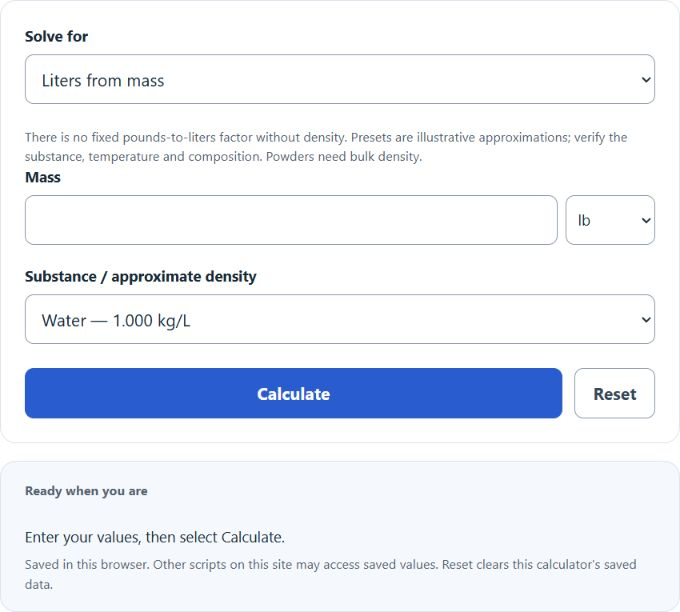
Convert pounds to liters or liters to pounds using material density, with common substance presets, custom density, and metric and US volume results.
- All Unit Converters
- Lbs to mL Calculator
- mL to Lbs Calculator
- kg to L Converter
- L to kg Water Conversion Calculator
- Weight to Volume Calculator
- Mass to Volume Calculator
Lbs To Liters Formula
The following formula is used to calculate the conversion from pounds to liters.
Variables:
- L is the volume in liters
- P is the mass in pounds
- D is the density of the substance (in pounds per liter)
For density in lb/L, liters = pounds ÷ density. If density is in kg/L, first convert pounds to kilograms: liters = pounds × 0.45359237 ÷ density. The water preset assumes approximately 1 kg/L; actual density varies with temperature and composition.
| Pounds (lb) | Liters (L) |
|---|---|
| 0.25 | 0.113 |
| 0.5 | 0.227 |
| 0.75 | 0.340 |
| 1 | 0.454 |
| 1.5 | 0.680 |
| 2 | 0.907 |
| 2.5 | 1.134 |
| 3 | 1.361 |
| 4 | 1.814 |
| 5 | 2.268 |
| 6 | 2.722 |
| 8 | 3.629 |
| 10 | 4.536 |
| 12 | 5.443 |
| 15 | 6.804 |
| 20 | 9.072 |
| 25 | 11.340 |
| 30 | 13.608 |
| 40 | 18.144 |
| 50 | 22.680 |
| * Rounded to 3 decimals. Assumes water (ρ = 1.00 kg/L). Conversion factor: 1 lb ≈ 0.453592 L. | |
What Does “Lbs to Liters” Mean?
Lbs to Liters is a conversion between two different types of measurements, pounds (lbs) and liters (L). Pounds are a measure of weight, commonly used in the United States, while liters are a measure of volume, used worldwide. The conversion between the two is not straightforward as it depends on the specific substance being measured, due to the fact that different substances have different densities. For example, one pound of water is approximately 0.4536 liters, but this would not be the same for a pound of oil or a pound of gold.
How to Calculate Lbs To Liters?
The following steps outline how to calculate the Lbs To Liters using the formula: L = P / D
- First, determine the weight in pounds (P).
- Next, determine the density of the substance in pounds per liter (D).
- Next, gather the formula from above: L = P / D.
- Finally, calculate the volume in liters (L).
- After inserting the variables and calculating the result, check your answer with the calculator above.
Example Problem :
Use the following variables as an example problem to test your knowledge.
weight in pounds (P) = 150
density (D) = 0.8 lb/L. Select Custom density and the lb/L unit; 150 ÷ 0.8 = 187.5 L. This assumed example is not the same as 0.8 kg/L.