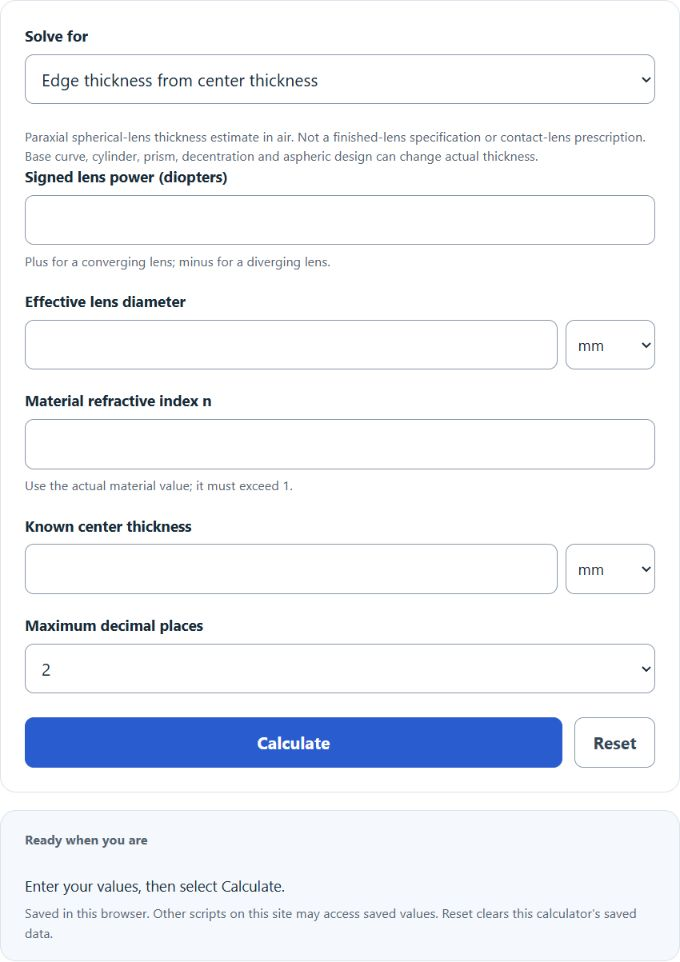
Estimate center or edge lens thickness from signed spherical power, effective diameter, material refractive index and the other known thickness using a paraxial approximation.
Related Calculators
- Vertex Form Calculator
- Angle of View Calculator
- Field of View Calculator
- Focal Length to Zoom Calculator
- Minimum Focus Distance Calculator
- Viewing Angle Calculator
- All Physics Calculators
Lens Thickness Formula
The calculator estimates center or edge thickness from signed spherical lens power, effective diameter, material refractive index and the other known thickness. It uses a paraxial small-sag approximation in air.
- F = signed power in diopters
- D = effective lens diameter in millimeters
- n = material refractive index, greater than 1
Important: This estimates thickness in millimeters. Refractive index is a material property, not thickness divided by radius. This tool does not calculate vertex compensation.
Rearranged Forms of the Formula
Select the thickness to estimate and enter the known thickness.
Positive power gives a thicker center; negative power gives a thicker edge. Zero power gives equal thicknesses in this approximation.
How to Estimate Lens Thickness
- Select edge or center thickness as the result.
- Enter signed lens power and effective diameter.
- Enter material refractive index and the other known thickness.
- Select Calculate and review the estimate and its limitations.
A zero or negative estimated thickness is rejected. A positive result does not establish a safe minimum thickness.
Example Calculation
For −4 D, a 60 mm diameter, n =1.50 and a 2 mm center:
The estimated edge thickness is 2 − (−3.6) = 5.6 mm.
How to Interpret the Result
| Power | Approximate geometry | Interpretation |
|---|---|---|
| Positive | Center thicker than edge | Plus spherical power |
| Negative | Edge thicker than center | Minus spherical power |
| Zero | Equal thicknesses | Plano approximation |
How Each Variable Affects the Output
| Change | Effect on thickness difference | Condition |
|---|---|---|
| Larger power magnitude | Larger difference | Other inputs fixed |
| Larger diameter | Difference grows with diameter squared | Other inputs fixed |
| Higher refractive index | Smaller difference | Same power and diameter |
| Larger known thickness | Both thicknesses shift together | Same power, diameter and material |
Unit Tips
- Power is in diopters.
- Diameter and thickness support mm, cm and inches; changing units converts the current quantity.
- Results are in millimeters.
- Refractive index is dimensionless.
Common Mistakes
- Entering radius instead of diameter.
- Dropping the minus sign from lens power.
- Entering a geometric ratio as refractive index.
- Treating this estimate as a finished-lens design.
When This Calculator Is Useful
- Comparing idealized spherical-lens thickness estimates.
- Exploring diameter and material effects under fixed assumptions.
- Classroom paraxial calculations.
- Checking approximate consistency of supplied thicknesses.
Frequently Asked Questions
Does the result have units?
Yes. Estimated thickness is in millimeters.
Can I use cm, mm or inches?
Yes. Choose each field’s unit; the calculator converts it.
Is refractive index calculated?
No. Supply the actual material refractive index, greater than 1.
Does this specify an actual lens?
No. Base curve, cylinder, prism, decentration, aspheric design and manufacturing requirements can change actual thickness. Consult the manufacturer or eye-care professional.