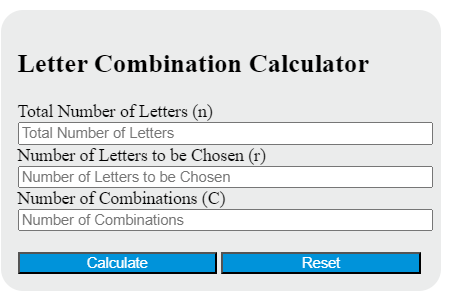
Calculate how many combinations your letters can make and list every one. Enter your letters, pick how many per combination, and set order and repeat rules.
Related Calculators
- Hamming Distance Calculator
- Permutation Multiplication Calculator
- Binomial Coefficient Calculator
- Letter Probability Calculator
- Scrabble Word Calculator
- Word Value Calculator
- All Math and Numbers Calculators
Letter Permutation Formula
This calculator is used to find the number of distinct arrangements that can be made from a set of letters. In counting terms, these are permutations, because the order of the letters matters.
- P = total number of unique letter arrangements
- n = total number of letters entered
- m1, m2, m3, … = counts of letters that repeat
- Factorial means multiplying a whole number by every positive integer below it
If every letter is different, the repeated-letter adjustment is not needed and the count simplifies to:
What This Calculator Actually Generates
Although people often say “letter combinations,” this tool is really producing full-length permutations. That means it rearranges all letters entered and treats different orders as different results. For word-game use, some outputs may be valid dictionary words while others are simply mathematically valid rearrangements.
Why Repeated Letters Reduce the Count
When a letter appears more than once, swapping those identical letters does not create a new visible arrangement. The formula accounts for this by dividing by the factorial of each repeated-letter count, preventing duplicates from being overcounted.
| Letters | Pattern | Unique Arrangements |
|---|---|---|
| EAST | All letters are different | P = 4! = 24 |
| LETTER | Two E’s and two T’s repeat | P = (6!) / (2!2!) = 180 |
| BANANA | Three A’s and two N’s repeat | P = (6!) / (3!2!) = 60 |
How to Calculate Letter Permutations
- Count the total number of letters.
- Identify any letters that appear more than once.
- Compute the factorial of the total letter count.
- Compute the factorial of each repeated-letter count.
- Divide the total factorial by the product of the repeated-letter factorials.
This process gives the number of distinct outputs, not the number of times a computer might generate duplicates before filtering them out.
Example with Distinct Letters
If all entered letters are different, every rearrangement is unique.
So a 5-letter input with no repeats has 120 possible orderings.
Example with Repeated Letters
Suppose a set of 6 letters contains one letter repeated twice and another letter repeated twice. The total starts with the full factorial count, then duplicate orderings are removed by division.
This is why repeated letters can dramatically shrink the final result count even when the total number of letters stays the same.
Result Growth by Letter Count
The number of possible outputs increases very quickly. For distinct letters, the growth follows factorial behavior, which is why even small increases in input size create many more arrangements.
| Number of Letters | Distinct-Letter Count |
|---|---|
| 1 | 1! = 1 |
| 2 | 2! = 2 |
| 3 | 3! = 6 |
| 4 | 4! = 24 |
| 5 | 5! = 120 |
| 6 | 6! = 720 |
This rapid growth explains why longer inputs take more time to generate and, when word validation is included, more time to check against a dictionary.
Tips for Using the Calculator
- Use only letters when you want true anagram-style outputs.
- If all letters are unique, expect the largest possible result set for that length.
- If letters repeat, the number of unique outputs will be lower than the full factorial count.
- For longer inputs, generation and word checking can take noticeably more time because more candidate arrangements must be processed.
- If you are searching for words, remember that not every valid permutation will be a real dictionary entry.
Permutation vs. Partial Arrangement
This calculator is best for rearranging all letters entered. If you instead want arrangements that use only part of the available letters, that is a different counting problem.
Here, A represents the number of ordered selections when only part of the original set is used. That is useful for shorter strings built from a larger pool, but it is not the same as full-length anagram generation.
Common Uses
- Solving anagrams and word puzzles
- Checking how many distinct arrangements are possible from a set of letters
- Teaching factorials and counting principles in math courses
- Comparing cases with repeated letters against cases with all unique letters
- Estimating the size of a search space before trying all possible letter orders
Frequently Asked Questions
Does order matter?
Yes. Changing the order creates a different permutation, even when the same letters are used.
Are repeated letters handled correctly?
Yes. Repeated letters reduce the count of unique results because identical swaps are not counted as new arrangements.
Will every result be a real word?
No. A permutation is any distinct rearrangement of the letters. Some outputs may be valid words, while many will simply be non-word letter orders.
Why do larger inputs take longer?
Because factorial growth increases the number of possible arrangements very quickly. More outputs means more generation, more filtering, and more dictionary checks when word validation is used.