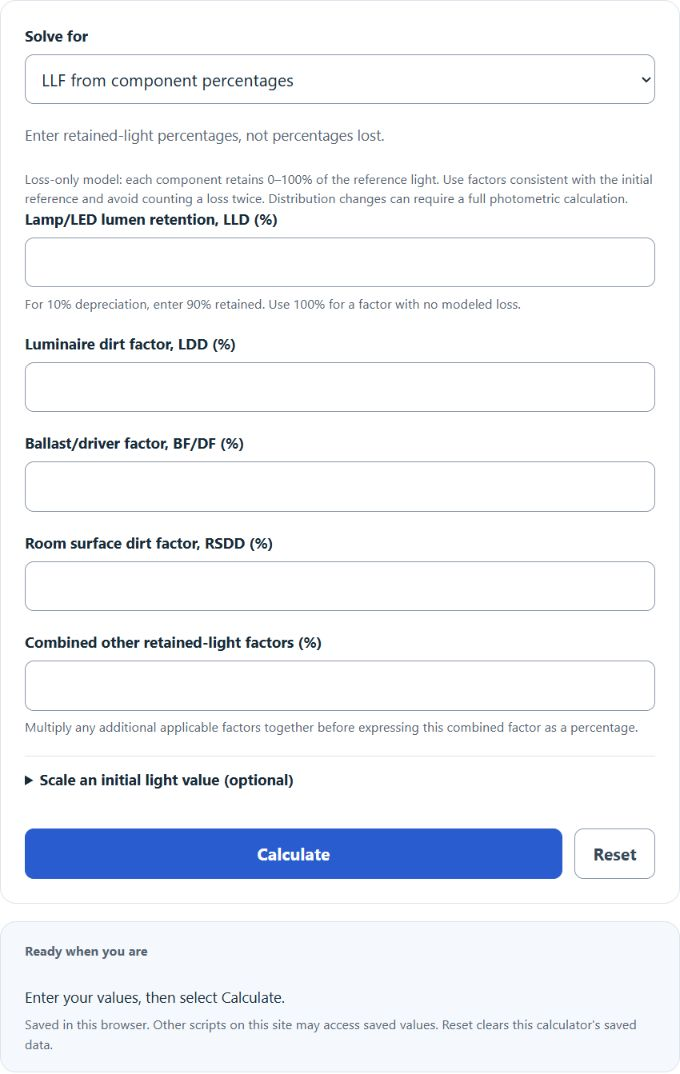
Calculate light loss factor from total depreciation or retained-light components, then optionally scale an initial luminous flux or illuminance value.
Light Loss Formula
Variables:
- LLF is the light loss factor (dimensionless multiplier, typically 0 to 1) equal to maintained output divided by initial output.
- ED is the expected depreciation / light loss as a fraction of initial light output (dimensionless, 0 to 1). It is related to LLF by
ED = 1 − LLF. - LLD, LDD, RSDD, BF/DF, ATF, VF, LBF, LPF, and Other are common component multipliers that together make up the overall LLF in the lumen method.
In lighting design, LLF is usually found by multiplying applicable component factors. This calculator uses a loss-only scope, with each entered retained-light percentage from 0% to 100%; a 10% component loss means 90% retained. Enter 100% when an applicable component has no modeled loss. Combine additional factors in Other. Use factors consistent with the initial reference and avoid double counting. Once LLF is known, ED = 1 − LLF; total-loss mode instead uses LLF = 1 − ED. Optional initial and maintained light values use the same selected quantity and unit. A scalar LLF does not determine fixture counts or illuminance distribution.
How to Calculate Light Loss?
The following steps outline how to calculate the light loss (depreciation) fraction.
- Determine the overall light loss factor (LLF). In many designs, this is done by multiplying the relevant LLF components (LLD, LDD, etc.).
- Use the relationship between loss and factor:
ED = 1 − LLF(equivalently,LLF = 1 − ED). - Compute the result and express ED as a fraction (0 to 1) or as a percentage (0% to 100%).
- After inserting the variables and calculating the result, check your answer with the calculator above.
Example Problem :
Use the following variables as an example problem to test your knowledge.
LLF = 0.809 (so expected depreciation/light loss ED = 1 − 0.809 = 0.191, i.e., 19.1% loss)
FAQs
What is expected depreciation in the context of lighting?
Expected depreciation in lighting refers to the decrease in light output (luminous flux) over time. In calculations it is often expressed as a fraction of initial output (for example, a 0.20 depreciation means a 20% reduction), and it relates to the light loss factor by ED = 1 − LLF.
How can understanding light loss benefit lighting design?
Understanding light loss is crucial for lighting design because it helps in selecting lighting systems that maintain adequate illumination over their lifespan. It ensures that spaces remain well-lit, safe, and functional, even as the lighting fixtures age.
Are there any common factors that contribute to the depreciation of light output?
Yes. In the lumen method, the overall light loss factor (LLF) is commonly modeled as the product of factors such as lamp/LED lumen depreciation (LLD), luminaire dirt depreciation (LDD), room surface dirt depreciation (RSDD), and ballast/driver factor (BF/DF), among others.
Can the Light Loss Formula be applied to all types of lighting technologies?
The relationship ED = 1 − LLF applies whenever LLF is defined as the ratio of maintained light output to initial light output. The specific LLF component factors used (and their typical values) can vary by lighting technology, luminaire construction, environment, and maintenance practices.