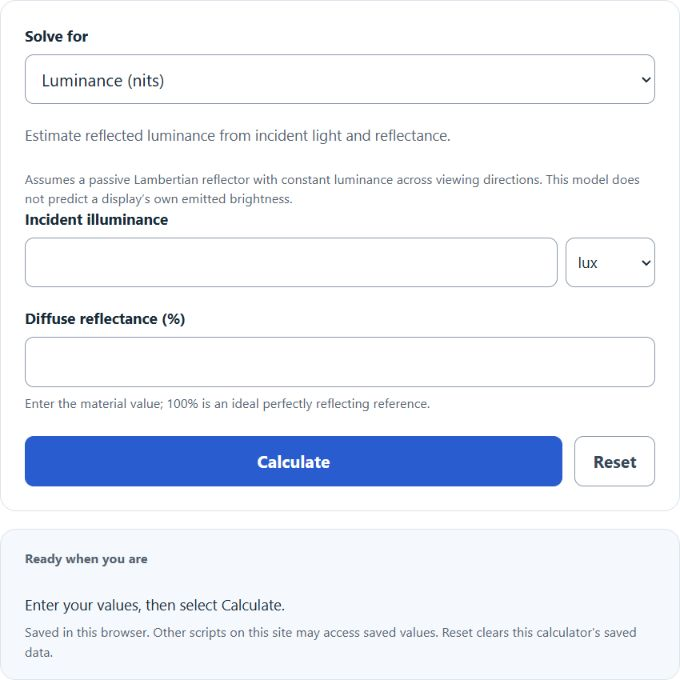
Estimate reflected luminance from illuminance and diffuse reflectance, or solve for illuminance or reflectance. The passive Lambertian model supports lux, foot-candles, nits (cd/m²) and foot-lamberts; it does not predict a display’s own emitted brightness.
- All Unit Converters
- Waves, Optics, and Quantum Unit Converters
- Lux To PPFD Calculator
- Watts To Lux Calculator
Lux to Nits Formula
For a passive Lambertian reflector, reflected luminance depends on both incident illuminance and the surface’s diffuse reflectance. The CIE Lambertian relation is M = πL; reflected luminous exitance is M = ρE, giving the formula below.
Variables:
- L = reflected luminance (nits, or cd/m²) in the observation direction
- E = illuminance (lux) incident on the receiving plane
- ρ = diffuse reflectance as a fraction from 0 to 1; divide the entered percentage by 100
Calculate L = Eρ/π. The inverse is E = πL/ρ for ρ > 0; reflectance (%) = 100πL/E requires E > 0. The simplified L = E/π applies only to the ideal 100%-reflecting reference. A measured pair requiring reflectance above 100% is incompatible with this passive Lambertian model.
| Lux (lx) | Nits (cd/m²) |
|---|---|
| 1 | 0.318 |
| 5 | 1.592 |
| 10 | 3.183 |
| 20 | 6.366 |
| 50 | 15.915 |
| 100 | 31.831 |
| 200 | 63.662 |
| 500 | 159.155 |
| 1000 | 318.310 |
| 2000 | 636.620 |
| 5000 | 1591.549 |
| 10000 | 3183.099 |
| 20000 | 6366.198 |
| 50000 | 15915.494 |
| * Rounded reflected luminance for ideal 100% reflectance. Multiply by the material’s reflectance fraction for another Lambertian reflector. 1 fc ≈ 10.7639 lx; 1 nit = 1 cd/m². | |
Lux vs. Nits: What Each Measures
Illuminance is incident luminous flux per unit area; luminance describes directional light per projected area. For illuminance, place the lux meter’s receiving sensor in the measurement plane with the surface’s orientation. A luminance meter observes a defined surface area from a specified viewing direction. Lux alone does not establish a surface’s luminance.
| Property | Lux (lx) | Nits (cd/m²) |
|---|---|---|
| Quantity | Illuminance | Luminance |
| What it counts | Light hitting a surface | Light leaving a surface |
| SI unit | lm/m² | cd/m² |
| Meter orientation | Sensor lies in the receiving plane | Observes the surface from a defined direction |
| Surface-dependent? | No | Yes (reflectance or emission) |
| Typical instrument | Lux meter | Luminance meter / colorimeter |
| Common use | Lighting design, photography exposure | Display calibration, signage spec |
Illustrative Illuminance and Diffuse Reflection
The following illuminance scenarios are illustrative. Reflected luminance assumes an ideal diffuse reflector with 100% reflectance. These values do not specify emitted display luminance or universal requirements for readable screens.
| Environment | Assumed lux | Reflected nits at 100% |
|---|---|---|
| Moonlit night | 0.1 | 0.03 |
| Candlelight | 10 | 3.2 |
| Dim indoor room | 50 | 15.9 |
| Standard office | 500 | 159 |
| Bright office / classroom | 1,000 | 318 |
| Overcast outdoors | 10,000 | 3,183 |
| Open shade outdoors | 20,000 | 6,366 |
| Direct sunlight | 100,000 | 31,831 |
| * Ideal Lambertian reflection: L = E / π only at reflectance 100%. Screen readability also depends on reflections, contrast, content and viewing conditions. | ||
Display Luminance References and Illustrative Examples
The table mixes named reference conditions with illustrative device values. It is not a complete range for each category or a set of interchangeable visibility requirements. Peak patch luminance, sustained full-screen luminance and reflected screen luminance describe different conditions.
| Device / Standard | Reference or illustrative nits | Context and measurement conditions |
|---|---|---|
| SDR cinema reference white | 48 | DCI screen-center white reference; separate HDR cinema specifications exist. |
| Budget laptop / monitor | 200–250 | Dim indoors |
| Standard monitor | 300–400 | Typical office (500 lux) |
| VESA DisplayHDR 400 | 400 peak | LCD tier; small-patch peak criterion |
| Standard OLED TV | 400–600 | Dim to moderate indoors |
| VESA DisplayHDR 600 | 600 peak | LCD tier; separate sustained full-screen criterion |
| Premium LCD TV (HDR) | 700–1,500 | Bright living room |
| VESA DisplayHDR 1000 | 1,000 peak | LCD tier; also tests black level, color and contrast |
| QD-OLED / MLA OLED | 1,500–2,500 | Bright rooms, HDR highlights |
| Apple Pro Display XDR | 1,600 peak / 1,000 sustained full-screen HDR | Studio color grading |
| Smartphone (premium) | 1,000–2,000 | Check actual ambient contrast and screen reflections. |
| Indoor digital signage | 1,500–3,000 | Retail, transit |
| Outdoor digital signage | 3,000–10,000 | Actual visibility depends on contrast and reflections. |
| * Measurement conditions vary. VESA DisplayHDR CTS 1.2 uses an 8% center patch with a 2% APL background for its peak test and separate full-screen flash and long-duration tests. A peak rating is not a sustained full-screen value; other product tests can use different conditions. | ||
The Lambertian Surface Assumption
A Lambertian reflector has constant luminance with viewing angle. Its luminous intensity follows Lambert’s cosine law, I(θ) = In cos θ, rather than equal intensity in every direction. The hemisphere spans 2π steradians; its cosine-weighted integral is π. Thus M = πL and, with M = ρE, L = ρE/π. Being Lambertian does not imply 100% reflectance.
Use a measured or otherwise justified reflectance for the material and lighting conditions; a matte appearance alone does not establish its value. Specular reflections, directional scattering and self-emission can invalidate this passive model. A display’s measured luminance can include both its own emission and reflected ambient light, so ambient lux does not determine its emitted brightness. Direct measurement is appropriate when the Lambertian approximation is insufficient.
How to Convert Lux to Nits
- Measure incident illuminance in the surface’s receiving plane, in lux or foot-candles.
- Enter the material’s diffuse reflectance percentage. Convert it to the fraction ρ, then calculate L = Eρ/π with E in lux.
- The result is estimated reflected luminance in nits (cd/m²), valid under the passive Lambertian assumption. The calculator also shows foot-lamberts.
Example: Suppose a passive Lambertian surface receives 500 lux and has 80% diffuse reflectance. Then ρ = 0.8 and L = 500 × 0.8 / π ≈ 127.32 nits. At the ideal 100% reference, the same illuminance gives approximately 159.15 nits. These are reflected-luminance estimates and do not establish a display setting or a perceptual match.