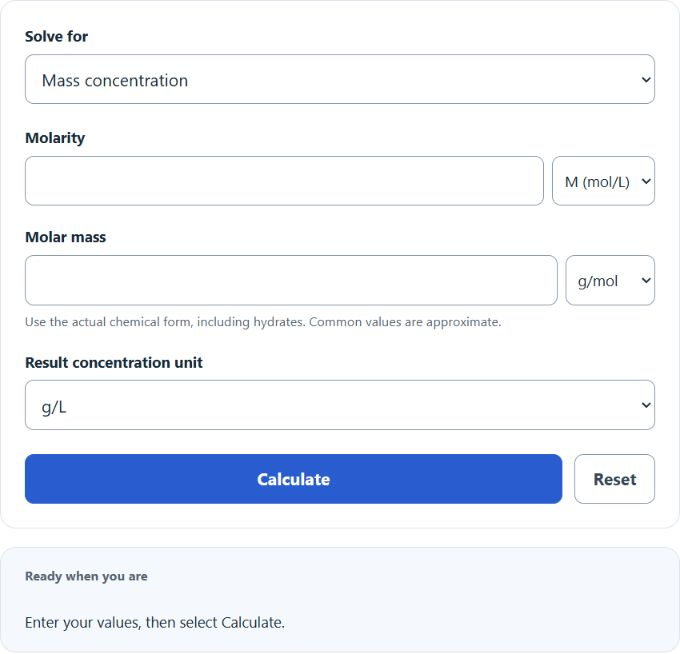
Convert molarity (M) to grams per liter, or solve for molarity, molar mass, and solution-preparation mass using common chemistry units.
Related Calculators
- M To mg/mL Calculator
- Moles/L To mg/mL Calculator
- mg/mL To mol/L Calculator
- Moles to Mass Calculator
- All Chemistry Calculators
Molarity to Grams/Liter Formula
Molarity tells you how many moles of solute are present per liter of solution, while grams per liter tells you the mass of solute present per liter of solution. Converting between the two is straightforward because moles convert to grams through the molar mass.
- Cg/L = concentration in grams per liter
- M = molarity in moles per liter
- MM = molar mass in grams per mole
The unit cancellation is what makes the conversion work:
If you need to rearrange the relationship, use the inverse forms below.
How to Convert M to g/L
- Find the solution molarity.
- Find the molar mass of the solute.
- Multiply the molarity by the molar mass.
- The result is the concentration in grams per liter.
This means a solution becomes more concentrated in g/L when either the molarity increases or the solute has a larger molar mass.
Unit Notes for This Calculator
This calculator also supports common chemistry unit variations. The relationships below are especially useful when your inputs or outputs are not in the base units of mol/L, g/mol, and g/L.
If molarity is entered in mol/m3 and molar mass is in g/mol:
If molar mass is entered in kg/mol and molarity is in mol/L:
To convert the result from g/L to mg/L:
To convert the result from g/L to kg/m3:
A very helpful shortcut is that at 1.00 M, the numerical value in g/L is the same as the solute’s molar mass in g/mol.
Quick Reference Table
The table below shows the algebraic mass concentrations for the stated formula masses. It does not establish that a substance dissolves or remains chemically unchanged at the listed concentration; use the correct chemical form, including hydrates, and verify solubility for actual preparation.
| Substance | Formula | Molar Mass (g/mol) | g/L at 0.10 M | g/L at 1.00 M |
|---|---|---|---|---|
| Water | H2O | 18.015 | 1.802 | 18.015 |
| Sodium Chloride | NaCl | 58.44 | 5.844 | 58.44 |
| Glucose | C6H12O6 | 180.16 | 18.016 | 180.16 |
| Sucrose | C12H22O11 | 342.30 | 34.230 | 342.30 |
| Acetic Acid | CH3COOH | 60.05 | 6.005 | 60.05 |
| Calcium Carbonate | CaCO3 | 100.09 | 10.009 | 100.09 |
Examples
Example: 0.50 M Sodium Chloride
For NaCl, use a molar mass of 58.44 g/mol.
Result: 29.22 g/L
Example: 0.10 M Glucose
For glucose, use a molar mass of 180.16 g/mol.
Result: 18.016 g/L
Example: Finding Molarity from g/L
If a solution contains 36.46 g/L of HCl and the molar mass is 36.46 g/mol:
Result: 1.00 M
What the Result Means
A value in g/L is a mass concentration. It tells you how many grams of solute are present in each liter of final solution. This is different from molarity, which counts the number of moles rather than the mass.
- Use molarity when stoichiometry or reaction ratios matter.
- Use g/L when preparing solutions by mass or reporting mass concentration.
- Use mg/L for dilute solutions such as water analysis and trace concentrations.
Common Mistakes to Avoid
- Using the wrong molar mass: Always use the molar mass of the complete compound, not just one element.
- Mixing solution volume and solvent volume: Molarity is based on total solution volume.
- Forgetting unit conversions: mol/m3, kg/mol, mg/L, and kg/m3 require conversion factors.
- Confusing molarity with molality: Molarity uses liters of solution, while molality uses kilograms of solvent.
When This Conversion Is Useful
- Preparing laboratory reagents from a target molarity
- Checking chemical feed concentrations in industrial systems
- Converting textbook molarity values into measurable mass-per-volume quantities
- Comparing compounds that have the same molarity but different molar masses
Frequently Asked Questions
Why do two 1.00 M solutions have different g/L values?
Because different compounds have different molar masses. The same number of moles can correspond to very different masses.
Is g/L the same as kg/m3?
Yes. For concentration by mass per volume, those two units are numerically identical, which makes them convenient for chemistry and engineering conversions.
Can I convert g/L directly to mol/L?
Yes. Divide the concentration in g/L by the molar mass in g/mol to return to mol/L.
Does this conversion depend on temperature?
The formula itself does not change, but measured solution volume can vary slightly with temperature. For routine chemistry calculations, the standard conversion is usually sufficient.