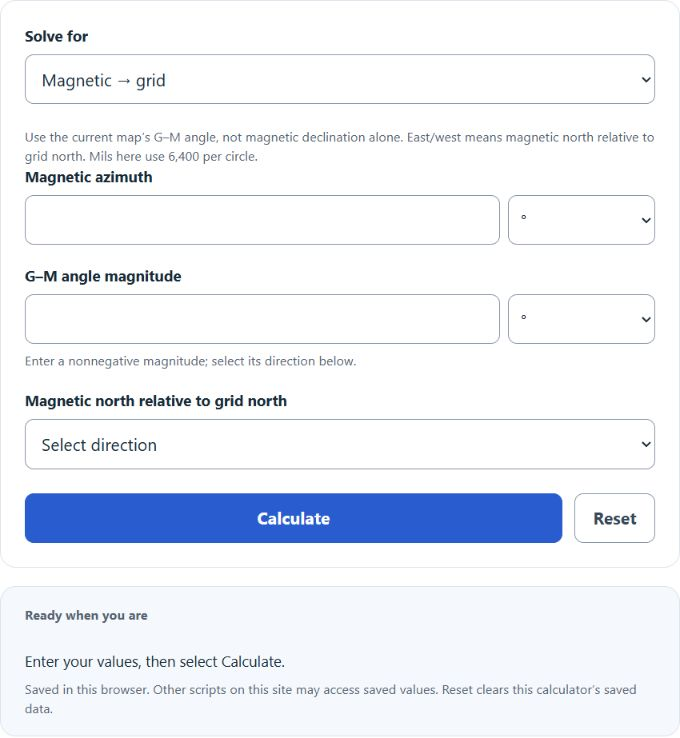
Convert magnetic azimuth to grid azimuth or grid azimuth to magnetic azimuth using the Grid-Magnetic angle for map bearings in degrees or mils.
Magnetic Azimuth To Grid Azimuth Formula
The following formula is used to calculate the Grid Azimuth from the Magnetic Azimuth when you know the Grid–Magnetic angle (G‑M angle).
Variables:
- GA is the Grid Azimuth (reported in degrees from 0° inclusive to 360° exclusive)
- MA is the Magnetic Azimuth (reported in degrees from 0° inclusive to 360° exclusive)
- V is the Grid–Magnetic angle (G‑M angle) in degrees: magnetic north east of grid north is positive, west is negative
To calculate the Grid Azimuth, add the Magnetic Azimuth to the Grid–Magnetic angle. If the G‑M angle is west (negative), this is equivalent to subtracting its magnitude from the Magnetic Azimuth. After the calculation, azimuths are commonly normalized (wrapped) to the range 0–360° (or 0–2π radians).
Note: Magnetic declination/variation is the angle between true north and magnetic north, while the Grid–Magnetic (G‑M) angle is between grid north and magnetic north. On projected maps, grid north may differ from true north due to grid convergence, so declination is not always the same as the G‑M angle. When needed, you can compute: G‑M angle = declination − grid convergence (using a consistent east-positive sign convention).
| Magnetic Azimuth (°) | Grid–Magnetic Angle (°) | Grid Azimuth (°) |
|---|---|---|
| 0 | +10 | 10 |
| 5 | +10 | 15 |
| 10 | +10 | 20 |
| 15 | +10 | 25 |
| 30 | +10 | 40 |
| 45 | +10 | 55 |
| 60 | +10 | 70 |
| 75 | +10 | 85 |
| 90 | +10 | 100 |
| 120 | +10 | 130 |
| 135 | +10 | 145 |
| 150 | +10 | 160 |
| 180 | +10 | 190 |
| 210 | +10 | 220 |
| 225 | +10 | 235 |
| 240 | +10 | 250 |
| 270 | +10 | 280 |
| 300 | +10 | 310 |
| 315 | +10 | 325 |
| 330 | +10 | 340 |
| 355 | +10 | 5 |
| Formula: Grid Azimuth = Magnetic Azimuth + Grid–Magnetic angle (east positive, west negative). Values shown assume a G‑M angle of +10° (E) and the final azimuth normalized to 0–360°. | ||
What Does “Magnetic Azimuth to Grid Azimuth” Mean?
Magnetic Azimuth to Grid Azimuth is a conversion process used in navigation and mapping to relate an azimuth measured from magnetic north (the direction a compass points) to an azimuth measured from grid north (the “north” direction defined by a map’s grid lines). Because magnetic north differs from true north (magnetic declination) and grid north can differ from true north on many map projections (grid convergence), magnetic and grid azimuths generally do not align. The offset between magnetic north and grid north is the Grid–Magnetic angle (G‑M angle), which is used to convert magnetic azimuths to grid azimuths and vice versa.
How to Calculate Magnetic Azimuth To Grid Azimuth?
The following steps outline how to calculate the Magnetic Azimuth To Grid Azimuth.
- First, determine the Magnetic Azimuth (MA) in degrees (or radians).
- Next, determine the Grid–Magnetic angle (V) in degrees (or radians). In the formula, use a positive signed angle for east and negative for west. In the calculator, enter the nonnegative magnitude and select East or West; mils use 6,400 per circle.
- Add the Magnetic Azimuth (MA) and the Grid–Magnetic angle (V) together.
- Normalize the result to an azimuth if needed (commonly 0–360°).
- After inserting the variables and calculating the result, check your answer with the calculator above.
Example Problem :
Use the following variables as an example problem to test your knowledge.
Magnetic Azimuth (MA) = 120 degrees
Grid–Magnetic angle (V) = +10 degrees (East), so Grid Azimuth (GA) = 120° + 10° = 130°.