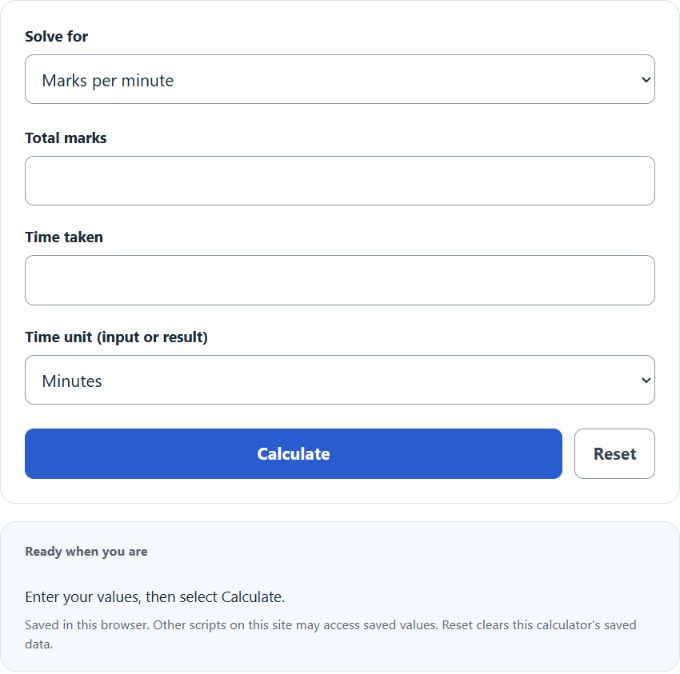
Calculate marks per minute, total marks, or exam time from any two values, with seconds, minutes, hours, and minutes-per-mark pacing.
- All Unit Converters
- Marks Percentage Calculator
- Points Per Minute Calculator
- Average Point Score Calculator
- Percentage Achievement Calculator
- Passing Score Calculator
Marks Per Minute Formula
Marks per minute is a simple pacing metric that shows how efficiently marks are earned over time during a test, quiz, mock exam, or timed assignment. It is useful for reviewing exam performance, comparing practice sessions, and estimating how long a target score may take under similar conditions.
In this formula:
- M = marks per minute
- T = total marks obtained
- t = time taken in minutes
If the total marks earned stays the same, a shorter completion time increases the marks-per-minute value. If the time stays the same, earning more marks increases the value.
Rearranged Forms
This calculator can also solve for the missing total marks or the missing time when the other two values are known.
How to Calculate Marks Per Minute
- Determine the total marks earned on the test or activity.
- Record the total time used.
- Convert the time into minutes if it was originally measured in seconds or hours.
- Divide the total marks by the total minutes.
If your time is not already in minutes, convert it first using one of the following relationships:
Examples
Example 1: A student earns 80 marks in 60 minutes.
The scoring pace is 1.33 marks per minute.
Example 2: A target score is 72 marks, and the expected pace is 1.2 marks per minute.
The required time is 60 minutes.
Example 3: A student maintains a pace of 1.5 marks per minute for 40 minutes.
The student would earn 60 marks at that pace.
How to Interpret the Result
A higher marks-per-minute value usually means time is being converted into score more efficiently, but it should always be interpreted with context. A lower value does not automatically mean poor performance; it may reflect harder questions, longer problem-solving steps, more written work, or a strategy focused on accuracy.
| Factor | Why It Matters |
|---|---|
| Test difficulty | Harder exams often reduce scoring pace even for strong students. |
| Marking scheme | Tests with multiple marks per question can produce higher values than simple right-or-wrong quizzes. |
| Accuracy | Fast pacing is only useful if it still leads to correct answers and earned marks. |
| Question type | Calculation-heavy, essay-based, and multi-step questions usually take more time per mark. |
| Section differences | One section of an exam may naturally have a much slower or faster scoring pace than another. |
Best Uses for a Marks Per Minute Calculator
- Practice exam review: Compare pacing across mock tests.
- Section analysis: Identify which parts of an exam consume too much time for the marks gained.
- Target setting: Estimate how much time is needed to reach a desired score.
- Study planning: Track whether speed improves as familiarity with the material increases.
- Performance benchmarking: Compare similar tests taken under similar conditions.
Using the Calculator Effectively
- Use earned marks, not just attempted questions.
- Make sure the time entered is the actual working time.
- Compare results only across tests with similar difficulty and scoring rules.
- Track the metric over several sessions instead of judging performance from one attempt.
- Pair this metric with accuracy, percentage score, or completion rate for a fuller picture.
Common Mistakes
- Entering time in seconds or hours without converting it to minutes.
- Using total possible marks instead of marks actually obtained.
- Comparing two exams that use very different mark distributions.
- Assuming a higher pace always means better exam performance.
- Ignoring skipped questions, penalties, or partial-credit rules.
Frequently Asked Questions
Can marks per minute be greater than 1?
A value above 1 is completely possible when a test awards multiple marks per question or when marks are earned quickly on shorter tasks.
Is marks per minute the same as questions per minute?
No. Questions per minute measures completion speed, while marks per minute measures score earned over time. A student can answer fewer questions per minute but still have a strong marks-per-minute value if those questions carry more marks.
Is a higher result always better?
Not necessarily. Efficient pacing is valuable, but the best exam strategy balances speed, accuracy, and question selection.
When should I compare two marks-per-minute results?
Comparison is most meaningful when the exams are similar in length, content, difficulty, and marking method.