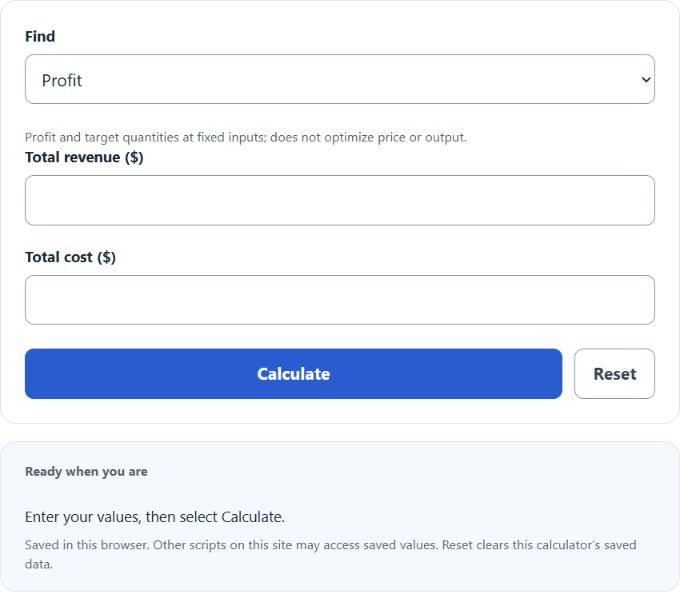
Calculate profit, breakeven quantity, margin and markup from revenue, cost, price, fixed cost, variable cost, and target profit in dollars.
Related Calculators
- Final Price Calculator
- Direct Margin Calculator
- Suggested Retail Price (SRP) Calculator
- Production Increase Calculator
- All Business Calculators
Profit Formulas
TR = Total Revenue | TC = Total Cost | COGS = Cost of Goods Sold | OpEx = Operating Expenses
Profit Types Compared
| Profit Type | Formula | Excludes | Measures |
|---|---|---|---|
| Gross Profit | Revenue − COGS | OpEx, interest, taxes | Production efficiency |
| Operating Profit (EBIT) | Gross Profit − OpEx | Interest, taxes | Core business performance |
| Net Profit | EBIT − Interest − Taxes | Nothing | Bottom-line profitability |
| Total Contribution Margin | (Price − Variable Cost) × Units | Fixed costs | Total fixed-cost coverage |
Illustrative Net Margin Ranges by Industry
| Industry | Illustrative Net Margin | Key Driver |
|---|---|---|
| Software / SaaS | 20–35% | Low marginal cost per user |
| Pharmaceuticals | 15–25% | Patent-protected pricing power |
| Financial Services | 18–28% | Interest spread and fees |
| Consulting | 12–22% | Low capital, high billing rates |
| Manufacturing | 5–10% | Material and labor cost drag |
| Healthcare | 3–8% | Reimbursement compression |
| Restaurants | 3–9% | High labor and food costs |
| Retail | 2–5% | High volume, thin margins |
| E-commerce | 1–5% | Logistics and returns costs |
| Grocery | 1–3% | Perishables, price competition |
Profit vs. Maximum Profit
The calculator above measures current profit at a given revenue and cost snapshot. Maximum profit is an optimization target: the output level or price point that produces the highest possible profit, not just a measurement at a fixed point.
For a differentiable interior profit maximum, marginal revenue equals marginal cost, with profit changing from increasing to decreasing around that point. Boundary choices and shutdown decisions must also be checked. In perfect competition, price equals marginal revenue. Demand and cost curves are needed to identify a profit-maximizing output; this calculator does not perform that optimization.
The contribution margin approach estimates profit and the quantity needed to cover fixed costs or reach a target, assuming a constant price and variable cost per unit. Choose Minimum quantity for target in the calculator above. It does not determine the best price or product mix without demand and capacity information.
Margin vs. Markup
Margin and markup both measure profit but from different bases. Margin divides profit by revenue (selling price). Markup divides profit by cost. With positive selling price and cost, margin is lower than markup except at zero profit, when both are zero. A common pricing error: setting a 50% markup while targeting a 50% margin produces a 33.3% margin instead, understating the required selling price.
| Markup | Equivalent Margin |
|---|---|
| 10% | 9.1% |
| 25% | 20.0% |
| 50% | 33.3% |
| 100% | 50.0% |
| 200% | 66.7% |
Example
A retailer buys products at $60 and sells them at $100, with monthly fixed costs of $8,000.
- Gross Profit per unit: $100 − $60 = $40
- Gross Margin: $40 / $100 = 40%
- Markup: $40 / $60 = 66.7%
- Breakeven quantity: $8,000 / $40 = 200 units/month
- Profit at 300 units: (300 × $40) − $8,000 = $4,000