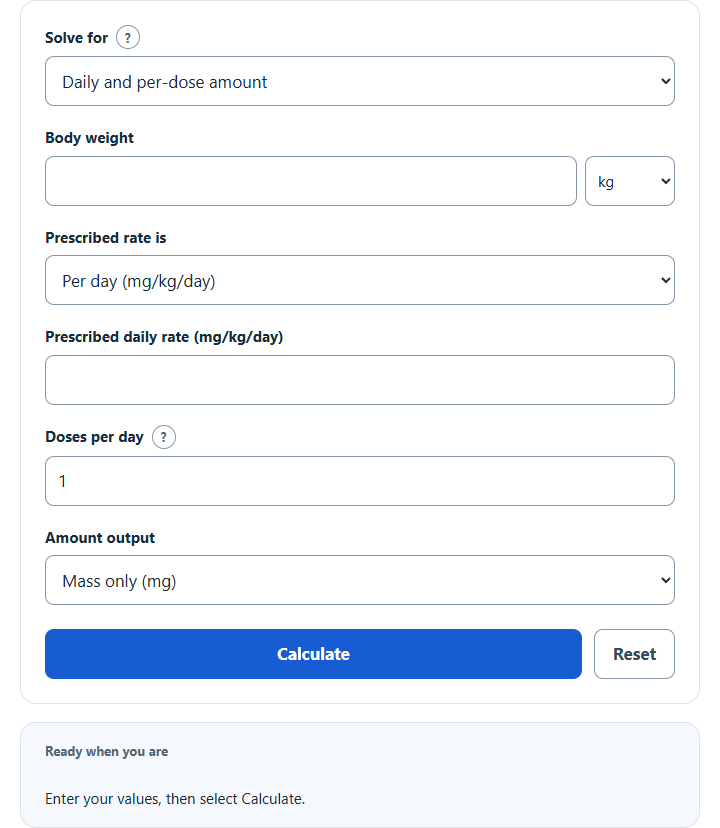
Calculate a dose from mg/kg/day or mg/kg/dose and body weight in kg or lb to get mg per day and per dose, mL of liquid, or the mg/kg/day rate.
- All Health and Medical Calculators
- mg/kg to Percent Calculator
- Magnesium Repletion Calculator
- mg To Tablets Calculator
Calculator Functions
| Function | What it does | What it requires |
|---|---|---|
| Daily and per-dose amount | Finds the total milligrams per day and the milligrams in each dose from a weight-based rate | Requires the body weight, the prescribed rate in mg/kg/day or mg/kg/dose and the doses per day |
| Daily rate (mg/kg/day) | Converts a known amount into a rate in mg/kg/day | Requires the body weight and either the total daily amount or the amount per dose with the doses per day |
| Weight from amount and rate | Finds the body weight that a daily amount and a daily rate imply | Requires the total daily amount and the daily rate in mg/kg/day |
Body weight goes in as kilograms or pounds, and pounds are converted at 0.45359237 kg per pound [2]. The first function can also give a liquid volume in mL when the final concentration of the product in mg/mL is entered. Doses per day can be any value up to 24.
mg/kg/day Formulas
| T | Total daily amount (mg/day) |
| R | Daily rate (mg/kg/day) |
| W | Body weight (kg) |
A weight-based order gives a number of milligrams for each kilogram of body weight, so the amount is the rate multiplied by the weight [1]. The other two functions rearrange this formula.
Daily and per-dose amount
P is the amount per dose in mg and N is the number of doses per day. With a rate per day, the daily total is found first and then divided into equal doses. At 25 mg/kg/day for a 44 kg patient, T = 25 × 44 = 1,100 mg/day, and in 2 divided doses each dose is 550 mg. At 2 mg/kg/day for a 130 lb patient, the weight is 58.967 kg and the daily amount is 117.934 mg.
With a rate per dose, the order runs the other way: the amount per dose is the weight times the mg/kg/dose rate, and the daily total is that amount times the doses per day. At 15 mg/kg/dose for a 10 kg patient, each dose is 150 mg, and 4 doses per day total 600 mg/day, which equals 60 mg/kg/day. For a liquid, the volume is the amount in mg divided by the concentration in mg/mL, so 550 mg at 50 mg/mL is 11 mL per dose.
Daily rate (mg/kg/day)
A total of 500 mg/day for a 70 kg patient is 500 ÷ 70 = 7.142857 mg/kg/day. When the known amount is per dose, it is multiplied by the doses per day first: 250 mg taken 2 times a day by a 50 kg patient is 500 mg/day, or 10 mg/kg/day. The number of doses does not change the rate when the daily total is already known.
Weight from amount and rate
A daily amount of 500 mg at 10 mg/kg/day implies a weight of 50 kg, which is 110.231131 lb. This is an algebra check on an order, not a measured weight.
What Does mg/kg/day Mean?
mg/kg/day is milligrams of a substance per kilogram of body weight per day. It is the total for 24 hours, not the size of one dose. A rate written as mg/kg/dose is the amount for a single dose, and it has to be multiplied by the doses per day to compare it with a mg/kg/day figure. mg/kg on its own leaves the time period unstated, so the order or label has to say whether it is per dose or per day.
How to Calculate mg/kg/day
Put the weight in kilograms, dividing pounds by 2.2046. Add up the milligrams taken in one day, which is the amount per dose times the doses per day. Divide the daily milligrams by the weight in kilograms. For a 20 kg child who takes 200 mg 3 times a day, the daily amount is 600 mg and the rate is 600 ÷ 20 = 30 mg/kg/day.
Limits of This Estimate
- This calculator is for educational purposes only and does not provide medical advice or dosing recommendations. Always follow the prescription or label and confirm calculations and units (mg vs mL, and the mg/mL concentration) with a licensed clinician or pharmacist, especially for children, pregnancy, and kidney or liver disease. Do not use this tool to start, change, or stop any medication.
- The result is arithmetic on the numbers entered. It does not check that a rate, a frequency or a daily total is within the safe range for a medication, which has to be looked up in a drug reference and compared with the calculated dose [1].
- Liquid volume is given in mL from the concentration entered. No dilution, syringe scale or measuring-device increment is taken into account, and display rounding does not make a dose measurable.
- A daily total is split into equal doses by plain division. A prescription may call for unequal doses or a different schedule, and the prescription controls. These estimates are based on the best available data and estimations.
Sources
- Open Resources for Nursing (Open RN), Nursing Skills, Chapter 5 Math Calculations, on NCBI Bookshelf: dose as milligrams per kilogram times body weight, and checking a calculated dose against the safe dosage range
- NIST, Guide for the Use of the International System of Units (SP 811), Appendix B.8: kilograms in one pound