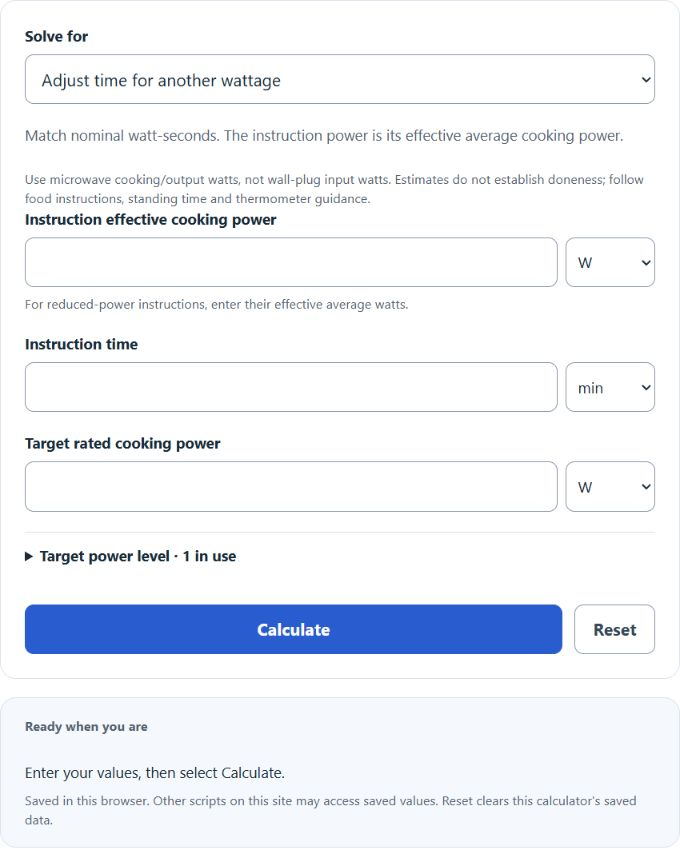
Adjust microwave cooking time between wattages, reverse-solve the power needed for a target time, or calculate delivered heating energy with an effective power-level control.
Quick overview: Microwave Watt to Time
Microwave heating is roughly proportional to power × time. If a recipe assumes a 1000 W oven, you can convert the cooking time for another wattage using:
t₂ = t₁ × (1000 ÷ your wattage)
- 5 min at 1000 W → 700 W microwave: ≈ 7.14 min
- 5 min at 1000 W → 800 W microwave: ≈ 6.25 min
- 5 min at 1000 W → 900 W microwave: ≈ 5.56 min
- 5 min at 1000 W → 1200 W microwave: ≈ 4.17 min
Lower-wattage ovens need more time, while higher-wattage ovens need less time to produce a similar heating effect.
- kVA To Watts Calculator
- Watts to Amps Calculator
- Grams To Volume Calculator
- Inches To Liters Calculator
- All Unit Converters
Microwave Watt to Time Formula
The formula below is the special case of a recipe using 1000 W effective cooking power and a target microwave at 100% power. The calculator also accepts other instruction wattages and target power levels. Use cooking/output watts, rather than electrical input watts.
Variables:
- t₂ is the adjusted cooking time
- t₁ is the original recipe time
- 1000 is the reference microwave wattage assumed by the recipe
- P₂ is your microwave’s wattage
For the 1000 W, full-power example, multiply recipe time by 1000 and divide by target cooking watts. Generally, target time = instruction time × instruction effective cooking watts ÷ [target rated cooking watts × target power-level fraction]. This preserves nominal watt-seconds, not guaranteed heat absorbed by food.
What is Microwave Watt to Time Conversion?
Microwave watt to time conversion is the process of adjusting a recipe’s cooking time when your microwave has a different wattage than the one used in the recipe. Use the wattage and power level stated by the actual recipe or package; 1000 W is only the reference example on this page. If your microwave is weaker, such as 700–800 W, food usually needs more time. If it is stronger, such as 1100–1200 W, the cooking time should be reduced to avoid overcooking.
The key idea is that microwave heating is roughly proportional to power × time. To keep the same overall heating effect, lower-power ovens need longer cooking times and higher-power ovens need shorter cooking times.
How to Calculate Microwave Watt to Time?
The following steps outline how to calculate the adjusted microwave cooking time.
- First, determine the original recipe time in minutes (t₁).
- Next, determine your microwave’s wattage (P₂).
- Then, calculate the adjusted time using the formula t₂ = t₁ × (1000 ÷ P₂).
- Finally, check the food early and adjust slightly if needed, since food type and microwave efficiency can vary.
Example Problem:
Use the following variables as an example problem to test your knowledge.
Recipe Time (t₁) = 5 minutes
Microwave Power (P₂) = 700 W
The watt-time model gives an approximate 7.14-minute estimate for those conditions at full target power. Follow the food instructions, stir or rotate as directed, observe standing time and verify the required internal temperature with a food thermometer.
Microwave Watt to Time Conversion Table
The table below shows example adjusted times for a 5-minute recipe written for a 1000 W microwave, converted to several common wattages using the formula t₂ = t₁ × (1000 ÷ P₂).
| Your Microwave | Power (W) | Time for a 5-Minute, 1000 W Recipe |
|---|---|---|
| Lower-power compact oven | 600 | 8.33 minutes |
| Typical older home unit | 700 | 7.14 minutes |
| Mid-range home microwave | 800 | 6.25 minutes |
| Higher mid-range unit | 900 | 5.56 minutes |
| Reference microwave (recipe) | 1000 | 5.00 minutes |
| High-power kitchen unit | 1100 | 4.55 minutes |
| Very powerful microwave | 1200 | 4.17 minutes |
In everyday use, packages and cookbooks may list a wattage that does not match your microwave. Scaling time with power can provide an initial estimate; it does not replace appliance and food instructions or checks for safe internal temperature.